Showing posts with label South Melbourne United. Show all posts

Friday, 7 December 2018

South Melbourne soccer club timeline pottering (2018)

While you're all waiting to find out whether South will secure an A-League licence and arguing about the matter with Twitter randoms, I'm going in the opposite direction and making a quick historical post.

The other day Socceroo and South Melbourne Hellas championship player Ted Smith asked for a timeline of all clubs which have ever borne the name 'South Melbourne', and after shooting off the email I kind of realised it'd be nice to post it here for all to enjoy and have as a handy reference. It may also act as an incentive for me to renew my efforts to do some more research on these clubs, and might be something I update each year around this time.

Timeline of soccer clubs which have borne the name 'South Melbourne'.
  • South Melbourne (1884-1890). This team played in Melbourne's first soccer competitions - such as the Beaney Cup, and the George and George Cup - under the auspices of the Anglo-Australian Football Association, and lasted until the end of the 1890 season. I haven't been able to find anything after that date for this team. It is not known whether any people involved with this club became involved in Victorian soccer once the game officially reformed in 1908.
  • South Melbourne (1908-1909). In 1908, when organised soccer in Victoria re-emerged from its long slumber during the 1890s and early 1900s, a South Melbourne team was one of the clubs that was involved. The only references to this club's existence - and the term 'club' should be used with caution here - are a scheduled match against Prahran in September 1908, and a scratch match on the South Melbourne Cricket Ground in April 1909. The result of the match against Prahran does not appear to have been reported in any media outlets of the day. At this stage it is unknown why South Melbourne failed to take part in the subsequent league and Dockerty Cup competitions, whether any of its players or officials moved across to the other clubs, or whether the club changed its name before the start of the 1909 season.
  • South Melbourne (1910-1911). Possibly the same club as the previous entry, but I'm uncertain - I've only recently come across this club in Mark Boric's statistical history work. This club played two seasons in the Victorian Amateur British Football Association's Amateur League (which was above the second tier 'Junior' league), and finished bottom of the table in both seasons.
  • South Melbourne (1927-1940). This club appears in 1927, which was the year Victorian soccer split into two competing organising bodies. It appears that this South Melbourne remained loyal to the original soccer body during this dispute. I have a hypothesis, as yet untested, that this South Melbourne is a re-badged Albert Park, but I need to do more research to confirm that theory. Albert Park had played in the post-war competition from 1919-1926, and an Albert Park club - possibly related to the post-war outfit - had also played before the war. At any rate, this South Melbourne does not seem to go beyond 1940, nor does it re-emerge after the Second World War. 
  • South Melbourne United (1937-1960). The exact origins of South Melbourne United are unclear;Soccer News article from 1953 claims that the origins of the club date back to 1932 in the guise of a club called 'South Melbourne Juniors', formed when members of the Middle Park Schoolboys' Soccer Club changed names, and that later on this junior club merged with the pre-existing South Melbourne senior club to form South Melbourne United (I have my doubts on this though - it is worth noting that the 1927 South Melbourne and South Melbourne United did play against each other in the late 1930s). Contemporary (and probably more reliable) sources seem to locate United's official founding to 1936 as a junior club formed by former pupils of the Middle Park School and the South Melbourne Technical School. By early 1937, South Melbourne United had decided to field senior teams in the local competition. It is unclear if this team played in the 1943 season, but it certainly competed in every other season from its foundation up until the point it helped form South Melbourne Hellas. Occasionally in the record books - principally in the early 1950s - the club is sometimes referred simply as 'South Melbourne' without the 'United' name. In 1946, some younger players split from South Melbourne United to form Park Rangers.
  • South Melbourne Hellas/Lakers/FC (1959/1960 - present). In August/September 1959, two local Greek clubs - Hellenic and Yarra Park - merge to form Hellas. In early 1960, the newly formed Hellas amalgamates with South Melbourne United. The club decided to use 1959 as its foundation date, but more correctly, the true foundation year is 1960.

Saturday, 1 December 2018

Για την Ελλάδα, ρε γαμώτο! Or not! And Britain too, I think! I'm not sure

I'm starting this piece by way of one of my standard unnecessary preambles. Earlier this week I was at my day job, attending one of the daily stand-up meetings that management is using to tell us how great their latest project is. 

To help prove how important and interesting this new endeavour is, one member of management referred to a PowerPoint slide linking to positive news articles (I assume positive, because why else would management link to them otherwise), not caring that they were behind a Murdoch paywall, and probably not caring or perhaps even oblivious to the fact that a room half-full of humanities academics is probably the last group of people likely to be taken in by such obvious PR guff passing as journalism.

I begin with that pointless anecdote if only to ask the question of whether we as South fans could do with looking at the news we consume with a bit more caution and a detached critical eye, rather than interpreting even the slightest ambivalence about our A-League bid as a call to furious arms.

To wit, a situation was created by what was and is a rather straightforward article of little consequence about A-League expansion; a summary of what to the jaded and the unbiased alike are the obviously lesser hopes of the Canberra and South Melbourne A-League bids in securing one of the two expansion licences on offer. It was an article written by Michael Lynch, The Age's chief soccer reporter, and someone I've posted my occasional criticism of during the past eleven years on here, and before that, too. And if I'm being honest and fair, Lynch is someone whose forté is beat writing rather than dense or lyrical analytical pieces.

That's not a crime, but it does acknowledge a historic structural issue in the relationship between Australian soccer and the media. Australian soccer has been and remains an also-ran insofar as its treatment goes in the mainstream written press. It might not be a palatable fact, but it is true. And even as that relationship goes through peaks and troughs, each daily newspaper tends to end up with one and only decicated soccer writer, who is expected to cover all angles of every issue, even as the space allotted to them to do so is limited, and even as they are expected to be all things to all people - beat reporter, political analyst, on-field tactician, and quasi-historian.

These days you can add click-bait writer to those functions, a less than appealing idea for any news writer with a semblance of self-respect, but utterly necessary when newspaper revenues are in such steep decline.

(And incidentally, this is one of the reasons why I took out a digital subscription to The Age - yes there are noble sentiments in this somewhere about being part of the solution rather than the problem, but it's also for the chance to be smug and note that as a subscriber, the concept of the click-bait reader is marginally less applicable to me because of the $4.?? I allocate to this weekly expenditure.)

In the article, Lynch points out that Canberra and South are perceived - both in the public sphere, and within the behind-closed-doors decision making sphere - as being the obvious outsiders compared to the other four remaining bids. Lynch rightly asks the question about Canberra's previous poor history of soccer at a national level - both on and off the field - and the feedback he has received from current Canberra soccer followers that times have changed, especially with the nature of the city itself. Lynch compares Canberra's difficulties of being a regional centre (and thus having doubts about its ability to raise sufficient sponsorship, as well as getting a new stadium), with South's troubles of being perceived as an ethnic/old soccer throwback with limited broad appeal.

Now, Lynch is clearly not saying that he himself thinks South should be excluded from an expanded A-League because of 'ethnicity'; only that, rightly or wrongly, such perceptions exist, and that they will be a factor in the decision making process. While singling out ethnicity as a drawback factor for us, along with Canberra's tainted 1990s national league history, Lynch puts these issues into the perspective of representing:
... interesting arguments about the history, diversity and geography of the game in this country. 
These are arguments which Lynch doesn't expand upon on this article. Like I said, it's neither his speciality, nor do the constraints of time, space, and editorial line allow for something more effusive on what multiculturalism actually means in Australian society, and the way in which Jim Cairns' dream of a pluralist Australian multiculturalism persisted beyond his term in government most notably via deliberately and inadvertently insular ethnic soccer clubs. In short, history can be a launching pad, but it can also be an albatross, and if you want to read something with more expansive intellectual heft on these issues, read Joe Gorman's book rather than a quick semi-throwaway article designed as much to leverage your anger as your sense of reason.

Now Canberra fans seem to be able to handle this casual dismissal of their A-League chances better than South fans. Not having a race issue attached to that exclusion certainly makes things less emotive, but we should also note that as far as controlling their tempers online goes, South fans have been garbage at it since they first got access to the internet. I say that as someone who when they were 16 years old would use school computers to act like the prototypical uncouth online Hellas knob. Things have only gotten worse in the ensuing years, as the experience of exponentially increasing irrelevance combined with the faintest whiff of hope from FFA's Pandora's Box sends fully grown men into a collective apoplectic rage whenever someone considers South to not exactly be a prime candidate for A-League expansion.

And thus Lynch's Twitter feed went into (relative) overdrive with people wanting to hammer him and correct him. The response from Lynch to that, er, 'feedback' is made up of several tweets amalgamated by me.

Hardly ironically, Lynch's article predicted such blowback:
It is not dissimilar to the arguments that South fans – often the most vociferous, if at times intemperate – make on social media when the plausibility of their bid is questioned.
But somehow being accused of being a racist by the very same people he described as borderline nutbags surprises him. Irony dies in the deep dark internet sea. It's not like he's the first journalist either in recent times to cop that kind of abuse merely for reporting what he hears that the public is not privy to. Recently hired Sydney Morning Herald soccer writer Vince Rugari has also copped his share of social media hate from some South fans for making similar observations about South's outsider status, with those South fans being unable to grasp the idea of confidential sources, much as the same people will willingly accept obtuse answers and impossible to verify information from South Melbourne board members.

No surprises though about who one of the ringleaders of the anti-Lynch lynch-mob was, a fact one can surmise by several "tweet not available" notices (because I'm blocked by him), but disappointing if not surprising that several other South fans chose to follow that particular lemming over the edge of the cliff. To be fair though, there was a higher than usual dose of bewilderment from South fans as well, wondering what all the fuss about Lynch's article was.

Of course our lovable larrikin soon-to-be former prez Leo Athanasakis also jumped in with his own 'facts'.


Facts which are anything but of course, and which are easily debunked only if you actually know what you're talking about on these matters. Unfortunately such knowledge is limited to a mere handful of people, most of whom have nothing to do with Twitter or social media and even when they do, they are rightly reluctant to wrestle with metaphorical pigs.

[And while no doubt well intentioned, the other bloke who said it was a four-way merger including a Jewish club is also peddling half-truths at best - because let's be honest, the 1980s merger with what was left of Hakoah was little more than a takeover by South which probably mostly served to secure us a few more grounds in the Middle Park area. And I'd love to be corrected but it was my understanding that the Hamilton (named after either former South Melbourne United and founding South Melbourne Hellas committeemen Des or Bill Hamilton, or perhaps even both) award for club best and fairest was actually a supporters group initiative, not an official award from the club.]

For starters, the 1959 date - which South Melbourne FC uses as its foundation date - is the birth of the Hellas club, which was a merger of the struggling (and still very young) Greek-Australian Hellenic and Yarra Park clubs. The new entity they formed, Hellas, amalgamated with South Melbourne United, an Anglo-Celtic Australian club (what you might also term an Australian club, for lack of a better term, to describe a club founded by non-migrants), at some point in early 1960, ostensibly to get access to Middle Park, the home ground of South Melbourne United (and also Melbourne Hakoah).

To make the merger more palatable to the supporters of the small United club, the Greeks of Hellas throw a few bones United's way. They add 'South Melbourne' to the front of the Hellas name, inadvertently making the thing sound more poetic while also being unusual in being an ethnic club in early 1960s Melbourne with a ready-made and self-selected and unforced district name. They keep United's white jersey with a red vee. And they allow some committeemen from United to be on the new South Melbourne Hellas committee.

It's an arrangement which lasts a mere half decade or so. Soon enough non-Greek committeemen are a thing of the past, United's red vee is gone, and all pretence that this club represents anything in the South Melbourne area apart from the Greek migrants who live there is over. Since that time, in its glory days the club had mostly been content to gloss over that early history and the Anglo connection. This is not a judgement call - whether what happened is right or wrong is for someone else to mull over - but it is an acknowledgement of what actually happened.

Later, toward the end of the NSL era there were the beginnings of attempts to recognise that early history, though I always get the vibe that it was a minority of forward thinkers rather than staunch traditionalists responsible for those efforts. As the club found itself in the (now seemingly without end) rut of being simultaneously abandoned by the Greek-Australian community (its core supporter constituency) and alienated from its identity of being a big fish in a small pond (which had begun to attract its share of non-Greeks, but not quickly enough to form a critical mass at the critical moment), one of the flailing measures taken to recalibrate the club's identity saw some people engage in bumbling and not entirely intellectually honest attempts to leverage elements of the club's history (and parts of pre-South Melbourne Hellas history) that had been neglected (and sometimes derided) for decades.

This led to some people trying to link South Melbourne Hellas directly to the very earliest soccer clubs with the name South Melbourne, as part of an attempt to claim something that is not ours to claim. As I have noted in several places, at best South Melbourne Hellas can lay claim to being the most important club in the South Melbourne/Albert Park/Middle Park precinct; at a stretch it can perhaps lay claim to being the most notable current custodian of a local soccer culture going back to 1884.

But since we know of no formal connections between the 1884 South Melbourne club to the South Melbourne club which was almost formed to play after soccer was reformed in Melbourne in the early 1900s, and certainly no known connection to the 1920s/30s South Melbourne, can we really claim a legacy that fragmented and uncertain? Never mind also that the 1920s/30s South Melbourne was a totally different club to the Middle Park Schoolboys junior club which eventually became South Melbourne United in the mid 1930s (with United thus being more aptly classed as an Anglo-Celtic Australian club than as a British club).

These are, in the greater scheme of things, annoying and pedantic points of history, wielded here by me not to show how smart I am - because at any rate, most of the work in this area has been done by others - but rather as an illustration of how utterly stupid discussions of history are, especially when they are made by people who have no respect for something they claim they have respect for while also claiming that others have no respect for that same history. In other words, as much as I'm drawn to the facts of what happened pre-1959, these bits of trivia become less important in a situation like this than the reasons and manner in which they are deployed -  too often in a shallow way to score cheap political points, ironically mostly in an environment where most supporters of Australian soccer see history as neither burden nor blessing, if they think about it at all.

Not that any of that matters, of course.

Sunday, 5 July 2015

Disappointed, embarrassed - South Melbourne 1 Heidelberg United 2

Normally I'd spend the day after a game like that just getting on with the job of writing this blog, but fuck it if I just could not be bothered with soccer at all yesterday. So I went and watched the Collingwood magoos take on Sandringham yesterday instead.

Throwing away the game like that in the way that we did was a travesty. Not just because it was against Heidelberg, but because undermanned as we were, we managed to look far better than we had in several weeks. Lujic looked like a threat again, Hatzikostas and Jawadi looked good in the middle, even if our back line was a mess. And even though some of our players had absolute nightmares of games - Lakic will surely never play that badly again - there was enough improvement in attack to say that we may just have turned a corner. Oh, Leigh Minopoulos, how did you miss that sitter when you came on? Oh Andy Kecojevic, why couldn't either of your two wonderful freekicks have snuck into the inside of the post instead of ricocheting off it and out? Where was the game sense in the last five minutes? I mean sure, go for the win, but don't throw away the point you've worked so hard to earn!

Then again, considering the shenanigans that happened off the field, I don't know how much I would have enjoyed the win anyway. The behaviour of some of our fans was nothing short of disgraceful. The flares were just the start of it. Despite the pleas from older heads in the week leading up to this contest not to light them in the ground, the calls went unheeded from at least one person.

I should be clear on my position on flares. Firstly, I don't like them from an aesthetic point of view - they smell, they sting my eyes and throat, and I think they look childish and pathetic in comparison to excellent chanting and the colour brought by many and diverse flags and banners. Secondly, the legality of releasing flares is less of an issue to me than the fact that because they're banned at soccer games in Australia, each one lit by one of our fans costs the club money. Now whether you like the board or not is immaterial to this discussion - I'm thinking here of the efforts of the volunteers and staff who bust a gut trying to get a team on the park each week and putting on a professional and well organised show. Thirdly, if you're gonna be a dick and light a flare, at least have the balls to hold it up instead of scurrying away. As for the tosser who threw the flare over the fence, thank goodness you didn't hit the running track. Frankly, if you're so into flares that they take precedence over the enjoyment of the match itself and the efforts of the people working hard to keep the club going, you'd be better off going to watch the gas flares at the casino.

'Lisa, maybe if I'm part of that mob, 
I can help steer it in wise directions.'
Of course there was also the typical sarcastic dropkick reaction of 'oh no, flares, how scary and wrong' - but it's not about the flares, it's about what they represent - a disregard for the club and your fellow supporters. But if only flares were the main problem from Friday night, we could all possibly put it down to some sort of immaturity, and that over time the kids would learn as the older Clarendon Corner heads had to learn.

Unfortunately the flares had to play second fiddle to some younger supporters stealing a banner from the Heidelberg active contingent. On a certain level, I can tolerate accidental stupidity, but planned stupidity - and the banner stealing certainly did seem like a planned affair - that's much less forgivable. This of course kicked off a sequence of events which saw Berger fans rush over to get the banner back and/or remonstrate, and then saw some push and shove after the match. Whatever anyone thinks of the South - Bergers rivalry, it is not a violent or angry one. Being both Greek-founded and supported clubs, many of us know and have known friends an relatives from both sides of the ledger. In the days when people went to more than one game a weekend, South fans would go with their Berger mates to their games, and they would reciprocate.

As for the Berger fans who apparently tried to storm the corporate areas after the ground announcer's 'eggs on toast' jibe, get over yourselves. It's not like he called you Bulgarians or something equally stupid.

Without wishing to absolve the guilty parties in any way, nor appearing to join the 'boys will be boys' crowd, security's efforts on the night were poor. The separation of the two sets of fans at the end of the game, the lack of an obvious presence around Clarendon Corner after some members of Enosi 59 had already lit flares before the match on Clarendon Street - surely Blue Thunder have been around these leagues and clubs long enough to have got even the basics right, but alas that was not the case.

Lest this tirade be taken as a slur against every person in Enosi 59 or their hangers on or supporters, it's not. There are good guys in the group, who've added to the atmosphere at games, and I've been more than happy to have a chat with those guys. Someone who should know better made the allegation recently that I am anti-active and pro picnic support. My response then, as it is now, is that I'm not against active support - I'm against dickheads whether they're chanting types or sitting down and enjoying the game on their own terms types. I'm still of the opinion that being a dickhead is not a genetic condition, and if that is the case, being a dickhead must therefore be a personal decision - and I've yet to meet someone who likes a dickhead.

The problems that pale in comparison to the other issues but which are still worth a mention
There's been an older guy turning up recently to the bay that Clarendon Corner uses who's been using a tabla drum. Some a re for it, some are against it, but I don't mind, it adds to the atmosphere and the guy can actually play. On Friday night though for some reason upon entering the ground, I noticed that he was singing along to a karaoke version of 'Livin La Vida Loca'. He also had Lefteri's trumpet tune hooked up to his sound system on wheels. to which many of the longer standing Clarendon Corner people objected, on the grounds (justifiably I think) of artificiality. Whether or not current trumpet player Bruno is at a game and/or willing to play the trumpet (and on this occasion he was), putting the sound effect on like that while well intentioned is just one step closer to taking away the fan made aspect of supporter groups, and that as such Stathi's vocalised version of the trumpet tune has more heart and character than a pre-recorded tune ever could. The situation seemed to resolve itself.

Crowd
700-800

Crisis at the canteen
Our crowd counter was disappointed that the canteen was no longer willing to serve the Fantastic brand cup noodle, because 'it would take too long to boil the water'.

Celebrity watch
George Calombaris was in attendance.

Next game
Tuesday night at home against a Green Gully side fresh from thumping Bentleigh Greens 4-0 - Bentleigh's first league defeat of the season.

FFA Cup news
We've been drawn against Queensland side Palm Beach, with the match to be played on the Gold Coast. The game will be at Robina Stadium, to be played on Wednesday 29th July at 7:30PM.

Being South Melbourne, the most important club in Australia, our game will be one of those broadcast by Fox Sports. I assume this means that we won't be having our own highlights up on youtube or on the SMFC TV show on Aurora. For those unable to be there in person, I assume some fans will gather at a pub somewhere to watch the game, and I'll let you all know where that will be should that happen. That's what happens when you don't have a social club.

There's also this:
South are marking their return to the big time by wearing their heritage strip of white with a red V, the colours of South Melbourne United, one of the three teams that merged more than 50 years ago to form the current club
Juniper Hill's home uniform.. Julius
Stoker is the club's games record
holder with 314 league and cup
appearances. The design was created
to my spec by 'paquebot', owner of
AS Uijeongbu 07, five time Korean
champions/
which as always has proved divisive on historical, cultural and aesthetic grounds. My stance on the matter is pretty clear, and dare I say it, progressive, rather than conservative (which I've nothing against) or reactionary (you know who you are). I'm not in favour of dislodging the blue and white of the home strip, but I reckon that the heritage strip should be made the permanent away strip. But then again, I am one of those people who likes the aesthetics of the heritage jersey, shorts and hooped socks combo, as well having what I see as a historical wrong being rectified.

The concerns however that it's being used a gimmick have some validity. Here's hoping that it's not just a one off event, and further more that the red vee is tasteful (as per the image adjacent) and not like some of the really huge South Melbourne United ones or heaven forbid, St George-Illawarra Dragons.

Actually, on reflection I may just be a rampant ideologue on this matter myself - after all, I did get a more a talented person than myself to customise my Hatriick team's home uniform to resemble the South Melbourne Hellas heritage strip. On that front, if it were at all possible, I'd also love to see the use of the 1966 Bristol Rovers style jersey, which is also a pearler. Then again, I once argued for QPR style hoops, if the right kind of sponsor could be found to augment the jersey.

Nick Epifano cuts Dundee United trial short
Also apparently done his hamstring, not sure of the severity. He was apparently in attendance at the game on Friday.

Speaking of South Melbourne United
While using Trove's newspaper database while doing some research on a project I'm working on, I came across an article from 1936 which talked about that club's very early days, and their application to use the Port Melbourne Football Ground - by which I assume they mean the venue commonly known as the North Port Oval. This is intriguing to me not just for its South Melbourne connections - and why did South Melbourne United form separately from the South Melbourne club that was already in existence? - , but also because of the fact that Port Melbourne as a district was, to my knowledge at least, virtually unknown as a soccer playing area. South Melbourne, Albert Park, Middle Park, St Kilda, South Yarra and Prahran all had lasting and consistent representation either as clubs or venue locations, but Port Melbourne is conspicuous by its absence in the records.

Upon further investigation, it appears that Royal Caledonians had a made an attempt two years earlier to get access to North Port, so it wasn't a new phenomenon. At a meeting to discuss South Melbourne United's application, one councillor said if it went ahead it would be 'the end of the Port Melbourne Football Club', an extraordinary claim to make considering that South Melbourne United had not even fielded a senior team yet. The councillor who stood against South Melbourne United's application was one JP Crichton, a long serving members of the municipality, many times mayor, and on at least on one occasion president of the Port Melbourne Football Club. Self-interest and self-preservation perhaps? Port Melbourne had finished two games clear at the bottom of the VFA ladder in 1936, but surely they couldn't have been that scared of soccer, being part of an Australian Rules club that already had such a storied history? I haven't yet been able ti find any further details of what happened to United's application, but it is an interesting story for both ground usage buffs and South Melbourne soccer history buffs - had United settled down in Port Melbourne, the events which lead to our club's founding some 24 years later would have been quite different.

Final thought
Don't go too hard on them on the blog he said. I gave him my best attempt at an affected death stare, but maybe he had a point.

Friday, 3 April 2015

Atypical artefact Friday - Hellas Soccer Club Melbourne pennant

In lieu of the Kiss of Death having gone missing this week, I decided to pull out an artefact for a Friday instead of a Wednesday. This pennant was in the South Melbourne Hellas boardroom back at the old Lakeside offices, and I assume that it dates well back to our days at Middle Park. Most notably, it does not include the name 'South Melbourne' in any part of its design - could this mean that it dates back to the 1959 merger of Yarra Park and Hellenic to form Hellas, but before that newly formed club amalgamated with South Melbourne United in early 1960? I can't say for sure; perhaps it was a later Anglisised example of the club's Greek name 'Ελλάς Μελβούρνης', (Ellas Melvournis). All that I can say for sure is that it's one of our most beautiful and well made pennants - flimsy this ain't - and something that many if not most of our fans would have never seen.

Wednesday, 19 November 2014

Donald Sutherland artefact Wednesday - 1954 South Melbourne United reserves

I was going to post this some time ago, but I wanted to get a few things checked out first. MFootball writer Donald Sutherland put this up on Twitter towards the start of the year. It's a photo of the 1954 South Melbourne United reserves team which, if nothing else, shows that youth development at South Melbourne was working a bit better back then. Donald's grandfather (also known as Donald Sutherland) is in this photo (see caption for more details).

1954 South Melbourne United reserves team, from left to right:
Back row: ???, ???, ???, ???, ???
Middle row: Des Hamilton, ???, ???, ???, Graeme James, ???, Peter Hathaway
Front row: ???, ???, ???, Macka(?), Donald Sutherland, ???,  ???.

Former South player Ted Smith was able to fill in some of the player details. Peter Hathaway went on to play for South Melbourne United's senior team, as did Graeme James. According to Smith, both these players also played in the Laidlaw Cup (the local mock world cup tournament of the time) representing Australia. Des Hamilton was of course one of the two founding vice-presidents of South Melbourne Hellas (the other was Floros Dimitriadis of Yarra Park), and reportedly was still coming to South games in the 1990s.

(as an aside, I believe the original South Melbourne Supporters Group may have even named an award after him, for the fans' player of the year. Maybe we should bring that back...)

While the official in the top row, second from left remains nameless, he has been equated by former South Melbourne United junior Graeme Hocking as being the same person as the man in the middle of the back row in the team photo in this entry, and I reckon it's a pretty certain thing. Of course, any help people can offer in filling in the gaps would greatly appreciated.

Wednesday, 26 March 2014

Lakeside Stadium artefact Wednesday - Middle Park plaque

Like its Lakeside counterpart, which we looked at last week, this is located on the front of our grandstand, though on the right hand side of the players race as you face the stand.

It's a reminder that while it was typically associated as being the South Melbourne Hellas ground, Middle Park was in fact a venue that we shared with Hakoah, and later several other clubs, and that both Hakoah and Hellas contributed to the building of the grandstand.

Prior to the building of the stand, South Melbourne Hellas had barely existed. Of course it was the merger of 'Hellas' - itself a merger of Yarra Park and Hellenic - with South Melbourne United, the longer term tenant of the ground, which saw South Melbourne Hellas play out of Middle Park (it was of course a massive part of the reason for the merger occurring). In contrast, Hakoah had a history dating back to 1927, with a history of playing out of several venues before eventually settling down at Middle Park by about 1957.

While Middle Park and neighbouring suburbs such as South Yarra, St Kilda and Prahran (but not, curiously, Port Melbourne) all had a longstanding soccer culture and presence, Middle Park appears to have been the original heart of that culture dating back to the 1880s. Why this is so is still to be fully teased out, but one of the core reasons was the Albert Park precinct itself.

If you can think of a sport or hobby that could be pursued outdoors, Albert Park probably hosted it. According to the Gillard Report, a government report from 1961 on the management and usage of Albert Park, the following activities were all taking place at the time:

...on the lake, there is rowing, yachting, boating, speed boating and canoeing. Fishing and sailing of model boats is allowed. On land, the park is regularly used for golf, cricket, lacrosse, hockey, baseball, soft ball, girls’ basketball, Australian Rules Football, Soccer, Rugby, Irish football, Hurling, Archery, Tennis, competitive walking, athletics and the flying of model aeroplanes. In addition, the Park has at times been used for cycling, and on several occasions in the past has been used for motor car racing. In renovated buildings, provision has been made for indoor sports of basket ball, badminton and table tennis. 

So rather than being a special case in and of itself, it appears as if soccer was part of the great many activities that were played there, perhaps chiefly because it was the largest and most easily accessible space to use for a fledgling sport, and because of its reputation as being the 'lungs of Melbourne'. This intense sporting usage was at the heart of the conflict between some locals, who wanted to use what was one of the few public parks available to them for walking and passive recreation, and those sporting persons who often came from outside the local area, who saw it as just the right spot for their sporting interests.

The Middle Park field (oval no. 18) used by South Melbourne United by the early 1950s (in the south-west corner of the boundary between the South Melbourne and St Kilda councils, on a reclaimed landfill site) also saw conflict between different sports. For example, the venue at the time also had a cycling track around it, built at the expense of the Albert Park Management Committee in the early 1950s (and hence the odd curve behind the goals at Middle Park). The cyclists never paid that money back, but were also incensed at the damage caused to the track by both footballers' boots as well as the spectators who were coming in increasing numbers to watch the games. They soon abandoned it.

Postcard with a photo of what is probably a Hakoah game (opponent unidentified) at Middle Park, circa early 1960s. This is just one of a series of postcards depicting sporting life in Albert Park during this era. The postcard series can be viewed on site at the State Library of Victoria, though you need to book this in advance (hence the white gloves I'm wearing).

The Middle Park ground just prior to the release of the Gillard Report was an unenclosed venue. This was at the heart of how and why Middle Park eventually became enclosed. There were only three enclosed venues in the precinct - these were the South Melbourne Cricket Ground (Lake Oval), the St Kilda Cricket Ground (Junction Oval) and a bowls club. These weren't officially enclosed - the public was supposed to be able to gain access to those fields outside of match days - but the reality of course was quite different. There was also the concern of accommodating spectators as opposed to participants. Oliver Gillard's preference was for the latter, but the existence of the Lake and Junction Ovals with their grandstands and brick walls complicated matters.

Gradually, and not exactly legally, a fence started going up around the ground, with the public only left with access from the northern side of Oval No. 18, followed by introduction of turnstiles. In the Gillard Report, the exact way this enclosure had happened was never quite explained, and there remained rather a lot of doubt and confusion on this matter, as politics and non-minuted details combined to see the area enclosed almost by default. Labor senator Pat Kennelly, also a member of the management committee, had almost had his endorsement for the senate blocked by the union movement for denying access to public land during the early 1950s.

Kennelly himself was a supporter of the need of newly arrived migrants for a proper soccer venue and the ability of clubs to collect gate money. This was a view that went against some on the management committee, who thought of soccer as just one of many passing fads that had been seen in Albert Park (ignoring soccer's long history in the area), and not one with any chance of longevity once all the migrants assimilated. The example of the cyclists, too, was also fresh in the memory.

The Middle Park grandstand plaque, photo uploaded to Twitter on December 12 2013. Contrary to some scaremongering on smfcboard, the plaque was still there during the 2013 pre-season, even while the concourse in front of it was being being re-concreted. Photo: Paul Mavroudis. 

However it came about, the fact that the Committee loaned money to Hellas and Hakoah to build the grandstand necessitated or at the very least encouraged the quiet enclosure of the ground, to allow for more money to be raised at the gate, and therefore allow the grandstand debt to be paid off; in addition, the enclosure saw soccer quickly become one of the management committee's biggest earners.

Later attempts to improve upon the venue were frustrated by both the management committee, but especially local residents, but that's a story for another time. For those interested in reading further on the history of the Albert Park from the 1850s up to about the mid 1990s, I highly recommend seeking out Jill Barnard's People's playground: a history of the Albert Park. It was exceedingly helpful in providing the background for much of this article, as well as for referring me onto the Gillard Report.

As for the plaque itself, while many items supposedly went missing during the shift from Middle Park to Lakeside, this was not one of them. It famously appeared in this video with Greg Blake and Kyle Patterson during the demolition of Middle Park. And while Middle Park may be gone, 53 years on a piece of it remains with us, and long may it do so.

Wednesday, 23 May 2012

Update on an old Floros Dimitriadis post

A few weeks ago I finally made it down to the Public Record Office in North Melbourne. It's like the more uptight sister to the State Library.

I looked through files containing details of the hotel interests of one of South's founding vice-presidents, Floros Dimitriadis, principally the Duke of Kent Hotel on La Trobe Street - where South was born. That is, it was the place where the newly formed Hellas - the merger between Hellenic and Yarra Park - amalgamated with South Melbourne United, completing the triumvirate.

Check the comments section of the relevant post to see what we confirmed, and what other tidbits we've learned.

Wednesday, 6 July 2011

Graeme Hocking and the story of his local club - now updated!

Recently one Graeme Hocking wrote to club historian John Kyrou, to talk about his time as a schoolboy footballer for South Melbourne United, and John was kind enough to pass along the letter and photos of Hocking's team medal and personal medal - which Hocking has donated to the club - to South of the Border.

Graeme was a member of United's 1951 Dunklings Shield winning team, which was a schoolboy competition which had run since at least 1934, but rather was confusingly also the name given to trophies for several other sports. including rowing and life saving.

In previous discussions (here and here) on South Melbourne United, we noted that members of United's junior wing left in the mid 1940s to form the Park Rangers club. United's continuing success in junior soccer indicates that there was a healthy soccer playing community within the South Melbourne/Albert Park/Middle Park area.

Hocking was the captain of the side, and his dedication to his teammates and the game can be seen by the fact that even when his family moved from the Middle Park area, first to Upper Ferntree Gully, then Castlemaine, he would still make the trip down by steam train to Melbourne to play for his team, arriving home at 7:30pm after having gotten up at 4:00am to perform his duties as an apprentice baker.
Graeme Hocking captained the side, and can be seen seated behind the Dunklings Shield. On his
 left, seated behind the small trophy, is vice captain Don Dodds. The goalkeeper behind Dodds is
 Del Mannering. The gentleman in the dark suit is Alex McFadyen. The suited man on the right
 hand side is Jack Olsen. The rest of the people in the photo Hocking does not remember the
 names of. Mannering would go on to play senior football with Melbourne Hakoah, playing in
 the state league for several seasons in the 1960s. Prior to that he had played with George Cross,
 and in the early 1970s it seems also with Wellington Olympic.

Update! With thanks to Ted Smith and Graeme Hocking for the additional info.
  • After playing senior football for South Melbourne United, goalkeeper Del Mannering played for Hakoah, George Cross, Makedonia, and in the early 1970s it seems also with Wellington Olympic.
  • Alex McFadyen, the man in the dark suit, was a coach at both South Melbourne and at the South Melbourne Technical School. Ted Smith recalls "Mr. McFadyen also set up a St. Kilda Junior team which he asked me in 1957 to coach, and I had them all them in my first car – a 1938 Ford – including Mike Mandalis, Attila & Joe Abonyi who had just arrived from Hungary."
  • The suited man at the opposite end of the photo is Jack Olsen. He was secretary at South Melbourne United in its early days. According to Ted Smith, Olsen was also heavily involved with the VASFA's junior setup, which is corroborated by a 1950s Soccer News article listing him as the secretary of the Victorian Junior Soccer Association.
  • While he is not this photo, Graeme Hocking has noted that Frank Crean, then president of the club, "lived next door to our cake shop and house which was located on the corner of Mills and Richardson Streets, Middle Park, directly opposite what was Middle Park Central School (likely now Middle Park Primary School -ed), which I attended.

Wednesday, 29 December 2010

Blast from the past - Martin Power

With apologies for the terrible photo taken on my terrible mobile phone. This is a small but important piece of South Melbourne Hellas history. It's a trophy presented as a memento of the 1960 championship season to an Irishman named Martin Power. Power played as a goalkeeper in our inaugural season, after originally coming to Melbourne as an assistant to the Irish boxing contingent for the 1956 Olympics. A former Irish boxing champion himself, Power also played Gaelic football in Melbourne. He came to Hellas having previously played with South Melbourne United. Despite it having immense sentimental value to him, Power sent this trophy back to South, and thus a small part of our fragmented early history is made known.

Monday, 27 September 2010

Roy Hay piece on Middle Park, as seen in Goal Weekly

This was apparently published a couple of weeks back, worth a read.


Middle Park: at the centre of Victorian football

By Roy Hay

When Melbourne gained the rights to hold the Australian Formula One Grand Prix at Albert Park in 1996 one of consequences was that South Melbourne Hellas and football lost its historic ground at Middle Park and gained the Lakeside (later the Bob Jane) stadium on Lake Oval, the old South Melbourne cricket ground. So ended a tradition stretching back to the 1880s when the game was known as British Association football to distinguish it from the home-grown variety. The South Melbourne cricket ground was the venue for one of the two interstate matches with New South Wales played in 1883 but the round ball game quickly established itself at Middle Park during that decade. The Middle Park hotel was the meeting place for players and sometimes several matches would be played opposite the hotel on an afternoon.

When the game revived in the years before the First World War, Middle Park was the central venue for league games. On 26 September 1908 for example, three games kicked off at 3 pm, St Kilda v Albert Park, Carlton United v Fitzroy and Prahran v South Melbourne. Middle Park was also the venue for the well-attended ‘international’ matches between Scotland and England. These were games between Australian players of the relevant heritage not games between touring teams from the United Kingdom. While club football seems to have been hard hit by the depression of the 1890s Scotland and England met at Middle Park on 1 September 1894. In September 1908 Scotland beat England three-nil, but the following year the English got their revenge by three goals to two. There were matches against visiting teams too, as when the steam ship Persic and the navy’s HMS Powerful arrived in 1908. Powerful was the flagship of the Royal Navy squadron on the Australian station from 1905. Dockerty Cup matches were also played at the ground. So Middle Park was firmly established as the main football venue in Victoria when the First World War brought about an interruption that lasted till 1919.

On 2 August 1919, Windsor beat Albert Park two-one, Northumberland and Durhams (N and D) accounted for Spotswood by the same score, Footscray Thistle outclassed St David’s by five-nil and Melbourne Thistle drew with Preston in league games. Attendances at games are notoriously rubbery but some thousands attended Dockerty Cup games, and it was said that an unspecified record crowd watched the matches on 3 July 1920 with the highlight being that between N and D and Melbourne Thistle, effectively another ‘England v Scotland’ game.

For many years the pitches were not enclosed and Ted Smith remembers playing on one that ran parallel to the Albert Park lake into which one of the players had to wade to retrieve the ball. A bicycle track was built with a pitch in the centre in the 1950s, then came change rooms and perimeter fencing. A new stadium was constructed in 1959 with a capacity of 18,000 including the grandstand, which held 2,000, close to the railway station. There were later extensions to include offices, a café and terracing. The stadium was demolished in 1994.

Competition from other venues became greater as time passed with the Melbourne Showgrounds, Olympic Park and even the Melbourne Cricket Ground accommodating major games, but Middle Park continued to be significant for the Victorian Amateur Soccer Football Association and its successor the Victorian Soccer Federation in the post-Second World War years. Park Rangers and South Melbourne United had their home at Middle Park in the 1940s. Both clubs later merged, Park Rangers with Moreland in 1985, while South Melbourne United joined another combined club. South Melbourne Hellas began as the product of a merger between Hellenic and Yarra Park in 1959. The Hakoah club, founded in 1924, became a tenant at Middle Park. Later it played at Olympic Park. By 1956 Hakoah was back at Middle Park and merged with St Kilda in 1972 and then in 1982 joined with South Melbourne United as the Victorian arm of South Melbourne Hellas which was playing in the National Soccer League in 1982. Other clubs used the stadium for brief periods. In 1960 Waterside Workers Federation shared the Park Rangers ground at Middle Park.

Victorian Premier League finals were played at Middle Park until 11 September 1994, when Preston Lions beat Port Melbourne Sharks by three goals to one. Gerry McAleer, Chris Sterjovski with two goals gave Preston a winning lead and Peter Tsolakis converted a late penalty for the Sharks. Sterjovski won the Jimmy Rooney medal for the player of the grand final. At half-time another youngster, Josip Skoko, was presented with the ABSW player of the year award completing an excellent day for youth.

National League football matches were also played at Middle Park until its demise and many of the local derbies involving Hellas, Melbourne Croatia (later the Knights), Heidelberg Alexander, JUST and Juventus drew five figure crowds over the years. There were around 12,500 when Hellas with Malcolm MacDonald, superstar with Newcastle United and Arsenal, took on St George Budapest from Sydney who had Derby County’s Charlie George, who also played with Arsenal, in 1977. On 23 October 1994 Hellas played the last game at Middle Park, thrashing Heidelberg United Alexander by four goals to one. There were 11,926 fans there to see them do so, with two goals by Ivan Kelic, and one each to Con Boutsianis and Francis Awaratife. Peter Tsolakis’s penalty was once again the consolation goal for his team.

Squads for the final game at Middle Park

South Melbourne: Steve Mautone, Mehmet Durakovic, Kevin Muscat, Paul Wade, Michael Valkanis, Gary Hasler, Jason Polak, Micky Petersen, George Goutzioulis, Con Boutsianis, Francis Awaritefe, Ivan Kelic, Paul Trimboli.

Heideleberg United : David Miller, Angelo Koutsos, Alan Scott, Richard Watson, George Georgiadis, Eric Vasiliadis Tom Karapatsos, Peter Tsolakis, Walter Ardone, Alex Kiratzoglou, Damir Gnjidic, Andy Vlahos, Michael Michalakopoulos.

Wednesday, 5 May 2010

Vale Antonis Karagiannis, Henri Van Groningen

Sad to hear of two deaths of former South players, one recent, and one from a few months back.


Antonis Karagiannis article taken from the official site.

The entire South Melbourne FC family would like to extend its deepest condolences and wishes to the Karagiannis family on the passing of former South Melbourne FC player Antonis Karagiannis, who sadly passed away last Sunday.

Karagiannis was a foundation player for South Melbourne FC and represented the club for two seasons from 1960-61. In 1960, he played an integral role in the club's promotion from Metropolitan Division 1 North (now State League 1) into the Victorian State League (now the VPL). In 1961, Karagiannis scored 15 goals for South in the Victorian State League and finished as the club's leading goal scorer for that season. In recognition of his efforts in the club's early years of existence, Karagiannis was inducted into the SMFC Hall of Fame at the 50th Year Anniversary Gala Ball at the Crown Palladium last year.

South Melbourne FC President Leo Athanasakis, speaking to smfc.com.au, remarked that "it is sad to see the passing of one of the individuals who were part of the Club in its formative years. We would like to extend our best wishes and condolences to the Karagiannis family."

As a mark of respect at Mr Karagiannis' passing, South Melbourne FC players will wear black armbands for Saturday's match against Oakleigh. In addition, a minute's silence will be held prior to the match commencing.


Little is known of Henri Van Groningen - whose sole reference in online Australian soccer archives is in a game for South Melbourne Hellas against Moonee Ponds in our inaugural 1960 season (he was listed erroneously as Van Gronignon). Initially it was thought by club historian John Kyrou to be an error, as there was no other supporting evidence for his existence - but a recent email by his son Anthony, who is living in the United States, has helped clarify matters. Van Groningen, born in the Netherlands, was a goalkeeper, and apparently also played at South Melbourne United prior to playing at South. He passed away on January 1st 2010, at the age of 74. Our sincerest condolences to both families.

Wednesday, 24 March 2010

Honouring our takeover of Melbourne Hakoah

These South Melbourne Adidas members polos are top notch.
Just one thing though.
Have you seen the logo?
I mean, really looked at it?
Four stars as is normal.
But four stars now with six points as opposed to the previous and customary five.
Not quite Star of David, but pretty close.
Subtle. Hooped socks and a red v away top can't be too far away.
You know it makes sense.

Sunday, 10 January 2010

What we think learned yesterday

Not much really. Games at Lakeside this year? Not many. Location of the relocation? Not for public dissemination, yet. Memberships? Soon. Merchandise? Soon enough. Hooped shirt ala Jim Marinis' beloved Queens Park Rangers, just for something different (and with the right kind of sponsor logo, would look very good)? Maybe some day. Red V as an away strip? Not on your life. Hooped socks? I'm the only one who cares, it seems. Cocktail parties? All the rage apparently. The furrowed brows, darting between offices and internal wrangling that goes on about every minute detail? Limitless. Dense elaboration of private conversations? Never.

Thursday, 10 September 2009

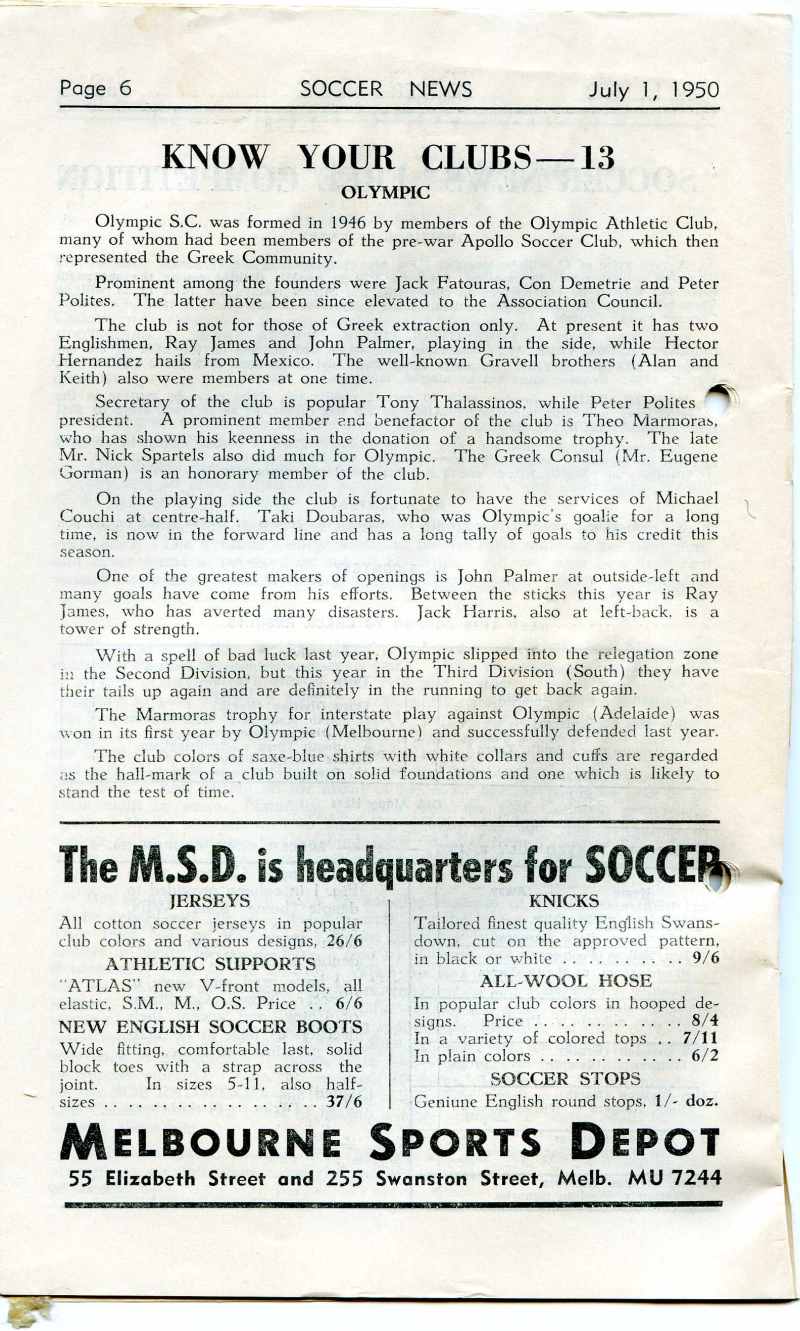
Know Your Clubs - Olympic

Alright then, special treat for everyone today - everyone that is who didn't see this when I posted it on smfcboard last week. Courtesy of 4Flares, the following is a club profile on Melbourne's Olympic, one of South Melbourne Hellas's predeccessors.

A lot of names, some of which are apparently also related to Apollo Athletic, as stated in the article. From the little cross referencing I've been able to do so far I've been able to find that

  • The late Nick Spartels was likely a boxer in the 1920s
  • From another edition of Soccer News: Hector Hernandez, inside-left for Olympic, would be the only Mexican playing soccer in Australia. A Batchelor of Commerce, he is over here on a scholarship from the Mexican Government for the next two years, during which he hopes to obtain his Master of Commerce.
  • We now know for certain that the Marmaras Cup was between the Olympics of Adelaide and Melbourne. The Melbourne and Sydney Hakoahs had a similar trophy they'd play for.
  • (Sir) Eugene Gorman was a well known barrister in the first half 20th century Melbourne. The Greek Consul bit referred was an honorary title.
  • In another 'Know Your Clubs' section, Park Rangers are mentioned as having been born off a split from the South Melbourne United Juniors in 1946. A Dockerty Cup winner, Park Rangers played in the Middle Park area for quite some years, before being taken over by a bunch of Scots (as mentioned to me by Hugh Murney) and moving to Kew. Later they became absorbed into what is now Moreland City. Does that make us related somehow? Up to you I guess.

Wednesday, 13 May 2009

More South Melbourne United and Frank Crean and Des Hamilton stuff

From Soccer News, August 1, 1953 (page 6)

It is in the junior ranks that South Melbourne United has had its greatest successes. Today we find South Melbourne Junior teams in Under 20, Under 17, Under 15 and Under 14 competitions, and in each case the club's team is well to the fore. With South Melbourne Technical School to draw on and with the club junior coach, McFadyen, coaching at the school, the club is assured of a constant stream of juniors from year to year.

The club is fortunate in having as its president a keen soccer man in Mr. Frank Crean, M.H.R.. The present secretary, Des. Hamilton, who has been a member of the VcA.S.F.A; council for five years, is a wide awake and tireless worker for soccer generally, and for his club, which for so long has had the ground at Middle Park as its headquarters

Wednesday, 25 March 2009

Apollo Athletic - another predecessor of what we have now

This is a partially colourised version of the photo I used to have on this article.
The previous version was hosted on a third party hosting site, which stopped
working. This one has been sourced from the La Trobe Greek archives.
Before Melbourne's urban sprawl was filled to the brim with little Greek fiefdom clubs, before even the days of Hellenic, Olympic, Yarra Park Aias, Alexander and Florina, there was Apollo Athletic, which is as far as anyone knows, the earliest Greek Australian club of them all.

The club was born sometime around 1934, and didn't last much longer than 1935, playing in the 3rd division at the time, and reaching the 2nd round of the Dockerty Cup, where they lost 3-0 to Shepparton East. Curiously, another club calling itself Apollo participated in competition during 1952, but disappears thereafter... and it's late in 1952 that Hellenic is formed... is there any connection? Who knows. There was also one final team using that name, but this was more of an amateur outfit playing somewhere out of Fitzroy/Collingwood calling itself Apollo 11, during the early 1970s.

Apollo Athletic had a mix of Greeks and non-Greeks in the team, perhaps the most notable of which was Floros Dimitriadis. Dimitriadis later became involved with Yarra Park, and through this association was one of the two founding Vice-Presidents of South Melbourne Hellas (the other being South Melbourne United's Des Hamilton). It was also at Dimitriadis' hotel The Duke of Kent that the amalgamation between newly formed Hellas and South Melbourne United took place. Whether it's the same pub as the current Duke of Kent on La Trobe street I don't know, and any information on that is more than welcome. *see comments section for update.

The following information is from a La Trobe Uni pdf I found on the net somewhere.

Athletes and members of the Apollo Athletic Club in the early ‘30’s. In 1934, shortly after its establishment Apollo appears as the first Greek Soccer Club in Australia. In 1935, despite its progress to the 3rd category in the Victorian State Championship, it dissolved mainly due to lack of interest on the part of the Administration. In the front row from left is seen Mr Floros Dimitriadis, the founding member of Melbourne Hellas.

Friday, 6 March 2009

The 50th anniversary game of the century! Round 2, South Melbourne vs Heidelberg United

Last Time They Met
Preview
I've been too busy giving the bourgeoisie hell in working class writing this week to type out something meagingful. Ok, that's not entirely true. Just on Friday afternoons. And spent the rest of the time doing the following
1. Arguing with Hellas fans
2. Trying to get smfcboard opened up
3. Arguing with Melbourne Knights fans
4. Dropping a subject I was somehow enrolled in twice.
5. Adding heaps of people on Facebook.
6. Knocking back invitations to join some crew in Mob Wars
7. Telling that summer league agenda spouting twat Teo Pellizzeri to answer the damn question.
8. Getting reeady to join the Offset 2009 crew.
9. And other things.
Anyway, I provided plenty of stuff for this week, so get off my back. Should be a good game but. We'll be wearing the red and white jersey of South Melbourne United this week. The question on everyone's lips though: will there be hooped socks? It's the hooped socks that make the original South Melbourne Hellas strip complete and well balanced aesthetically.

Thursday, 26 February 2009

Yarra Park never stood a chance

Looks like the collective amnesia has shifted from South Melbourne United to Yarra Park Aias. I'm sure in another 50 years we'll sort that out too. I've ordered the jersey Rama is wearing, but hopefully the other two become available for purchase as well, seeing as how there has been a fair bit of interest in the Hellenic strip in particular.

Sunday, 18 January 2009

50th anniversary jersey, combines old and new into stunning design.

In a South of the Border exclusive, we can reveal to you dear readers a prototype of the jersey we'll be wearing in this, our 50th anniversary year. The crack design team from Cartoon Stock, who were commisioned for the project, issued the following explanation of some the design's elements.


"Owing to the mass amnesia of the involvement of South Melbourne United in the creation of South Melbourne Hellas, it was a no brainer to not even consider using the original red 'v' design. The thing to do then was to use the traditional blue motif, but instil some new and old meanings into the design; we wanted it to tell a story. So while maintaining blue as the pricniple colour, we've gone with a more faded blue, in homage to the Jim Marinis-not-washing-the-shirts-as- punishment-for-playing-like-shit-and-with-no-heart in 2007 era. We've also gone for a very, well what we thought was a cutting edge move, in putting a whole potato, to symbolise, well, the literal potato on the shoulder of the club. It also quietly pays due respect to South's place in Australia, the land from the which potato came, specifically the old Middle Park and its immediate surrounds, and the club's role in cultivating the crop which has been crucial in alleviating world hunger."


Cartoon Stock's fee for the design has been the subject of much speculation, with rumours even circulating that they have received monies from South Melbourne's 2012 World Club Championship money, which the club will receoive once they receive entry into the A-League and win the title at it's first attempt.