Showing posts with label Middle Park. Show all posts

Friday, 13 August 2021

South Melbourne Hellas vs Sunshine George Cross, April 1985

Another day, another week, another round postponed. But no sooking today, because we have a bit of a treat. 

As regular readers will know, I've been uploading old South videos on YouTube, usually one each weekday, over the past few months. There's been some great content in there, and there's still at least a couple of months' worth of uploads to go.

Today's upload is seventy minutes' worth of South Melbourne Hellas vs Sunshine George Cross at Middle Park, from the 1985 National Soccer League season.

I suspect that the footage is an original recording by SBS, intended for use in highlights packages (with possible commentary overdubbing) and news reports, and thus the reason for there being no live commentary (or TV graphics) on the video. 

It is also an unpackaged video; that is, it is not trimmed down to key highlights. This video begins midway through the first half, thus it is missing South's first goal by Charlie Egan. (it is also missing the lap of honour taken by ultra-marathon runner Yiannis Kouros before the game, a week after winning the Sydney-to-Melbourne race)

Unfortunately, there are also two glitchy bits embedded in the source tape which desynchronise the sound and vision. After the first glitch, the sound is ahead of the vision by about six seconds; after the second glitch, the sound is ahead of the vision by about 15 seconds.

But considering how much Australian soccer material has been lost over the years, it is remarkable to come across something as lengthy and as unadulterated as this. Just one camera, no intrusions from commentary, just the vision of the game and the ambient noise of the crowd. 

It's a slight shame that the sound isn't a little crisper to make out more of the discussions taking place within earshot of the camera position. All you can really make out are occasional comments by some kids (including one asking to get chips from the restaurant), occasional berating of the referee in Greek and English, and some conversation in Greek about "ψωμί με σάλτσες, με αλάτι και πιπέρι λένε πολύ". (basically, something about "bread and sauces, with salt and pepper, many say")

External to that, you can hear Lefteri's trumpet playing his regular tune, as well as the Last Post; classic/basic chants from South's younger fans, including ye olde "dig a hole" and "here we go", belying the British influence of "active" culture in Australia back in the 1980s; and you can also hear the ground announcer read out the halftime scores from the other round 7 matches. And yes, there are novelty horns and vuvuzelas in there, too.

You also occasionally get the thunderous sound of stomping and thudding on the grandstand, and the roar of the crowd when it goes in. Most times though, the quality of the atmosphere is social, cheerful, and communal, like people are out at a picnic. And I suppose on a nice day like that, it makes sense that it comes across that way. It feels almost antique; the crowd rises and falls of its own accord, but mostly ebbs at a low hum; but at the time is not disinterested in the game, with key moments eliciting the appropriate response of joy or anger.

Visually there are all the usual markers of Australian soccer from the early to mid -980s - a lack of shirt sponsors, for one, as well as the dress sense of the crowd when we get a look at them. But also the general attributes of soccer from back then, most obviously the backpasses to the goalkeeper, which are still jarring to me no matter how many of them I've seen through the course of uploading these videos. 

And you get a pretty good view of Middle Park and the city skyline as well at times. Anyway, it's a long video, and I don't expect anyone to watch the whole of it, but it is a valuable piece of archival footage nonetheless.

Wednesday, 3 June 2020

Scrapbook artefact Wednesday - SM Hellas vs Newcastle BHP, 1993

After initially being a cautiously keen user of the Australian Football Before the A-League page, I'd boycotted it for a few years. Partly because I'm not a Facebook fan; partly because the page was becoming increasingly repetitive and was of poor quality from an artefact and discursive perspective; and partly because the moderators of the site did nothing to curb possibly libellous personal abuse levelled at myself and another user.

But the past is the past. Though some of the discussion on there is still vintage garbage TWGF level in terms of its pitting the past against the present, the quality of the artefacts seems to have improved somewhat, as the page's user base has increased in size. Some people are even posting full programs instead of just newspaper cut-outs!

In amid the usual and the surprising, you occasionally stumble across interesting items like this:

Click to enlarge the image. Credit: Mark Taylor.

It comes from a series of scrapbook notes taken by one of the page's members, Mark Taylor, who has been sharing them on the group's page. The game was South vs Newcastle in February 1993, the home game after the Clash of the Titans. In its own way it's a kinder gentler version of something like this,

Anyway, thanks to the relevant Facebook page, I've also been able to add even more content to South of the Border's match program archive, including the program from the opening of St George Stadium - at present our oldest NSL program on the site, and our second oldest overall. We've also got away to Marconi in 1979, and hopefully soon Marconi away 1980 and 1981.

Wednesday, 25 October 2017

South Melbourne Soccer Club Stadium permit artefact Wednesday

This post is more to keep up radio contact than anything, a sort of New Horizons green light to let everyone know we're still alive during this mostly dormant stage.

This is a planning permit (click the image to enlarge) for improvements to the South Melbourne Soccer Club Stadium, by which I assume was meant Middle Park, as signed in December 1993.

There'd been plans of sorts around the early 1990s about improving Middle Park, and it looked like finally, after decades of fighting against councils, planners and especially the locals, South would finally get on to the task of improving what was a dilapidated ground.

Of course Jeff Kennett brought the Formula 1 Grand Prix to Melbourne from Adelaide soon after this, and things were never quite the same again. So it goes.

Wednesday, 10 August 2016

'A little piece of home' artefact Wednesday - Middle Park soil and turf

This week's handcrafted South Melbourne Hellas artefact - a jar of soil and turf taken from Middle Park Stadium after the final match there - comes courtesy of one of our readers, the 'Lakeside Spy'. Lakeside Spy had previously sent us a photo of one of his Philips Soccer League NSL plates, which we used for an artefact article earlier this year.

After I asked Lakeside Spy whether the club sold these items or whether they made it themselves - admittedly a naive question, but as an old teacher of mine who ended up working in the light department at Bunnings Altona North once said, 'ask a question, look like an idiot for three minutes; don't ask the question, be an idiot forever' - Lakeside Spy noted in correspondence with South of the Border:
The soil I did myself. It's a bit clumsy / amateurish but I still treasure it as a piece of history. As a lot of people did I walked on the ground after the last match played there. I scooped up a patch of grass sand/dirt with a small implement and put it into my jacket pocket. I'd also be fascinated to hear what other mementos fans took from the ground. I'm sure people connected with the Club also have some great items in their own private collections.
One doesn't doubt that there are some remarkable items out there - I read once on Facebook an account by someone claiming to have the sign from outside the old Middle Park Stadium car park - but for now let's embrace this piece of handcrafted nostalgia which reminds us of our spiritual home, and the reason we came to exist as we did. Here's hoping it encourages a few more people to share the artefacts in their collections.

Wednesday, 30 March 2016

An older social club artefact Wednesday - Middle Park redevelopment

My, isn't it good to finally have this issue resolved!*

Of course this saga (in its Lakeside format at least) started all the way back in 2005 with a George Donikian thought bubble; became 'official' in 2008; got the 'yes' vote from members in 2009 or thereabouts; saw South of the Border gain the briefest bout of infamy imaginable March 2014, and the had these wonderful moments in 2014 - hedging our bets with with separate photo ops with the then Liberal Party candidate for Albert Park (plus the top brass), and and reigning and still your Labor Party MP for Albert Park, Martin Foley kicking a ball.

Or of course you could just trawl through all the articles on here that have the label 'Lakeside redevelopment' attached. Far more detailed, messy and just plain fun than what the club has been able to produce over the years; then again, I'm not quite beholden to the same standards of truth, accuracy and a fair go that they are.

All of which seems as good as time as any to post this little artefact of sorts. Earlier this year, while searching through early 1990s copies of Neos Kosmos in the State Library's newspaper archives - I was looking for a poem my dad wrote about Heidelberg, which ended up getting him a double pass to a game; I haven't found the poem yet - I came across this article in the English language 'New Generation' supplement of 11th January 1993 edition of Neos Kosmos. 

New Generation was edited at the time by George Bisas, and one time South Melbourne club historian Petros Kosmopoulos. You can see for yourself that the club had lofty ambitions for its Middle Park redevelopment. Improved facilities for members which would also be accessible to parts of the local community, and the status of being an enduring legacy for the Greek community; ideals which have also been taken off the shelf and dusted off for 2016.

Of course the arrival of grand prix to Albert Park saw improvements come to our facilities in a similar but different way. One always wonders though, had this project gotten through rather than the eventual Lakeside move, whether things would have turned out better.

*Assuming ti is actually resolved. You know, building permits, grant money coming through, all necessary legislation getting throigh parliament, etc

Wednesday, 5 August 2015

Greek studs and disco kings artefact Wednesday - Heartbreak Kid mementos

In the old Lakeside social club, there were many memorable framed jerseys, as well as many of less worthwhile calibre. And yet the two frames included in this week's artefact segment were found not on a wall in the social club, but hidden away in a drawer. The two frames are signed mementos from the Australian film The Heartbreak Kid, which starred Alex Dimitriades and Claudia Karvan. The film is fondly remembered by sections of the Greek-Australian community, if for no other reason that it included Dimitriades in the role of a young Greek Australian stud (as opposed to Dimitriades' turn as the hedonist bisexual Ari in Head On, sometimes derisively called 'that poofter film') as well as for its soccer scenes based out of South Melbourne Hellas, which was one of the film's key sub plots.
'Thanks for the use of your soccer field. Claudia Karvan'
'To everyone at Hellas, thanks! Alex. D.'
The Heartbreak Kid was of course not the first bit of Australian film or television to feature South Melbourne Hellas. The still popular sitcom Acropolis Now would occasionally feature references to South Melbourne Hellas and soccer, including a whole episode centred on a Hellas player played by Russell Crowe. West Adelaide Hellas and Adelaide City Juventus also featured briefly in the now long forgotten Garry McDonald film Struck by Lightning.

For those who recall The Heartbreak Kid (and to a much lesser extent its soapy spinoff Heartbreak High) many would be surprised to learn that the film was originally a play set in a Sydney high school, covering much the same territory, albeit in a far more chaste manner. In the play there's desire, but no sex; there are class issues, but they play second fiddle to the puppy love of a student for his teacher. The movie in that sense has a harder edge. Without wanting to wax philosophical (because the film deserves its own thorough analysis) the migrant issues are portrayed in a much more brutal manner, along with the working class aspect as one of the results of moving the film's setting from Sydney (where the main Greek characters were Sydney Olympic fans) to working class inner Melbourne (the film shot at Prahran High), where Dimitriades' character is a talented player whose ambition is to play for South Melbourne Hellas, as well as (notably) Australia.

The film had several soccer scenes, including extensive filming of Middle Park. Sydneysider Dimitrides is a fine actor, but he ain't no soccer player, and thus for those scenes where his character is required to perform some soccer sequences - especially one memorable late night scene after breaking into Middle Park - Con Boutsianis was hired to be the stunt double, which explains the framed photo below.

'To all the players and members of 'Hellas', thanks for all the help and support!
Special thanks to Barry and of course, the Disco King himself, Con Boutsianis!
Thanks once again, and good luck this season. From a friend. Alex D.'
Ben Hudson has noted on Facebook that "the producers wanted to hire Francis Awaritefe as a soccer consultant, but when they saw how poor Alex was as a player they decided the consultant also needed to be a body double - at which point they switched to Con Boutsianis because Francis couldn't manage it for some reason..."

All of which is, as usual, a very long winded way of saying when we do get the social club up and running, these would be a couple of very nice items to put on display.

Update 25/11/2018
Nice little insight by Leigh Tsoumerkas about the final scenes of the film.

Update 16/08/2019
Update 16/08/2019 (second update)

Monday, 11 May 2015

Wake - South Melbourne 1 Avondale Heights 0

You can divorce your spouse, change your religion, and sadly these days even change your soccer team, but one thing that should remain a constant - as long as its feasible - is the bloke who cuts your hair. I've been going to the same barber for 28 years now, a bloke named Chris who really only knows how to cut hair in two styles: a buzz cut, and what one of my brothers calls 'the Hitler'. I had the Hitler (or variations thereof) up until I was about 15; then he went overseas for a bit and had another barber take over his shop for a few months, and she convinced me to try a buzz cut. Nearly 17 years later I'm still here: I chose my haircut when I was 15, my fashion sense when I was 18, and have barely deviated since.

If anyone can explain why back in the day South fans had a
chant for the English medley pianist and singer Mrs Mills,
I'd really appreciate it, because it's got me baffled.
I bring this up because my barber, as all good barbers should, likes to talk about sport. Sure he knows next to nothing about the topic, but as a living example of the changes in Australian sporting tastes, he's as good as anyone. There used to be a TAB outlet across the road, and the local Greek bums would go back and forth between the TAB and Chris' shop with the radio, and the shop's copy of the form guide going from hand to hand. Chris was also once the first aid man at Doxa Yarraville; he even has a signed Mark Philippousis photo from when the Scud decided he'd do a pre-season there during the Hellenic Cup one summer. The shop being located midway between East Altona PAOK and Doxa Yarraville meant that you'd get all the local goss about those two sides. And sure there was always talk about Liverpool, Olympiakos and Footscray, but the centre of it in my flawed recollection was that there was always local soccer in there in amid the dirty jokes (told around a ten year old with a nod and a wink), perving on attractive women who walked past the shop, all done to a soundtrack of easy listening, the races, and Greek radio only when there were no ξένοι in the shop, or no races on.

The TAB outlet closed, and most of the bums moved on. Our conversations over the years became harder, now that I was at the centre of them, with no or fewer distractions from other people. As I became estranged from watching local soccer except for Hellas (when I could), then as my support for Liverpool evaporated, my fleeting interest in Greek soccer succumbed to apathy, and as he moved towards watching the A-League and I moved away from it and fully back into the local scene, all that was left was a ritual repeated for the sake of obliterating the silence. Yarraville would have high hopes but do nothing, while Altona East would plod along a division higher, and we would discuss the reasons why they wouldn't merge. Even if I had an interest in Liverpool or Greek soccer or the A-League, the lack of pay television would have made all these things redundant. And thus while he gives me my $10 haircut ('only for you Paul, because I've known you for nearly 30 years'), we stumble through a haphazard conversation, where if I spoke in English he would answer in Greek, and if I spoke in Greek he would answer in English.

When he asked me on Friday if I was going to the soccer that night - meaning the Victory-Heart game, for which he allegedly had a ticket - I said yes, I'm going to watch Hellas. He asked who we were playing and I said Avondale Heights, a team Yarraville would have once been accustomed to playing against in the middle tiers of Victorian soccer. But then he said something weird to me, and I assume it was based on my saying that I was going to Lakeside instead of Docklands: 'The reason I like you Paul, is because you don't have any friends'. He then went on some bizarre spiel about friends betraying you, an eye for an eye and all sorts of guff, but that line really got me thinking. Is that the reason I go to South?

If that's a long-winded way of eventually getting to the bit where I discuss the game, I think it still fits neatly enough into how the night was passed. At the pub, which had reputedly only bought a few weeks worth of sponsorship, and thus we were not obliged to drink there from now on, much of the time was spent in lament in terms of where we were, and where we had been. This in and of itself was not a first, and most of it was still centred on humour, but the wistfulness of remembering some of the long lost faces and voices, who had either given up the ghost, or would now prefer to go watch the game up the road, along with some of the players who had disappeared into thin air had a certain fatalism attached to it.

At the ground the self-declared Ultras group Enosi 59 were nowhere to be seen, and thus chanting took a while to get going, what with being relatively miserable as we collectively stared into the face of Australian soccer oblivion. Andy Brennan's cross to Milos Lujic for the game's only goal livened things up a bit, and even as the standard of play deteriorated, there was a sort of joy restored to the situation even if it was mostly a celebration of mediocrity. Thus chants on being aspirational, about Frank Piccione wearing a sports bra (originally intended for Griffo), 'we're gonna breakaway/fuck the FFA', 'we only chant for promotion (but also relegation)', and a whole series of handbag related chants that had nothing to do with the Ladies Night theme but were there nonetheless.

VPL legend and current South goalkeeper coach Bojo Jevdevic, in action
during the halftime penalty shootout match day experience gimmick.
Photo: Cindy Nitsos.
At halftime one of the sponsors was giving away a prize of a cosmetics pack to a lucky lady who was good enough to win a penalty shootout competition with Bojo Jevdevic in goal. That went on for probably 15 minutes, and probably ten minutes too long. The second half was largely forgettable muck from both sides. The visitors hit the crossbar, and had a goal disallowed for offside, but that was about it. Everything remotely useful seems to be going through Brennan and Lujic at the moment, while the rest of the team responsible for attacking maneuvers flounder. Nick Epifano was back in number seven, but was otherwise a non-entity (it's also being rumoured that he'll be flogged off overseas somewhere during the upcoming transfer window). Iqi Jawadi is not at the level he was last year, while others struggle with fitness and/or form. And yet we're still picking up points, we're still undefeated, and we still could make some good signings during the transfer window to liven up the side. I just hope the team finds its bearings again sooner rather than later - but things could definitely be worse!
Next game
Tuesday night at home against Dandenong Thunder, at the spiffing time of 8:30PM even though there won't be an under 20s curtain raiser.

Edit:
They may be a curtain raiser held after all.

Vale Fotis Antipas
The following is taken from the South site's article.
South Melbourne FC is in mourning after learning of the recent passing of founding member and club volunteer Fotios Antipas.
Mr. Antipas played for Hellenic in the 1950s, with history showing that Hellenic merged with Yarra Park and South Melbourne United to form South Melbourne Hellas in 1959.
When his playing days were complete, Mr Antipas volunteered at South Melbourne FC and was a very proud supporter and life member.
SMFC President Leo Athanasakis added that “on behalf of everyone at SMFC, we extend our condolences to the Antipas family on the recent passing of Mr Fotios Antipas, a man who has been involved at our great Club ever since it was formed over 55 years ago. We have also lost a link to our history as well, with Mr Antipas being involved with one of the three pre-merger clubs in Hellenic. We mourn his loss.”
Our thoughts are with his family at this very tough time.
Antipas is in the team photo of Hellenic in this post. Former general manager Peter Kokotis, whose family was involved with Yarra Park back in the day, informs me that Antipas was originally from Panachaiki, and that Yarra Park had tried to sign him, but that Hellenic via Antonis Karagiannis (also spelled Carayiannis) managed to get him first.


Around the grounds
Only the lonely (Dum-dum-dummy doo-wah)
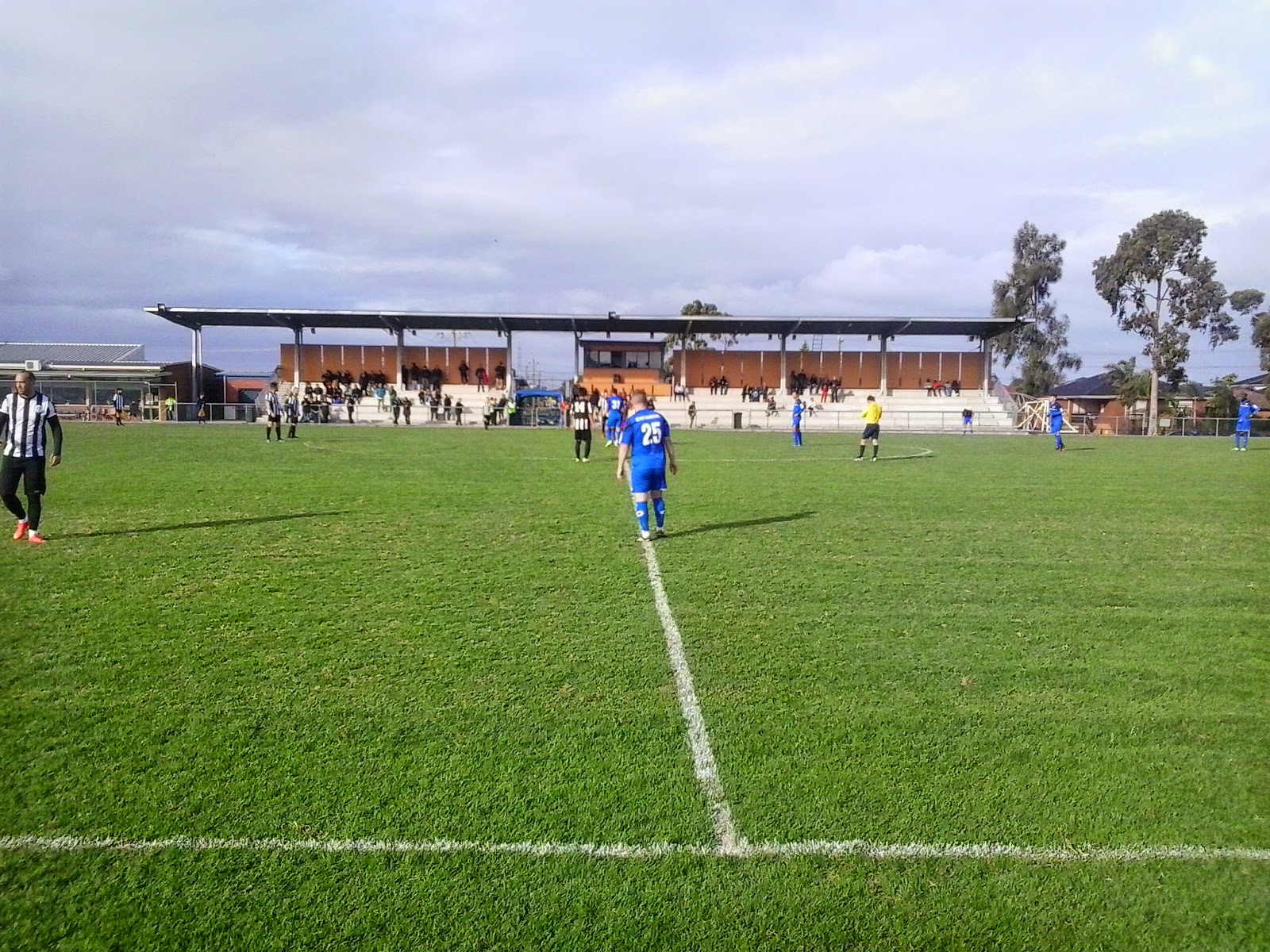
While not a Western Suburbs fan, I'd still been to Ralph Reserve on several previous occasions, but yesterday was my first match there as a West Sunshine local; conveniently, it was against my pseudo-genetic-geographically allocated state league side Altona East. The souvs in the social club are still only $7, and they also had a wide range of pastelia on sale. Being probably the only person left in Victoria who gets a craving for a pasteli at the soccer, I was appreciative of the gesture, even if it's likely that most of them have been sitting there for a decade. In amid the motley mix of Greek music and classic hits being played over the PA system to the crowd of 50 people or so (I blame Mothers Day for the diminished crowd), they also played Kurtis Blow's 'The Breaks', thereby almost completely redeeming the concept of playing loud music at a sporting venue.
The view from between the benches at Ralph Reserve, as Western Suburbs
and Altona East prepare to kick off . Photo: Paul Mavroudis
I couldn't figure out where to watch the game from, but eventually settled for the outer side in between the benches. The media box was out of the question, not only because I did not bring my media pass with me; nor for the isolating experience it would be being in there by myself; not even for the hilarity of having anyone bother to make the appearance of writing a genuine match report on this fixture; but also because I know the day I actually legitimately get into a media box, that a little part of whatever street cred I have left will be annihilated.

The home team's jerseys had player names on the back. The away team had strips where some of the jerseys had thick stripes, while others had thin ones. Suburbs had three or four African players, a smattering of Brazilians, former South player Andy Bourakis, and Terry Antoniadis as coach, who avoided getting Altona East relegated when he coached there in 2013 and 2014 mostly because of the NPL sucking up teams to a higher division. Altona East had a Japanese forward, a Turkish captain, a Welsh midfielder who sometimes barked like a dog at his opponents, and a Neighbours tour bus worth of British players of varying degrees of mouthiness.

Panellinios: Honoured the Greek name.
Everyone to Middle Park on Sunday!
Hellas - Brisbane City.

Suburbs started the stronger, but soon East began getting behind the home team's defence, and the pattern of the game was set. The Fernando de Moraes of State League 1 (complete with black gloves) was ineffective, Suburbs players got too physical for the referee's liking, and Antoniadis got more abusive to everyone as the half rolled on. For their part, East's coach (who seemed to be the assistant taking over for the regular guy, probably due to suspension), spent most of his time quietly giving instructions and telling one of his players ('Robbie') to shut his mouth.

East eventually worked out how to a score a goal following some comical finishing before that, as the little Japanese bloke Honda (one of the blokes nearby made the reassuring comment that Honda was fast) squeezed the ball home. Just before half time, as the referee was busy talking to a Suburbs player, a loud thwack was heard, and the linesman in front of the social clubs started waving his flag. A few metres away, an East player was down on the ground, and the inference was clear - he'd been decked by an opponent, who got his marching orders. Antoniadis was filthy, thinking that that player had just cost him the game.
The view from Ralph Reserve's stand. Photo: Paul Mavroudis
But early in the second half when Suburbs found themselves clear on goal, an East defender pulled the attacker back, and while the ref played advantage, the failure of Suburbs to make the most of the chance saw the foul called back with the East player sent off, and numerical parity restored. East scored a goal from a free kick which was called back for offside I assume, but then the rain came down, and since I only act hardcore for South, I decided to go into the stand.

The combination of long grass, flat balls, the sun poking through, the fine mist of rain swirling around like Jamie Oliver scattering herbs from a great height (most of which are destined to miss the plate), made the game hard to watch - and that's not even taking into account the relatively poor standard of play. But the one on one duals, the physicality, the ebbs and flows of the match, the small crowd made up of old men, reserves and assorted dateless wonders, and of course the struggle against the elements all gave the game a sort of backhanded sense of nobility. It wasn't pretty, but there was endeavour. The game had minimal meaning, but it still meant something. Suburbs fought back and took control, but could not manage an equaliser. As I was leaving I saw a likeable but opinionated South fan I knew stuffing his face full of hot chips, and maybe that's what the game meant - a chance for the lonely to go outside of their homes, and find something to eat in the alleged company of familiar faces. Maybe my barber was right, but it's maybe not just me who doesn't have any friends, and the question then becomes 'where would senior men's soccer in Victoria be without us?'

Final thought (courtesy of FS)

Wednesday, 12 November 2014

Bubblewrap artefact Wednesday - framed Team of the Century print

This post is tinged with both sadness and also a bit of hope. I have lived in the same house for something like 27 years, and now it's on the market. Quite where my family and I will end up is undecided at this point in time, but wherever that new home happens to be, one thing I will finally be able to do is find somewhere to hang up this framed South Melbourne team of the century poster - since I had it framed back in July, it's just been sitting on the floor of my study, leaning up against my brother's barely used drawing board.


The club still has a small handful of these posters left - probably fewer than ten - and not all of them are in the best condition, but most are still in acceptable condition. I found them during my stint cleaning out the social club several years ago in preparation for its renovation, and since then have always wanted one, even though I did cringe at the $150 cost, not including the framing. I suppose I could have nicked one then and there, but I would have felt sick doing that. Besides, I was compensated for my efforts well enough.

As for the painting itself, I'm not sure who the artist is. I may have had the detail somewhere, but I can't seem to find the information now. I'm pretty certain that it was not done by Jamie Cooper, who did the AFL team of the century paintings, and I probably wouldn't class this painting as being equal to that standard - to me at least, it seems like the players' bodies are too similar, and there doesn't appear to be a sense of warmth, camaraderie or connectedness - the subjects being too scattered and lacking in focus, the antithesis of your typical soccer photo, with the starting lineup looking forward with just a hint of the askance, waiting for battle. I suppose I would have liked to have seen the players in the various jerseys used by the club over the years as well, something akin to the Fitzroy team of the century painting - but you can't always get what you want.

Of course the original painting - rarely seen by South supporters, because of the fact that it was located in the old Lakeside boardroom - is in storage at the moment along with our other treasures. Will it be brought out into the public areas of the revamped social club, or will it retain its place in the new boardroom? I'm not too fussed either way, but I did like the way it dominated the old boardroom space, reminding whoever was in charge that there was a profound legacy that they were being asked to maintain, with the muted, but still inherent menace of the framed photos of the club legends in David Williamson's The Club.

Update
Our friend Pavlaki tweeted this as part of his response to this piece.
The suggestion is that the artist's name may be Dave Thomas, who has also done a few other team of the century paintings, from what I can tell mostly rugby league ones.

Saturday, 25 October 2014

Joe Gorman on Middle Park in The Guardian

Just in case you've missed it on its various Facebook and Twitter incarnations, Joe Gorman has recently written an excellent piece on Middle Park for the Guardian. It includes interviews and reminiscences from Mike Mandalis, Jimmy Armstrong, Kimon Taliadoros, Ange Postecoglou, Francis Awaritefe and friend of South of the Border Pavlaki. It also includes speculative commentary on the future by Tom Kalas.

Wednesday, 22 October 2014

Social club artefact Wednesday - Middle Park 'field of dreams' flag

2014 is not only ten years since we nearly went kaput, but it's also twenty years tomorrow since we played our last game at Middle Park. The acquisition of Middle Park is a huge part of our history, and it's the reason why from the start - or at least the merger of Hellas and South Melbourne United in early 1960, which perhaps should be the real founding date for the club - we've been known in English as South Melbourne FC/Hellas/Lakers/Pirates, and not probably something like Melbourne Hellas ala Melbourne Croatia.

That Middle Park is still sorely missed, and that Bob Jane Stadium/Lakeside never had the same feel, is almost a given. As an aside, it's disappointing, though not surprising, that the loss of soccer's suburban grounds was never given as much focus as those from footy, when the equivalent blood, sweat and tears were invested into the soccer venues, and that their demise as top tier venues was, aside from being linked with ethnic, non-conformist soccer clubs, also due to the same forces of economic rationalism and ground rationalisation.

Anyway, the video below is an absolutely priceless bit of footage for all sorts of reasons, including but not limited to:
  • The souvlakia grilling on the barbecue.
  • The most badass women's team ever assembled, with superb motley hairstyles and a keeper with sunnies. They're also wearing this rare jersey.
  • The ad hoc parade of champions
  • The Bristol Rovers style jerseys which harks back to 1966 when we wore a similar jersey.
  • The run through banner which the players will tear through unlike the weak AFL players of today who need a door to go through a banner. Soft.
  • Highlights of the actual game, including Gus Tsolakis acting like a bit of a knob after his goal. When he was playing for the Bergers, my uncle (then a diehard fan, later, meh) called him a monkey. When Gus was playing for us, he was dynamite. True story.
  • The post game scenes overlaid with cheesy music. Really cheesy music. 
  • There's a flag at 5:28 that I would kill to get a hold of.
  • A montage of photos including several run through banners and shots of the Middle Park outer.


The flag below was obviously designed and made especially for the occasion, The design looks a bit stiff, very dated even by 1994 and is, well, just plain ugly. Usually I'd find that charming but for some reason I've never been able to warm to this design. Still, it's a part of our history and any anecdotes about the design or the day are most welcome.


Wednesday, 26 March 2014

Lakeside Stadium artefact Wednesday - Middle Park plaque

Like its Lakeside counterpart, which we looked at last week, this is located on the front of our grandstand, though on the right hand side of the players race as you face the stand.

It's a reminder that while it was typically associated as being the South Melbourne Hellas ground, Middle Park was in fact a venue that we shared with Hakoah, and later several other clubs, and that both Hakoah and Hellas contributed to the building of the grandstand.

Prior to the building of the stand, South Melbourne Hellas had barely existed. Of course it was the merger of 'Hellas' - itself a merger of Yarra Park and Hellenic - with South Melbourne United, the longer term tenant of the ground, which saw South Melbourne Hellas play out of Middle Park (it was of course a massive part of the reason for the merger occurring). In contrast, Hakoah had a history dating back to 1927, with a history of playing out of several venues before eventually settling down at Middle Park by about 1957.

While Middle Park and neighbouring suburbs such as South Yarra, St Kilda and Prahran (but not, curiously, Port Melbourne) all had a longstanding soccer culture and presence, Middle Park appears to have been the original heart of that culture dating back to the 1880s. Why this is so is still to be fully teased out, but one of the core reasons was the Albert Park precinct itself.

If you can think of a sport or hobby that could be pursued outdoors, Albert Park probably hosted it. According to the Gillard Report, a government report from 1961 on the management and usage of Albert Park, the following activities were all taking place at the time:

...on the lake, there is rowing, yachting, boating, speed boating and canoeing. Fishing and sailing of model boats is allowed. On land, the park is regularly used for golf, cricket, lacrosse, hockey, baseball, soft ball, girls’ basketball, Australian Rules Football, Soccer, Rugby, Irish football, Hurling, Archery, Tennis, competitive walking, athletics and the flying of model aeroplanes. In addition, the Park has at times been used for cycling, and on several occasions in the past has been used for motor car racing. In renovated buildings, provision has been made for indoor sports of basket ball, badminton and table tennis. 

So rather than being a special case in and of itself, it appears as if soccer was part of the great many activities that were played there, perhaps chiefly because it was the largest and most easily accessible space to use for a fledgling sport, and because of its reputation as being the 'lungs of Melbourne'. This intense sporting usage was at the heart of the conflict between some locals, who wanted to use what was one of the few public parks available to them for walking and passive recreation, and those sporting persons who often came from outside the local area, who saw it as just the right spot for their sporting interests.

The Middle Park field (oval no. 18) used by South Melbourne United by the early 1950s (in the south-west corner of the boundary between the South Melbourne and St Kilda councils, on a reclaimed landfill site) also saw conflict between different sports. For example, the venue at the time also had a cycling track around it, built at the expense of the Albert Park Management Committee in the early 1950s (and hence the odd curve behind the goals at Middle Park). The cyclists never paid that money back, but were also incensed at the damage caused to the track by both footballers' boots as well as the spectators who were coming in increasing numbers to watch the games. They soon abandoned it.

Postcard with a photo of what is probably a Hakoah game (opponent unidentified) at Middle Park, circa early 1960s. This is just one of a series of postcards depicting sporting life in Albert Park during this era. The postcard series can be viewed on site at the State Library of Victoria, though you need to book this in advance (hence the white gloves I'm wearing).

The Middle Park ground just prior to the release of the Gillard Report was an unenclosed venue. This was at the heart of how and why Middle Park eventually became enclosed. There were only three enclosed venues in the precinct - these were the South Melbourne Cricket Ground (Lake Oval), the St Kilda Cricket Ground (Junction Oval) and a bowls club. These weren't officially enclosed - the public was supposed to be able to gain access to those fields outside of match days - but the reality of course was quite different. There was also the concern of accommodating spectators as opposed to participants. Oliver Gillard's preference was for the latter, but the existence of the Lake and Junction Ovals with their grandstands and brick walls complicated matters.

Gradually, and not exactly legally, a fence started going up around the ground, with the public only left with access from the northern side of Oval No. 18, followed by introduction of turnstiles. In the Gillard Report, the exact way this enclosure had happened was never quite explained, and there remained rather a lot of doubt and confusion on this matter, as politics and non-minuted details combined to see the area enclosed almost by default. Labor senator Pat Kennelly, also a member of the management committee, had almost had his endorsement for the senate blocked by the union movement for denying access to public land during the early 1950s.

Kennelly himself was a supporter of the need of newly arrived migrants for a proper soccer venue and the ability of clubs to collect gate money. This was a view that went against some on the management committee, who thought of soccer as just one of many passing fads that had been seen in Albert Park (ignoring soccer's long history in the area), and not one with any chance of longevity once all the migrants assimilated. The example of the cyclists, too, was also fresh in the memory.

The Middle Park grandstand plaque, photo uploaded to Twitter on December 12 2013. Contrary to some scaremongering on smfcboard, the plaque was still there during the 2013 pre-season, even while the concourse in front of it was being being re-concreted. Photo: Paul Mavroudis. 

However it came about, the fact that the Committee loaned money to Hellas and Hakoah to build the grandstand necessitated or at the very least encouraged the quiet enclosure of the ground, to allow for more money to be raised at the gate, and therefore allow the grandstand debt to be paid off; in addition, the enclosure saw soccer quickly become one of the management committee's biggest earners.

Later attempts to improve upon the venue were frustrated by both the management committee, but especially local residents, but that's a story for another time. For those interested in reading further on the history of the Albert Park from the 1850s up to about the mid 1990s, I highly recommend seeking out Jill Barnard's People's playground: a history of the Albert Park. It was exceedingly helpful in providing the background for much of this article, as well as for referring me onto the Gillard Report.

As for the plaque itself, while many items supposedly went missing during the shift from Middle Park to Lakeside, this was not one of them. It famously appeared in this video with Greg Blake and Kyle Patterson during the demolition of Middle Park. And while Middle Park may be gone, 53 years on a piece of it remains with us, and long may it do so.

Tuesday, 21 January 2014

The story of Melbourne Hungaria (not very SM Hellas related)

So I went to Melbourne Museum yesterday to check out Melbourne SC: The First Twenty Five Years, the cover of which you can see on the right. Why the interest in Hungaria and what's the relevance to South? I'll get to the latter toward the end of the entry. But as to the former question, since finding about this now extinct club a few years ago, I've been intrigued. They are seldom ever spoken about by the reminiscing Victorian soccer fan. They don't have the same historical/cultural resonance in Victorian and Australian soccer as do their Sydney counterparts St George Budapest, nor did they match St George's success. And yet in their short existence - the club went out of business at the end of 1987, just five years after this booklet was published - they did make an impact on the local scene.

Hungaria's most notable playing product was Attila Abonyi, the Socceroo striker who was at one time the national team's all time leading scorer. While the club had one Victorian State League second place finish (1970), and three third place finishes (1960, 1966, 1972), undoubtedly the club's most successful year was 1967. They not only won the league title that season, but went on to win the Australia Cup as well, beating APIA Leichhardt 4-3 in the final.

Possibly a photo of a young Ernie Tapai playing
for a Victorian state youth team.
Unfortunately, the bulk of the booklet's text is in Hungarian, with only advertisements (almost all small businesses, or pro forma congratulatory pieces from supporters) and a small portion at the end in English. There are many photos, but apart from player names (often surnames only) there are usually no other identifying details. The format is largely a year by year almanac style account, with an interesting deviation in the middle dedicated to junior players and even a women's team of some sort, before returning to the yearly summaries.

Despite a strong early 1970s period, the club had only a small community to draw upon. After being relegated from the state league in 1975, the club bounced between the Victorian second and third divisions for the next decade. and it appears that the lack of a permanent home ground didn't help matters. 

In the late 1950s, they played out of Elwood Reserve/Elwood Park in Elwood, before spending time at Port Melbourne's JL Murphy Reserve, Olympic Park, McDonald Reserve in Gardiner, Elsternwick Park, and even the St Kilda Cricket Ground (aka the Junction Oval, which was also used by Juventus; that venue was rejected as a possible home ground by South in the late 1970s/early 1980s, but that's another story)

The stability issue is perhaps undermined a little by the fact that Hungaria spent the entire period of 1969-80 at Middle Park Stadium, making them the third longest tenant behind Hellas and Hakoah in the ground's post-enclosure era. From 1981 until their final move to Williamstown, they played on one of the adjacent fields to Middle Park, Oval No.7. The last 12 pages of the book, in English, focus mostly on the future that the club's board had in mind.

The board, perhaps surprisingly considering the trends that were already in evidence among ethnic clubs at the time, had some seriously lofty aims. The main find for me is that the club managed to apparently secure some land in Williamstown (near the Rifle Range), and had plans to build both a new ground with a small grandstand (seating 300), as well as a social club. The intention was to supplement their soccer income in order to make a tilt at getting into the national league. Sound familiar?

Neither Melbourne Hungaria's plans for a boutique suburban ground, nor their aim of reaching the National Soccer League came to pass. As usual, apologies for the poor quality of my photos.

The grandstand and social club never got built, as a visit to JT Gray Reserve in Williamstown can attest to. The amenities in the shadow of the oil refinery are limited to the portables that used to be at Paisley Park. Why Hungaria's plans never happened I'm not sure, though we can take an easy guess. Diminishing crowds, diminishing interest, diminishing money. After having made it back to the state league in 1986, they got relegated immediately. In 1987, they got relegated again, and that was that. See the link Mark Boric has provided (in the comments) to a 1985 feature article on the club -

Is there a warning there for us? Without getting too melodramatic I think there is. I think we have some advantages in comparison - a good junior wing, stable enough existence at a home ground, enough corporate and pleb support to keep us going nicely for the time being. But Hungaria's plans and subsequent demise demonstrate the absolute necessity of getting this lease deal done. Not for the sake of some possible attempt at a national league return, or even for the money, but for the sake of the club itself. Here's hoping the movers and shakers are getting closer to finalising the deal.

Update
In the 1952 VASFA handbook (which you can download from here, courtesy of Mark Boric), there is a Hungaria listed as due to play in the fourth division. Unlike its successor team, which played for most of its existence in a completely white strip, except for a one red and one green horizontal stripe, the 1952 Hungaria kit is as listed as being a red shirt, white shorts, green socks.

Unlike other clubs however, there is no home ground listed - the only reference I can find to their existence in The Argus on Trove is in the round 1 results for 1952. Their match against the RAAF side is listed as not having been played, with no reason being given, unlike in other games where ground (for example) is listed as the reason for no game being played.

After checking with fellow Victorian soccer historian John Punshon, it appears that they pulled out early on, and teams due to play them got a bye. This was noted in the 'Secretary's Notes' section of the April 26 1952 edition of Soccer News.

Saturday, 19 January 2013

Dina Dounis - Soccer At Middle Park

In my other line of existence - being a career student at university - my honours thesis looked at the history of Australian soccer literature. That is, creative written work by Australians on soccer, and by Australians or otherwise on soccer in Australia. As has been mentioned previously, the nature of this work was in large part bibliographic - trying to find all the disparate texts and create a genre of sorts for them. The secondary goal was to begin analysis into the issues of the naturalisation of soccer in Australia; that is, at what point and how will soccer become genuinely Australian, and not subject to the whims of the cultural cringe.

One of the more interesting aspects of this research is how little of the substantial work has been done by members of the major community players in Australian soccer. That is, where was the work by the Greeks, the Italians, the Croatians, etc? Yes, there are certainly works about these groups and their involvement in Aussie soccer, but often times these are written by people from outside these communities.

So the question that leads on from there is, why are there so few texts from Aussie wog writers dealing with soccer? The easy answer is, combined with their under-representation in Aussie literature anyway, and ingrained antipathy among the intellectual class for sport (David Malouf's poem 'At a School Athletics Day' always comes mind) and it seems utterly natural that these works shouldn't exist.

But when you dig a little deeper, you find the apparent lack of even mentions of soccer within migrant written works as problematic. Soccer clubs are some of the major institutions created by Continental European migrants. And it's not like other major areas of their lives are not covered in Australian literature. Social life, family life, church etc. And yet soccer seems to fall by the wayside for some reason.

Maybe the texts do exist, but are hidden in language/community specific literary journals (like the Greek 'Antipodes' journal)? Perhaps because they are written in languages other than English, it makes it more difficult for databases to annotate and archive their existence? Perhaps, influenced by their Anglo brethren, writers from non English speaking backgrounds do not conceive of sport as important enough to be written about 'seriously'?

All of which is a circuitous way of getting to the thing that I wanted to cover most in this entry. While having another look at the AusLit database, which collects and categorises works of Australian literature (sadly for the general public, access is generally limited to people with university library accounts), I found something intriguing. Among several new entries, there was this poem by Konstandina Dounis, who also goes by the name Dina Dounis.


I was happy to find it for several reasons. It's about South and it's (of course) about Middle Park. It's the first text that I've found that deals with our club outside of allusions one could take from David Martin's 1962 novel The Young Wife and my own haiku phase, and disregarding uses of Middle Park and South in the film adaptation of The Heartbreak Kid and of course the still much loved sitcom Acropolis Now.

It's also by a Greek, unlike most of the main literary texts dealing with Aussie-Greek soccer. It's by a woman, which helps undercut the notion that it was only blokes at the soccer in the old times - indeed, Dounis says it is a family outing. Dounis also brushes aside the issue of crowd violence as something 'occasional'. It also brings class issues into the picture, something which I told my students in my Australian Literature tutorial to do, but which they seemed to not be interested in.

My guess is that Dounis seems to be talking about going to Middle Park at some time during the 1960s. The poem makes allusions as to why crowds have fallen at all ethnic clubs (putting aside for the moment South's exclusion from the top flight). That sense of ethnic community solidarity, which was once so necessary for newly arrived migrants, on an individual and community level, is no longer a driving force. As discussed by Matthew Klugman in his work on Sydney's Italian-Australian soccer community (which you can find in here), while there is still nostalgia among first, second and third generation migrants for that part of Australian soccer, these days it is almost entirely a nostalgic phenomenon.

In the present, members of these communities do not feel that they need that tangible or formal bricks and mortar style of community interaction in order to be 'Greek' or 'Italian' or whatever cultural tag may apply. The same could probably be said of regional associations, local community groups and churches. The decline of the ethnically backed soccer club does therefore not exist in a social vacuum. The poem is balanced in both undercutting and confirming stereotypes of supporting South, but being anchored by a nostalgic tone, it avoids making a direct comment on the present and future.

If you want to find out more about Dounis you an start by going here and here. If anyone out there knows of any literary texts dealing with Australian soccer, no matter how trivial and whatever the quality or language, do let us know. We'd love to know about them.

Monday, 27 September 2010

Roy Hay piece on Middle Park, as seen in Goal Weekly

This was apparently published a couple of weeks back, worth a read.


Middle Park: at the centre of Victorian football

By Roy Hay

When Melbourne gained the rights to hold the Australian Formula One Grand Prix at Albert Park in 1996 one of consequences was that South Melbourne Hellas and football lost its historic ground at Middle Park and gained the Lakeside (later the Bob Jane) stadium on Lake Oval, the old South Melbourne cricket ground. So ended a tradition stretching back to the 1880s when the game was known as British Association football to distinguish it from the home-grown variety. The South Melbourne cricket ground was the venue for one of the two interstate matches with New South Wales played in 1883 but the round ball game quickly established itself at Middle Park during that decade. The Middle Park hotel was the meeting place for players and sometimes several matches would be played opposite the hotel on an afternoon.

When the game revived in the years before the First World War, Middle Park was the central venue for league games. On 26 September 1908 for example, three games kicked off at 3 pm, St Kilda v Albert Park, Carlton United v Fitzroy and Prahran v South Melbourne. Middle Park was also the venue for the well-attended ‘international’ matches between Scotland and England. These were games between Australian players of the relevant heritage not games between touring teams from the United Kingdom. While club football seems to have been hard hit by the depression of the 1890s Scotland and England met at Middle Park on 1 September 1894. In September 1908 Scotland beat England three-nil, but the following year the English got their revenge by three goals to two. There were matches against visiting teams too, as when the steam ship Persic and the navy’s HMS Powerful arrived in 1908. Powerful was the flagship of the Royal Navy squadron on the Australian station from 1905. Dockerty Cup matches were also played at the ground. So Middle Park was firmly established as the main football venue in Victoria when the First World War brought about an interruption that lasted till 1919.

On 2 August 1919, Windsor beat Albert Park two-one, Northumberland and Durhams (N and D) accounted for Spotswood by the same score, Footscray Thistle outclassed St David’s by five-nil and Melbourne Thistle drew with Preston in league games. Attendances at games are notoriously rubbery but some thousands attended Dockerty Cup games, and it was said that an unspecified record crowd watched the matches on 3 July 1920 with the highlight being that between N and D and Melbourne Thistle, effectively another ‘England v Scotland’ game.

For many years the pitches were not enclosed and Ted Smith remembers playing on one that ran parallel to the Albert Park lake into which one of the players had to wade to retrieve the ball. A bicycle track was built with a pitch in the centre in the 1950s, then came change rooms and perimeter fencing. A new stadium was constructed in 1959 with a capacity of 18,000 including the grandstand, which held 2,000, close to the railway station. There were later extensions to include offices, a café and terracing. The stadium was demolished in 1994.

Competition from other venues became greater as time passed with the Melbourne Showgrounds, Olympic Park and even the Melbourne Cricket Ground accommodating major games, but Middle Park continued to be significant for the Victorian Amateur Soccer Football Association and its successor the Victorian Soccer Federation in the post-Second World War years. Park Rangers and South Melbourne United had their home at Middle Park in the 1940s. Both clubs later merged, Park Rangers with Moreland in 1985, while South Melbourne United joined another combined club. South Melbourne Hellas began as the product of a merger between Hellenic and Yarra Park in 1959. The Hakoah club, founded in 1924, became a tenant at Middle Park. Later it played at Olympic Park. By 1956 Hakoah was back at Middle Park and merged with St Kilda in 1972 and then in 1982 joined with South Melbourne United as the Victorian arm of South Melbourne Hellas which was playing in the National Soccer League in 1982. Other clubs used the stadium for brief periods. In 1960 Waterside Workers Federation shared the Park Rangers ground at Middle Park.

Victorian Premier League finals were played at Middle Park until 11 September 1994, when Preston Lions beat Port Melbourne Sharks by three goals to one. Gerry McAleer, Chris Sterjovski with two goals gave Preston a winning lead and Peter Tsolakis converted a late penalty for the Sharks. Sterjovski won the Jimmy Rooney medal for the player of the grand final. At half-time another youngster, Josip Skoko, was presented with the ABSW player of the year award completing an excellent day for youth.

National League football matches were also played at Middle Park until its demise and many of the local derbies involving Hellas, Melbourne Croatia (later the Knights), Heidelberg Alexander, JUST and Juventus drew five figure crowds over the years. There were around 12,500 when Hellas with Malcolm MacDonald, superstar with Newcastle United and Arsenal, took on St George Budapest from Sydney who had Derby County’s Charlie George, who also played with Arsenal, in 1977. On 23 October 1994 Hellas played the last game at Middle Park, thrashing Heidelberg United Alexander by four goals to one. There were 11,926 fans there to see them do so, with two goals by Ivan Kelic, and one each to Con Boutsianis and Francis Awaratife. Peter Tsolakis’s penalty was once again the consolation goal for his team.

Squads for the final game at Middle Park

South Melbourne: Steve Mautone, Mehmet Durakovic, Kevin Muscat, Paul Wade, Michael Valkanis, Gary Hasler, Jason Polak, Micky Petersen, George Goutzioulis, Con Boutsianis, Francis Awaritefe, Ivan Kelic, Paul Trimboli.

Heideleberg United : David Miller, Angelo Koutsos, Alan Scott, Richard Watson, George Georgiadis, Eric Vasiliadis Tom Karapatsos, Peter Tsolakis, Walter Ardone, Alex Kiratzoglou, Damir Gnjidic, Andy Vlahos, Michael Michalakopoulos.

Monday, 5 April 2010

Days of redevelopment past

So, with us moving out for a bit, and them going to build a stand on the outer side at Lakeside, it's perhaps worth noting our history of outer sides. Of course, there was no outer side stand at Middle Park. It was always that Hellas and Hakoah built stand from the very early days of Middle Park's history as a stadium, and not simply a probably unenclosed park.

And there was this, which I've nicked from Austadiums

Bob Jane Stadium Redevelopment  

Current Status:
At this stage, is is unlikely this redevelopment will go ahead.

Overview:
The proposed redevelopment of Melbourne's Bob Jane Stadium will include a new Grand Stand to be built opposite the currently members stand. The plans for the new grandstand include seating for six thousand people in a two-tiered structure, as well as increased corporate dining facilities and viewing suites. The plans also include office facilities, which could include housing for the Victorian Soccer Federation.

I'm not sure what year that's from. One wonders if it had been built, what route our fortunes may have taken. A facility of that sort, accommodating the pleb and celeb alike in great comfort, hell, even just the increase in undercover seating... but that opportunity, for whatever reason, is long gone, and with it... well, another set of what ifs I guess.

Certainly, in the late NSL era, Peter Mitrakas said the following in a Herald Sun article about building a new stand:

Mitrakas said South was looking for a co-tenant at Bob Jane Stadium, with an ultimate aim of building a second grandstand and turning the ground into a 14,000-capacity, all-seater stadium.

"When we took out the lease in 1995, we also got a development approval to build another grandstand (opposite the current stand), but we haven't got the money to do it," he said.

"We estimated then it would cost up to $3 million but that will at least have doubled now.

This was before the new league even had a name, and the allegedly Chinese backed consortium Melbourne Dragons was rumoured to be a candidate for inclusion into the new competition. Nobody talks about that anymore though.

Saturday, 21 November 2009

To verb the adjective noun!

Just posting some random and not so random crap, some off smfcboardm which most of you can't see - and it is nearing to AGM time after all - more on that on a later issue.


Item! Already received one private message, from my good buddy Gains, wishing that my review of the Tony Squires book had come out earlier so he wouldn't have bought the abomination. Ah well.

Item! At last year's AGM, I brought along a printed list of questions, some spare paper and a clipboard (and a training jersey from 2001 that I bought off ebay for some guy, but that's not really relevant) and for my efforts received this question on the forum

PS Does anyone know who was the dude near the front with the glasses who asked many questions????

12 months on, and one senile poster has forgotten my awesomeness, so much so that I had to sorta ask someone to mention it. We'll see how this turns out.

Item! It was fucking funny last year when the old bloke known to me only as Karantoni walked out of the meeting and everyone thought it was because he was pissed off, when he actually just went for a smoke.

Item! First it was the 1980 championship. Now the Bergers have moved another step closer to booking a bed in Ward 7. With thanks to Psile, as this is verbatim off his post.

On the bergers facebook page they have the neos kosmos article of the 1-2 at middle park when MM got the double for them, anyhow underneath it says:

ΕΛΛΑΣ/ΜΕΓΑΣ 1-2 93-94,SEASON LAST GAME AT THE PARK FOR HELLAS BEFORE IT CAME DOWN WHAT A DAY WILL ALWAYS REMEMBER THIS IS FOR THE OLD MEGA FANS WHAT CAN I SAY NEOS KOSMOS SAYS IT ALL

No you clowns...we thumped you 4-1 and it was round 1 of 94/95.

Sunday, 18 January 2009

50th anniversary jersey, combines old and new into stunning design.

In a South of the Border exclusive, we can reveal to you dear readers a prototype of the jersey we'll be wearing in this, our 50th anniversary year. The crack design team from Cartoon Stock, who were commisioned for the project, issued the following explanation of some the design's elements.


"Owing to the mass amnesia of the involvement of South Melbourne United in the creation of South Melbourne Hellas, it was a no brainer to not even consider using the original red 'v' design. The thing to do then was to use the traditional blue motif, but instil some new and old meanings into the design; we wanted it to tell a story. So while maintaining blue as the pricniple colour, we've gone with a more faded blue, in homage to the Jim Marinis-not-washing-the-shirts-as- punishment-for-playing-like-shit-and-with-no-heart in 2007 era. We've also gone for a very, well what we thought was a cutting edge move, in putting a whole potato, to symbolise, well, the literal potato on the shoulder of the club. It also quietly pays due respect to South's place in Australia, the land from the which potato came, specifically the old Middle Park and its immediate surrounds, and the club's role in cultivating the crop which has been crucial in alleviating world hunger."


Cartoon Stock's fee for the design has been the subject of much speculation, with rumours even circulating that they have received monies from South Melbourne's 2012 World Club Championship money, which the club will receoive once they receive entry into the A-League and win the title at it's first attempt.


Thursday, 17 July 2008

Billy Nats Is Hellas Mad!

A few weeks back I received a message out of the blue from one Billy Natsioulas, asking if he could contribute to South of the Border. Of course I jumped at the opportunity, and within a couple of days, Nats had got the following piece to me. I kept it on the backburner for awhile, seeking to release it during the week we played the Knights, an appropriate choice I thought. Anyway, if like Nats you would like to send in a piece talking about your love affair with South, or a great game or favourite player, by all means send it this way. Hopefully the floodgates open and we get a whole heaps submissions from players and fans alike. But now over to Nats, and his story.

Hellas Mad
This isn’t some half arsed suck up job and by no means is it my autobiography. I just have a lot of time to think things through and understand whatever happened to my so called soccer ‘career’. While I was doing this I got an understanding where this love for the game began. My dad and brothers were 'Hellas Mad'. This piece is to analyse what made me Hellas Mad, a football lover and a South Melbourne player.

Every home game, my brother, my cousin and I would hop into the back of my dad’s old Corolla and make what seemed like a long journey to Middle Park. We always got there early and parked around 10 minutes away to make sure we got parking that was easy to get out of. I would tie on my Hellas headband thinking that I was so cool. I have three vivid memories of growing up as a Hellas supporter.

The Past
Firstly, the 1991 Grand Final – My dad and I had left a family christening early to watch the final 15 minutes of the game. My dad drove like a lunatic to get to Olympic Park on time and we ran up the stairs, only to realise we were watching the game from the Croatia fans' side of the ground. Nevertheless, we watched and we hoped for an equaliser. My dad thought it was over and in typical wog style we conceded defeat and left early to beat the traffic. As we got into the car we heard the roar, game must have been finished. It wasn’t until we got home that we realised that the roar was for a South equaliser and we miraculously won the championship on penalties. Even watching the replay we couldn’t understand how we won that shootout.

Secondly, a friendly around 1992 between the great Hellas and the suburban Oakleigh at their old ground at Caloola Reserve, allowed me the chance to meet my heroes. Mehmet Durakovic, sporting a plastered broken arm took me under his wing and introduced me to each player. I got all their autographs and was over the moon, but as soon as I got out of that room my older brother stole the autograph book and claimed it as his own… PRICK!

The final memory comes from March 1994, 11,000 people packed into Middle Park to see Hellas vs Croatia. Wadey missed a penalty in the 94th minute that would've given South the game. On the way out we were met by the Croatian fans who started rolling big stones at us from the top of the hill. My dad took us through the trees and snuck us under the fence to safety before finding his way through the crowd and meeting us on the other side.

My career and the present
Who would've thought that after 16 years of supporting South that I would play for their dire enemies, the Knights. Well, that’s where I ended up. Credit to them, they gave me every opportunity and treated me brilliantly. Funny thing was the best game I played for them we got thumped 5-0 against South and a 35 year old Paul Trimboli scored two and tore future Socceroos Roddy Vargas and Adrian Leijer to shreds.

I had made a good name for myself at the Knights but when the NSL died and South came knocking it was just too easy for me to say of course I’ll sign. However, along with the initial signature there aren’t many highlights. Training with a retired Trimmers was great and even though he could barely move he still took the piss out of us. The first game against Heidelberg was great, the Championship in 2006 was brilliant but that’s where it all ends for me. Whether its a curse put on me by some old Croatian lady or simply bad luck my time at South reads as follows: 2005 – Glandular Fever (season); 2006 – Torn Hamstring and Lacerated Thigh (season); 2007 – Torn groin, concussion and head split open; 2008 – ACL knee reconstruction (season).

Not forgetting for a second all the mental issues which come with that kind of run of poor luck, which challenged my ability to get motivated week in week out, which probably doesn’t need to be put into details because everyone knows. I was spent and ready to give it up and many told me to do the same.

So why do I want to come back? I see the same desire in the eyes of my little brother and my students towards South that I had as a kid. I see their love for this club, I see others that have come before me with that same love. No other club has the team spirit that we have because we are honoured to put that top on every week. No other players can walk into clubrooms with the luxuries we have and look up at the names that have come before us. No other club has people like Trimmers and Jimmy Armstrong still around the place because even though they are legends of this game, they themselves know that this club is more special than any individual.

Until I am told I am no longer wanted at South I will keep coming back every year. Even when my body can no longer take it, I will be there supporting Hellas. Like my career, the club has had its dark days and setbacks. But it still has meaning for so many people, even though some try to deny it. Every time I look at my teammates I see that love. Every time I look at my brothers, my old man, my friends and my girlfriend I see that love. Hell, even when I speak to the old Greek bus driver Jimmy at my school, who’s been supporting this club since 1970 I see that love. South Melbourne is not a football club, it is a culture. I no longer play for my football ‘career’. I simply play for that shirt. I know that when I am gone, there will be plenty more to take my place and I will be there to support them… Long Live Hellas!

Saturday, 19 April 2008

South of the Border Haiku edition no.3

This is a rather unsatisfactory piece in my honest opinion. It lacks genuine flow and lightness, rather being dragged down by a lack of rhythm. Anyway, following last week's almost ethereal poem, this is one is grounded in the very earth itself. Back when Middle Park was still around, my father, perhaps of his support for Heidelberg, would never park inside the adjacent parking lot; instead we'd park some distance away, and walk through the then quite neglected Albert Park. Eventually we'd reach the ground, a little oasis of life amidst the neglect.

When we left and moved further north, these cross-country journeys were over, and indeed, made impossible not just by the relocation but also the complete makeover the precinct received. Still though, if you happen to venture down by where the pit lane is, near where we used to live, the earth, perhaps because of the drought or perhaps because of some sort latent memory in the place itself, still has that sandy, uneven, and familiar quality. Many a South fan has made mention that however nice Lakeside is, it's not Middle Park; and that the club was forever changed tangibly and intangibly by the move; and I'd agree with that. It was home after all. Going back there now, even without signposts, I reckon I can still feel the presence of the past, and rather predictably, wonder what will come of the future for South.


over the wasteland
of gravel, grass and sand
Middle Park was home