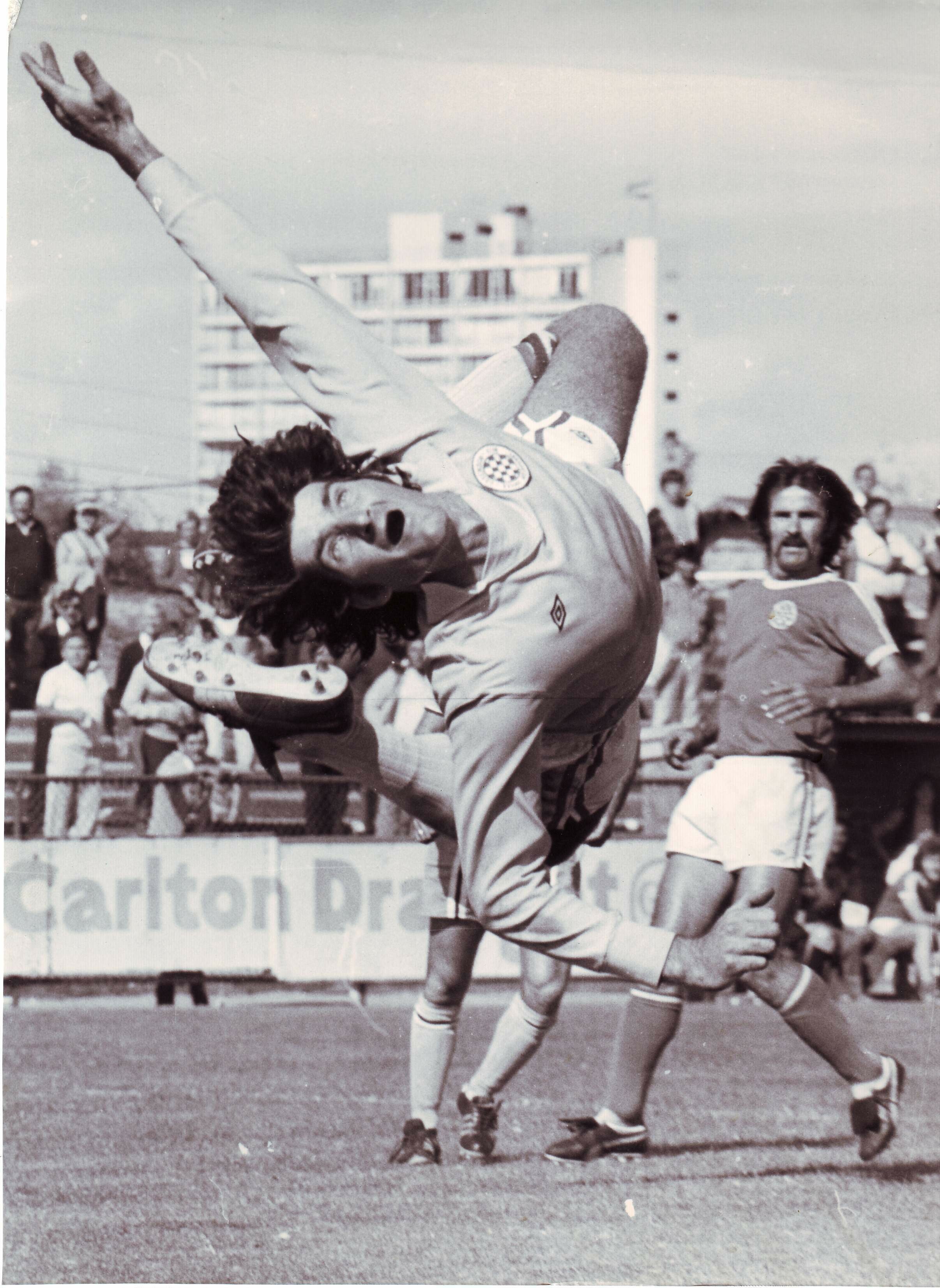
Showing posts with label Mehmet Durakovic. Show all posts

Monday, 20 February 2017

Everything in its right place - some overdue thoughts on the Ferenc Puskas statue

Ferenc Puskas bust at Real Madrid
training ground, Valdebabas, Spain.
Here is another post which would have been better off shorter and presented in a more timely fashion. So it goes.

Some of the photos of the various statues on this page were sourced from 'From Ptich to Plinth: The Sporting Statues Project', a quite interesting website with a fair bit of academic content as well. 

In retrospect, it made a lot of sense to walk from Flinders Street Station to Gosch’s Paddock along the Yarra. Yes, I had gotten into the city too early for the scheduled start of the unveiling of the Ferenc Puskas statue, but it was a nice day for that walk anyway, along the shaded path, just before it got too hot.

Along the way, I came across a broad spectrum of Melburnians. There were those making their way up to the tennis centre for the Davis Cup doubles tie; tourists; joggers; cyclists at various points along the Lycra-wearing spectrum; families out for a stroll; rowers on the river.

Statue of Collingwood champion Bob Rose, outside
Collingwood's Holden Centre headquarters.
Coming up to the revamped and renamed Glasshouse, now occupied by the Collingwood Football Club and re-named the 'Holden Centre', I saw the statue of Collingwood champion Bob Rose, captured in mid-baulk, and thought about how far away he was from home, both geographically and chronologically. How much would he recognise of what Collingwood had become? Would he wonder why his statue was not at Victoria Park, the scene of his greatest triumphs?

I then walked past Olympic Park, or what remains of it after Collingwood’s annexation of the stadium. This is where Puskas’ crowning achievement during his involvement in Australian soccer took place, the onetime de facto – and democratic – home of Victorian soccer. It had hosted Socceroo matches, National Soccer League matches and Victorian finals ranging from top-tier and Dockerty Cup deciders to amateur cup finals. Of course you would not know that if you looked at it now, but some peoples' histories are more important than others.

Statue of John Landy helping up Ron Clarke,outside what was once
Olympic Park.
Then it was past the statue of John Landy helping up Ron Clarke, which at least provided a sign of athletics’ past at the venue. At this point I was joined by an older, grey-haired gentleman wearing a suit - a bit too for me much considering how hot it had already become - complete with an embroidered Melbourne Victory jacket. We pooled our efforts into trying to find where the Puskas statue was meant to be unveiled. I never caught the man's name, and he didn't learn mine, even though he had attempted to tell me about his connection to Puskas.

We then went past the Bubbledome where keen Bruce Springsteen fans had already camped out hours before the gates were due to open for The Boss' concert. My grey-haired companion then saw some people he knew exiting the car park, and I left him to it. I proceeded around the eastern side of the Bubbledome, to the back of a Melbourne Storm training ground to where a couple of small marquees had been erected. The caterers had arrived, but not many others as yet.

The statue prior to its unveiling. Photo: Paul Mavroudis
I mention the existence of all these people not just to set the scene (which is a literary weakness of mine anyway), but to note the complete and utter obscurity of the unveiling of this statue as an event in its own right. Not that statue unveilings are usually big events in Australia, let alone for a soccer player, but that all added to the unnatural feel of this event even before it had properly got under way.

The statue was sitting underneath some trees almost in a grove, covered by a black cloth, out of the way of most foot traffic likely to approach the Bubbledome. On that matter, I found myself in polite disagreement with Roy Hay, who felt that there would be plenty of foot traffic that would come across the statue where it was situated. But more on that later.

Because before the statue could be unveiled, there was the necessity of enduring the official proceedings, which I assumed would be relatively short, so we could get to the business of seeing the statue and taking our share of the complimentary food and drink on offer. How wrong I would be on that front.

A small crowd gradually built up, a mix of elements of the local Hungarian diaspora, assorted official flunkies of the government and sporting worlds; a small official South Melbourne Hellas contingent; Australia’s preeminent soccer historian in the form of Roy Hay; South Melbourne Hellas fan and local Greek sports journalist George Karantonis; and me. Oh, and those who were due to speak as part of the day's formalities.

Les Murray opened up proceedings, discussing Puskas the player and what he meant to Hungarians of that era, followed by a video montage blighted by the kind of rousing, over-the-top symphonic montage music we should have all become de-sensitised to by now. Then for reasons that I still cannot fathom, Mark Bosnich was asked to speak. Bosnich had never played for a side coached by Puskas, nor played (so far as I’m aware) against a team coached by Puskas, and yet there he was, asked to be the day’s equivalent of Bob Newhart being asked to speak at Krusty the Clown’s funeral.
Peter Tsolakis, Mehmet Durakovic, Kimon Taliadoros and Joe Palatsides.
Photo: Roy Hay.
The most poignant part of proceedings soon followed however, when four members of the South Melbourne Hellas side that Puskas coached to the 1991 NSL title were given the opportunity to reminisce. Peter ‘Gus’ Tsolakis was first, and he provided perhaps the most profound insights into Puskas’ soccer idealism. Tsolakis recalled playing on the wing and tracking back to defend during a training session, and subsequently getting told off by Puskas: ‘that’s the full-back’s job – your job is to score goals’.

A statement like that reflected Puskas’ idealistic but also antiquated views on how to play football, one in which there was little room for cynicism, let alone tactics. Tsolakis went on to recall another simple instruction from Puskas: ‘show me what you learned as a child’, thus giving licence to his players to be creative, and to enjoy themselves, and to remember that the crowd is there to be entertained, that the game is about goals, but also that it is a players’ game, not a coach’s one.

Ferenc Puskas statue, Obuda (Budapest), Hungary.
Scuplture by Gyula Pauer and Dávid Tóth,
The statue was 'conceived the idea from a photograph of Puskás
 enthralling a group of children with his ball control
 at the Toros de Las Ventas square in Madrid
'
Mehmet Durakovic recalled being re-united with Puskas when Durakovic was captain of Selangor, and Puskas was there to coach the Hungarian national team against them. Puskas slapped Mehmet in greeting, shocking the Asian onlookers, who had very different rules of etiquette around physical contact.

Current Football Federation Victoria president Kimon Taliadoros recalled practicing free kicks with his non-preferred left foot, and being castigated for it by the notoriously single-sided Puskas. When Taliadoros scored a long-range bomb with his left foot for South against Melbourne Croatia at Somers Street, he ran to Puskas to let him know all about it – only to be greeted by Puskas wielding a doubled-handed mountza, the Greek hand gesture of insult descended from the Byzantine practice of smearing ashes over the faces of criminals.

Ferenc Puskas bust, Zala County, Hungary.
(For reference, there is also of course the recollection by Paul Wade in his autobiography Captain Socceroo, of Wade initially interpreting the mountzes he would receive from the crowd as a variation of a high five.)

Then it was time for one-time South Melbourne sponsor, then Melbourne Victory shareholder, and now Tasmanian A-League bid backer Robert Belteky to speak. As the Australian delegate to the Puskás Foundation Board of Trustees, Belteky was apparently instrumental in getting this statue commissioned and brought to Melbourne. Unfortunately, while Belteky spoke for a while, most of what he said was inaudible to those not underneath the marquee. This was not due to any technical malfunction, but rather due to Belteky mumbling his way through most of his prepared remarks.

Ferenc Puskas bust, Kobanya-Kispest traffic junction, Budapest, Hungary
Then it was the turn of a representative of the Hungarian government to pontificate for a while (a quick google says it was Zsolt Németh, chairman of the Hungarian parliament's foreign affairs committee) saying nothing of importance, while those members of the audience not fortunate enough to have snagged a spot under the marquee tried to avoid becoming roasted by the heat of the day.

Then another speaker in the never-ending cavalcade, a public servant or state government flunky of some sort standing in for the Victorian Minister for Sport John Eren (turns out it was Liberal state upper house member Bruce Atkinson). The aforementioned flunky at least managed to pique my interest as we sweltered in the shade, after what was almost an hour and a half's worth of speeches and formalities, by somehow bringing in a connection to Melbourne Victory and the Bubbledome, and throwing in the line that roughly went, 'wasn't it wonderful that South Melbourne had contributed to soccer's growth in Australia by bringing over Puskas, but wasn't it even better that we had now subsumed that tribalism and moved forward with the A-League and teams like Melbourne Victory'.

Ferenc Puskas statue, Pancho Arena, Flecsut Hungary.
It bears a striking resemblance to the statue unveiled in Gosch's Paddock.
Sculpture by Béla Domonkos 
Missing from the reminiscences of Puskas’ time in Australia was the story of how he got here and how he came to coach South Melbourne Hellas, regardless of whatever conjecture there is around that story. One can understand and forgive leaving out the controversies, while still feeling if not aggrieved, then at the very least disheartened by the lack of acknowledgement of the Greek community’s experience during this celebration of Puskas’ time in Melbourne.

If, as was acknowledged on the day, Puskas’ time in Australia went unnoticed by Australian society, then why was so little attention paid to those who did pay attention – in this case, one thinks specifically of Melbourne soccer’s community and the local Greek soccer community in particular who would flock to training sessions to be near Puskas?

Ferenc Puskas statue, Szentes, Hungary.
Sculpture by László Csíky
Photo: Dr László Csíky
If nothing else, Puskas' time in Australia was a supreme exemplar of what soccer was like in this country at the time. It was a pursuit that was followed madly by its adherents, but which was nigh on invisible to the rest of Australia society. One of world football's greatest was here for three years, living here in almost total obscurity - except, importantly, for those who knew and understood. It many ways, Puskas' time mirrored that of those who watched him, especially those of the predominantly central and southern European migrants involved with soccer at the time - both subaltern, and existing in a parallel cultural world to that of mainstream Australia.

There is little doubt that Puskas’ tenure at South had at least something to do with Puskas’ tenure as manager of Panathinakos in the 1970s. Because Puskas could speak Greek, but very little English, Ange Postecoglou, who was captain of that Hellas side, would act as the de facto translator. There were no South Melbourne Hellas office holders or supporters of that era asked to speak, nor any Greek-Australian soccer journalists of that time.

Instead, apart from those former South Melbourne players, the emphasis of the day was more on Puskas the phenomenon, to the point where even his managerial career was being extolled, when the record shows that he was in fact a mediocre manager at best.

Ference Puskas statue in Gosch's Paddock, Melbourne.
Photo: George Donikian.
Then finally, the statue was unveiled, and I must say I was underwhelmed. Keep in mind though that I'm at best an armchair art-critic when it comes to the visual arts - but I think there is something to the idea that soccer is a difficult sport to capture effectively in marble or bronze. With the exception of a goalkeeper making a save - something much better suited to photography than sculpture - the game's most poetic moments are embedded in movement, not in moments of stasis.

In that sense, cricket and footy have significant advantages when it comes to presenting heroic moments of stasis: for cricket, a batsman captured at the end of of his follow through on a batting stroke, or a bowler at or just after the moment of release; for footy, the high mark or the booming kick.

With the exception of the aforementioned diving save, soccer's most significant moments are not about stasis, but movement. The dribble (could you sculpt a nutmeg?), the interplay of a string of passes with the requisite movement off the ball, and of course the swerving shot, which at its peak exists purely in the realms of applied physics, independent of any player.

Ferenc Puskas during his stint as South Melbourne Hellas coach,
resplendent in a trademark ugly jumper.
Having said that, such observations do not seek to elevate the aesthetics of one sport over another, as was attempted - and irretrievably badly at that - by academic Stephen Alomes at the 2012 Worlds of Football Conference held by Victoria University. Nevertheless, having set up the parameters of soccer's most pleasing aesthetic moments in this way, this statue (to me if seemingly not to anyone else at the unveiling) seems lumpen and lacking in grace.

There is of course, also the incongruity of having a statue of Ferenc Puskas the player in Australia as opposed to the manager, despite Puskas having never played the game in Australia.

Yet to be completed Ferenc Puskas statue.
Ultimate destination unknown.
Sculptor, László Csíky.
Now despite the strong desire of what has been dubbed Australian #sokkahtwitter - including your correspondent - that Melbourne's Puskas statue be of the overweight, bad jumper wearing Puskas, or the tracksuit wearing Puskas, or at least the suit wearing, grand final day Puskas, one had to be realistic. Yet, all the same the fact it was a statue of the playing Puskas as opposed to a managerial Puskas was disappointing - the statue of a playing Puskas is utterly alienating, existing outside of almost all local context.

If the most poignant of reminiscences on the day were about Puskas' kindliness, humility and gentlemanly conduct while he was a football manager in Australia, this statue fails to get anywhere near that feeling. It was noted at the unveiling, almost as an aside, that this will be one of four Puskas statues around the world. Did they mean based on this mould? Or did they mean overall? If it is the former, then it hardly makes our statue unique. If it is the latter, it is not much better, as busts and statues of Puskas have sprung forth in many places, especially in Hungary. All the more reason then that our statue should have been of the Puskas that we knew.

The statue's position at the back end of a rugby field also separates Puskas from where he did his greatest work here. To a very large extent, this is unavoidable - Middle Park Stadium no longer exists; Olympic Park also no longer exists, if we're being honest; and for whatever reason (see later notes on this), the Hungarians and the Puskas Foundation, who funded this enterprise (along with a regional tour of the FIFA Puskas Award and a gala dinner on the Friday night before the statue's unveiling), didn't feel like placing it outside Lakeside (which would pose its own historical-conceptual issues, ala the Bob Rose statue, but at least it would be closer to where South Melbourne Hellas currently lives).

Soccer players statue at Australian Institute of Sport.
Scupltor, John Robinson.
Photo: Philip Abercrombie. 
The path that the statue sits alongside is very much out of the way - the majority of the mass of people that will head to the Bubbledome for its various sporting and musical events, or heaven forbid, Olympic Park for a Collingwood VFL game, will not come across the statue, as most people who visit those venues tend to come from Richmond station, or via the tram, or if they're feeling particularly fit, from along the river from Flinders Street. The people most likely to come across the statue are cyclists, who probably won't stop, or a Melbourne Storm player collecting a stray ball during a training session.

Sporting statues in Australia seem to me to be a fairly recent phenomenon. Before that, when it came to erecting statues we probably did much as the British did - when we commissioned sculptures, it was of soldiers, politicians, explorers, and maybe the occasional scientist. In more recent years, as sport has started catching up not just on the merits of history in its own right, but especially the propaganda value that it can elicit in the hearts and minds of the general public, various sporting bodies have seen the cultural heft that can be achieved by neoclassical tributes to sporting icons. Thus footy statues have sprung up in all sorts of usual (MCG) and unusual (Braybrook Hotel on Ballarat Road) places, and even tennis has chimed in with the cheaper alternative of using busts of its champions at the tennis precinct. (the only one of which was immediately recognisable was John Newcombe, because of the moustache).

Johnny Warren statue outside the
Sydney Football Stadium.
Sculptor, Cathy Weiszmann.
Photo: Johnny Warren Comnunity.
Aside from this Puskas statue, there are three extant soccer statues or sculptures in Australia that I am aware of. One of these is at the Australian Institute of Sport, and is of a generic soccer scene, with anonymous players. There is also the statue of Johnny Warren outside the Sydney Football Stadium. And lastly, there is the statue of the late Dylan Tombides outside Perth Oval.

In their own way all of these statues - including the Puskas one - represent some crucial aspect of the Australian soccer experience, even if that was not the chief intent of each of the sculptors. In Tombides, we have the personification of the young Australian soccer player venturing overseas, to Europe and especially England, seeking their footballing destiny and fortune. In Warren, we have the supreme archetype of the Australian soccer evangelist - noted more for those efforts rather than the exploits of their playing career. In the statue of the anonymous players, we have the anonymity of the game and its participants. And in Puskas, we have the overseas guest, a giant of the sport living almost anonymously in a town which was and still is alternately oblivious to soccer's existence, and envious of soccer's global reach. But the net effect of all of them is to remind Australians of soccer's sense of displacement within Australian culture. Even Warren, whose club career was entirely spent in Australia, is more notable for his efforts to create a place for a global game in this most crowded and parochial of sporting nations.

Now one can, as is often the case with my writings, take all of this pontificating with a large dose of salt. I am almost by nature drawn to the farcical and absurd in situations such as this, unwilling to accept the prosaic and straightforward nature of such projects. As nonsensical as I find the statue's placement to be, it will apparently be joined in future by other statues in what has at least been informally dubbed an 'avenue of champions'. I am told that there had been an attempt or an offer made by FFV to the people behind the Puskas statue project to have it located outside Lakeside Stadium, but that the decision to locate it at that particular part of Gosch's Paddock had already been made.

Stature of Dylan Tombides
outside Perth Oval..
Sculptor, Robin Hitchcock.
Photo: Perth Glory
If this 'avenue of champions' does actually come about, one wonders who will pay for it, and what hope there is of soccer getting any more statues as part of such a project. (I will leave the question of which Australian, or especially Victorian, soccer player would merit a statue open for now). This statue of Puskas reputedly cost $75,000, and was paid for by Belteky; though to cast doubt on that, there are various media reports which suggest this was all done by the Hungarians, who plan to unveil three more statues of Puskas around the world; even this monument then is not unique, but instead intended to imply a message of ubiquity.

(I should note that of the four Puskas statues to be created, I don't think any of the photos of the Puskas statues I've included here, apart from the Gosch's Paddock one, are part of that project. I have searched for a Puskas statue in Madrid, but I do not think one exists, and thus I assume that one of these four planned statues will end up there.)

It has been intimated to me that the Victorian Government initially didn't even want the statue, but after much negotiation eventually came around to the idea. As part of one of the most extended quid pro quo agreements I can think of, this whole thing is being done at the behest of the city of Budapest's bid to host the 2024 Summer Olympics. Apparently, when Melbourne was bidding for the 1996 Olympic Games, Ferenc Puskas had acted as a sort of ambassador for the bid.

In its design, procurement, placement and veneration, the statue is more about Hungarians' ideas of Puskas than of what his Australian tenure meant to those who experienced it first hand. Later, I would attend the Moreland City vs Werribee City game at Campbell Reserve - apart from those at the game who had also been at the statue unveiling, such as George Donikian, no one would have been the wiser that a Ferenc Puskas statue had been unveiled on the same day. Why would it?

Wednesday, 3 June 2015

Mehmet artefact Wednesday - Selangor FA pennant

Oh, so many fond memories of Selangor's tour of late 2013. I suppose it all started before they'd even thought of touring, when former South Melbourne Hellas championship player Mehmet Durakovic quit his post as South Melbourne FC director of football or technical director or whatever it was that he was doing with us, and took up the gaffer's job at Selangor, where he played in the 1990s. Then news filtered through that Selangor was in Australia as part of their pre-season schedule, and were using Lakeside as a training base. Would South Melbourne play them in a friendly? Would it be open doors? Would someone from the club say it was closed doors even it wasn't? Yes, yes/no/kinda and yes, but with appropriate caveats! And thus Gains and I went to this game expecting not very much and getting it. All of which is a very long winded way of saying that this week's artefact is the pennant Selangor presented us with prior to the game, and which was last seen somewhere in team manager Frank Piccione's dungeon. You know, because we don't have a social club and stuff.
Selangor FA pennant from our friendly kick about with them in December 2013. Also
partially visible is an 'I Love This Club' sticker from the 2010 season. Photo: Paul Mavroudis.

Wednesday, 10 December 2014

Social club artefact Wednesday - Team of the Century team sheet

I found a small bunch of these during my social club clean out a few years back. Not being there on the team of the century night, I assume these were made available on all the tables. Of course, the team of the century concept has always been something that's baffled me slightly, not only because it was clearly influenced by both the AFL's centenary celebrations as well as the millenarianism that was in vogue at the time, but also because the club was barely 41 years old and well short of the century mark. Of course as with all such endeavours there was also controversy regarding the selections. George Donikian noted at the time (in an interview with the Four Diegos I believe; wherever the link to that transcript was, it's now gone) that Ulysses Kokkinos was left out due to character issues. But perhaps the most interesting decision was to have Michael Petkovic in as first choice goalkeeper, ahead of the very popular Peter Laumets. While Petkovic did have the runs on the board with two national championships, his tenure at South up until that time had been comparatively brief; then again, Oscar Crino's South stint was much shorter. Petkovic is also the only person in the team of the century to have begun his South career in the 1990s - his 1996 starting date coming in seven years after the other most recent inductees. More disturbing perhaps in hindsight, is that due to the circumstances we find ourselves in, there will probably never be another player that could be included in any future or revised team of the century affair.

Tuesday, 10 December 2013

South Melbourne vs Selangor tomorrow night?

Well, this is an interesting development. A little birdy sent us a link to a Facebook page, which included talking about how Malaysian football side Selangor - one of Malaysia's more important and successful teams, currently coached by former South technical director (and champion South and Selangor player) Mehmet Durakovic - would possibly be playing against our very South Melbourne.

The discussion was in Malay, with a lot of slang, so Google's translation tool didn't work all that well, but the indication was that any possible game wouldn't be any time soon. Except that by checking Selangor's twitter feed, it appeared as if they were already here!

Selangor training at Lakeside Stadium. Photo: Selangor twitter feed.

Furthermore, it appears as if Selangor (who will be here until December 16th, as part of their pre-season preparations) have scheduled a match against us tomorrow evening at 6:00PM. Will it be open doors? What kind of team would we possibly field at such short notice? I'm guessing yes to the first question, and probably some cobbled together youth outfit for the second.

So, depending on how desperate you are to see some South action, you may want to head to this affair - with the full knowledge that it may be a closed doors session and of absolutely no consequence whatsoever considering who we'll have on the park, with our actual senior likely not starting pre-season training until some time early in the new year.

UPDATE
My mail suggests this is a closed door session.

Thursday, 31 October 2013

Has Mehmet Durakovic left for Selangor (again)?

Mehmet Durakovic (left) with Selangor teammate Jeff Hopkins
during the mid 1990s. I stole this photo from the
online  edition of the Malaysian newspaper 'The Star'.
Here's an interesting story I came across thanks to the much maligned poster known as 'mario' on soccer-forum (though really, if I wasn't focusing on my scholarship application today, I would have seen it first on Jakarta Casual).

There are reports flying around (see here and here) that South's technical director Mehmet Durakovic has signed up to be coach of Selangor in the Malaysian league. If true (and it appears to be so), this will be the second time Durakovic has left South for that club, after joining Selangor following the first of his two playing stints at South. Does this mean that we'll have to be on the look out for a new technical director? I still don't know what technical directors do, but get your coaching licences out people, there could be a job opening available at Lakeside soon.

Monday, 19 November 2012

Mehmet Durakovic new Senior Technical Director

But what does a technical director actually do? Add your answers - both sensible and otherwise  - to the comments section, because I don't have a clue as to what such a position entails.

Monday, 24 October 2011

Memories, light the corners of my mind

Meh, Melbourne Victory in some early strife on field, and for some reason Michael Lynch cautiously infers that a successful NSL/VPL coach might have been a better choice. Not one of ours thankfully (?!), but the VPL's King of Kings, Ian Dobson. Strange how people start thinking in a crisis.

Anyway, more curiously, Lynch's Age colleague Greg Baum thought it would be pertinent to compare the current Melbourne derby to one of former years - ours and the Knights rivalry.

This is not the derby of Manchester or Milan, because it cannot be. It is certainly not Glasgow's Old Firm. It is not yet even South Melbourne versus the Melbourne Knights, from Australian soccer's pre-reformation.

It's only one line, but someone remembers, or at least pretends to. Of course Baum then does what he does best, and brings aussie rules into the picture. But this is Melbourne and thus it is unavoidable I suppose.

Australian soccer's pre-reformation is an interesting notion though. I always preferred the imagery of the Rapture, with the well-behaved and pious A-League fans taken up to some kind of dull heaven, while all us unrepentant wogs are left below to deal with the Apocalypse as best we can.

To make Baum's analogy work however, we'd surely need a counter-reformation. Armies of wog club missionaries - maybe like the Olympic Ultras! - walking down the (internet) streets, proselytising. But who will be our Ignacio de Loyola?

Sunday, 10 April 2011

Day of Ghosts - South Melbourne 1 Richmond 0

Well, this was an unusual day.

The weather wheeled and turned the way it used to do in Melbourne. Rain, sun, wind, hot, cold, not necessarily in that order. Got to wheel out the Greek phrase "ο ήλιος έχει δόντια (the sun has teeth)", meaning that even though the sun is shining, there is no warmth. There's apparently also a version of this saying in Albania, so there's a good chance that it's a wider Balkan thing. The second umbrella I bought from Aussie Disposals kicked the bucket about five seconds after I opened it. So it goes.

And Lefteri was back, after years and years away. For the uninitiated - Lefteri was the sound of South Melbourne Hellas for about 25 years. The specific sound was his trumpet, calling ours fans to arms. Even if you didn't know what he looked like, even if you stood in another part of the ground, the trumpet was as much as part of the South Melbourne experience as souvlakia and a long line at the ticket booths two minutes before kickoff.

South fans happy to have Lefteri back. Photo: Cindy Nitsos
There are several rumours circulating about the reasons for his seven year absence. And it wasn't like there weren't several efforts in the post-NSL era to try and get him back. Why did he come back today of all days? Will he be back next week? The week after? Who knows. With all due respect to Bruno, the lad who's filled in on trumpet duties on and off in the year's since Lefteri's absence, it was nice to hear the original, even if it wasn't quite as powerful and fluent as it used to be, and to see him in his vintage vest, loaded with patches. In a very small way, for many it felt like nothing had changed. A quick look around though quickly breaks that illusion.

We started off the game well, dominating the first twenty minutes or so. All our chances went to waste though, and our slicing and dicing of the Richmond defence was all for nothing. The visitors picked up their game, but were still mostly reliant on set pieces on causing us problems. Steven O'Dor was back in this week, but he barely lasted half the game. He came off and Recchia was forced back to the defensive post he held last week. He's doing a good job - it's amazing what decent pre-season can do for a player.

But as the game wore on, we kept losing our shape. The main culprit was Ljubo Milicevic, who whether under the coach's instructions or his own decision to hark back to the days of Total Football, decided his role was to roam across the field, in every position it seemed except for the one he was supposed to be in: centre back. It caused all sorts of chaos on the field, and raised the ire of several of his teammates. And all of a sudden the ghosts of Ljubo's past are coming out again, to the point where maybe a Captain Obvious/Dr Philism comes into play - hey, maybe it's not always everyone else, maybe sometimes it's you.

Where was Simon Colosimo today? Photo: Gains
Anyway, Carl Recchia managed to score the winning goal, from a corner where allegedly the keeper was obstructed. I couldn't see if that was the case from the distance and angle I was at, suffice to say I was pretty confident when I saw the ball dip quickly at the near post with the keeper somewhat stranded. All in all not pretty stuff again for the most part, but good enough. Next week away to Hume for an earlier version of the Anzac Day Cup, one of the so-called 'Great Cups of Cuppage'.

Now for some of the other crap that happened today.
  • Discussing the current status of Greek provincial team Kalamata, it came to my attention that they had been relegated to the fourth division there due to either financial irregularities or mismanagement. Hell, let's just call it shenanigans. Somehow I managed to quip that there's probably a rumour starting over there that the fans are asking whether George Vasilopoulos or his Kalamata equivalent has a mansion in Dromana. 
  • Remember when Tony Free was captain of the Richmond aussie rules club? Hilarious stuff.
  • Dean Uthoff or Shawn Bradley?
  • Now this one's from Steve from Broady, so I can't really ascertain the truth of the matter. All I can say is that it sounds good. Anyway the story goes that former South Melbourne players and current Melbourne Victory employees Mehmet Durakovic and Kevin Muscat were at the game. At half time as Clarendon Corner went past as they were switching ends, Muscat for some reason apparently called us a club run by fish and chip shop owners. I haven't had this story verified by anyone else yet.
  • The "Keeping It Real" fad is getting out of control. I think I'm going to start the Hyperreal faction.

Thursday, 17 July 2008

Billy Nats Is Hellas Mad!

A few weeks back I received a message out of the blue from one Billy Natsioulas, asking if he could contribute to South of the Border. Of course I jumped at the opportunity, and within a couple of days, Nats had got the following piece to me. I kept it on the backburner for awhile, seeking to release it during the week we played the Knights, an appropriate choice I thought. Anyway, if like Nats you would like to send in a piece talking about your love affair with South, or a great game or favourite player, by all means send it this way. Hopefully the floodgates open and we get a whole heaps submissions from players and fans alike. But now over to Nats, and his story.

Hellas Mad
This isn’t some half arsed suck up job and by no means is it my autobiography. I just have a lot of time to think things through and understand whatever happened to my so called soccer ‘career’. While I was doing this I got an understanding where this love for the game began. My dad and brothers were 'Hellas Mad'. This piece is to analyse what made me Hellas Mad, a football lover and a South Melbourne player.

Every home game, my brother, my cousin and I would hop into the back of my dad’s old Corolla and make what seemed like a long journey to Middle Park. We always got there early and parked around 10 minutes away to make sure we got parking that was easy to get out of. I would tie on my Hellas headband thinking that I was so cool. I have three vivid memories of growing up as a Hellas supporter.

The Past
Firstly, the 1991 Grand Final – My dad and I had left a family christening early to watch the final 15 minutes of the game. My dad drove like a lunatic to get to Olympic Park on time and we ran up the stairs, only to realise we were watching the game from the Croatia fans' side of the ground. Nevertheless, we watched and we hoped for an equaliser. My dad thought it was over and in typical wog style we conceded defeat and left early to beat the traffic. As we got into the car we heard the roar, game must have been finished. It wasn’t until we got home that we realised that the roar was for a South equaliser and we miraculously won the championship on penalties. Even watching the replay we couldn’t understand how we won that shootout.

Secondly, a friendly around 1992 between the great Hellas and the suburban Oakleigh at their old ground at Caloola Reserve, allowed me the chance to meet my heroes. Mehmet Durakovic, sporting a plastered broken arm took me under his wing and introduced me to each player. I got all their autographs and was over the moon, but as soon as I got out of that room my older brother stole the autograph book and claimed it as his own… PRICK!

The final memory comes from March 1994, 11,000 people packed into Middle Park to see Hellas vs Croatia. Wadey missed a penalty in the 94th minute that would've given South the game. On the way out we were met by the Croatian fans who started rolling big stones at us from the top of the hill. My dad took us through the trees and snuck us under the fence to safety before finding his way through the crowd and meeting us on the other side.

My career and the present
Who would've thought that after 16 years of supporting South that I would play for their dire enemies, the Knights. Well, that’s where I ended up. Credit to them, they gave me every opportunity and treated me brilliantly. Funny thing was the best game I played for them we got thumped 5-0 against South and a 35 year old Paul Trimboli scored two and tore future Socceroos Roddy Vargas and Adrian Leijer to shreds.

I had made a good name for myself at the Knights but when the NSL died and South came knocking it was just too easy for me to say of course I’ll sign. However, along with the initial signature there aren’t many highlights. Training with a retired Trimmers was great and even though he could barely move he still took the piss out of us. The first game against Heidelberg was great, the Championship in 2006 was brilliant but that’s where it all ends for me. Whether its a curse put on me by some old Croatian lady or simply bad luck my time at South reads as follows: 2005 – Glandular Fever (season); 2006 – Torn Hamstring and Lacerated Thigh (season); 2007 – Torn groin, concussion and head split open; 2008 – ACL knee reconstruction (season).

Not forgetting for a second all the mental issues which come with that kind of run of poor luck, which challenged my ability to get motivated week in week out, which probably doesn’t need to be put into details because everyone knows. I was spent and ready to give it up and many told me to do the same.

So why do I want to come back? I see the same desire in the eyes of my little brother and my students towards South that I had as a kid. I see their love for this club, I see others that have come before me with that same love. No other club has the team spirit that we have because we are honoured to put that top on every week. No other players can walk into clubrooms with the luxuries we have and look up at the names that have come before us. No other club has people like Trimmers and Jimmy Armstrong still around the place because even though they are legends of this game, they themselves know that this club is more special than any individual.

Until I am told I am no longer wanted at South I will keep coming back every year. Even when my body can no longer take it, I will be there supporting Hellas. Like my career, the club has had its dark days and setbacks. But it still has meaning for so many people, even though some try to deny it. Every time I look at my teammates I see that love. Every time I look at my brothers, my old man, my friends and my girlfriend I see that love. Hell, even when I speak to the old Greek bus driver Jimmy at my school, who’s been supporting this club since 1970 I see that love. South Melbourne is not a football club, it is a culture. I no longer play for my football ‘career’. I simply play for that shirt. I know that when I am gone, there will be plenty more to take my place and I will be there to support them… Long Live Hellas!

Thursday, 15 May 2008

Durakovic, Mautone, alive, employed

From The World Game site, via smfcboard. Not necessarily fall out of your chair news, but good luck to them anyway, I guess. Noteworthy that TWG doesn't mention where these fellers played, yet the official Victory site (for Durakovic) does? Maybe.


Durakovic gets Victory role

Melbourne Victory has appointed Mehmet Durakovic as coach of its National Youth League team.

Durakovic, who will be assisted by Victory goalkeeping coach Steve Mautone, is an ex-Socceroos defender who made 64 appearances for his country and spent three years as assistant coach at the Victorian Institute of Sport.

“Mehmet Durakovic is a legend in Victorian football,” Victory football operations manager Gary Cole said.

“He was a wonderful player and he’s been assistant coach to Ian Greener at the VIS for three years.”

“He’s been part of their youth development and understands very well the football development program here in Victoria.”

“He’s very excited to be in football full-time and we’re sure he’s going to do a fantastic job.”

“To support Mehmet we’ve got Steve Mautone, who’s currently our goalkeeping coach and also has a terrific background,” Cole added.

“He’s got his International Asia ‘B’ Coaching Licence and has started work on his ‘A’ Licence.”

“Steve now has three roles within the one, he’s still the club’s goalkeeping coach and he’s also got a part-time recruiting role assisting (coach) Ernie (Merrick) and I.”

“As well as that, he’s assistant coach of the club’s National Youth League team and will be heavily involved with Mehmet in the recruiting of players for the National Youth League, which well and truly adds up to a full-time job.”