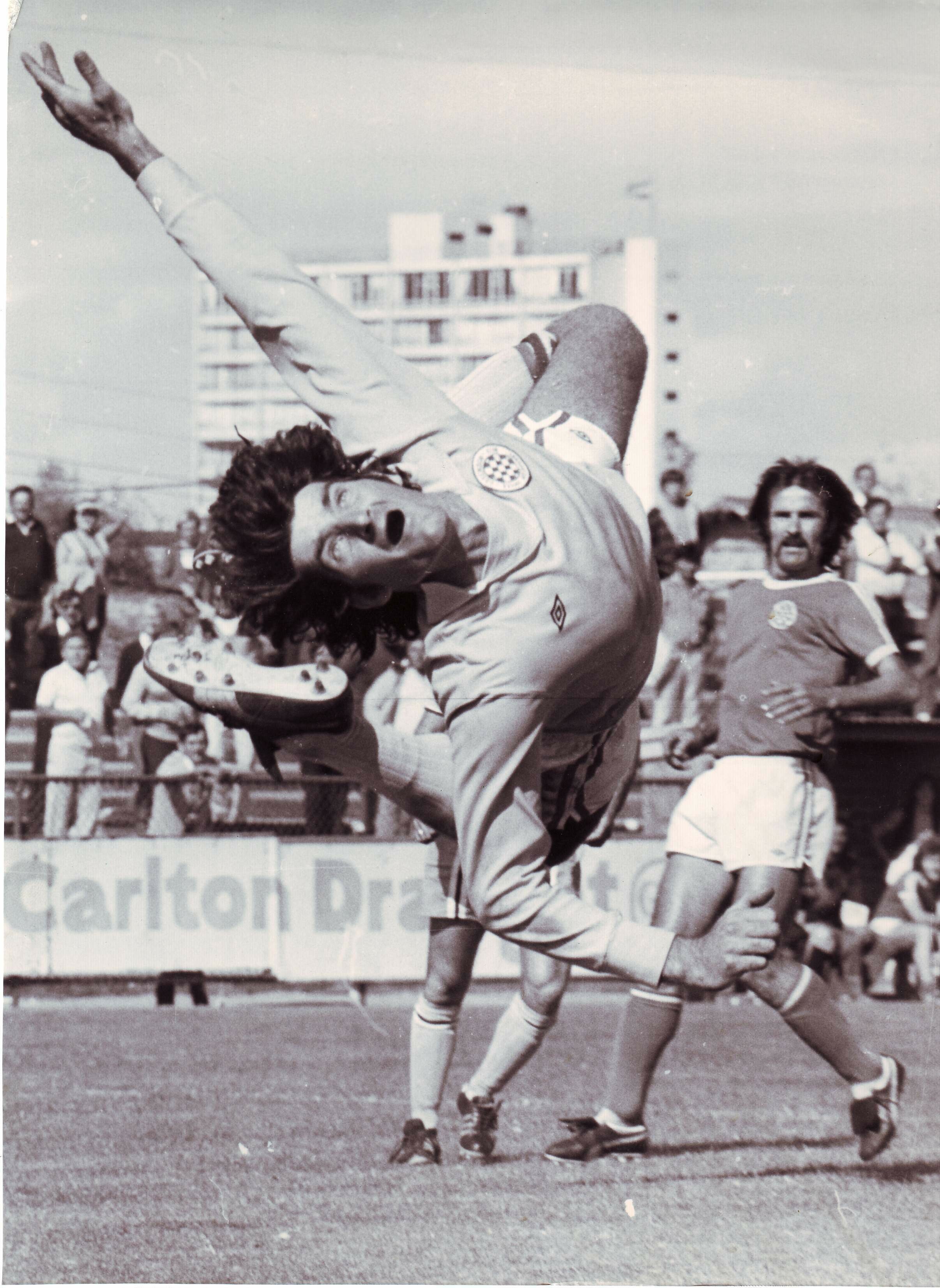
Showing posts with label Les Murray. Show all posts

Saturday, 5 August 2017

Les Murray on Laszlo Urge, and non-linear academic discovery

This is something I started last year but never got around to finishing. Seeing as how Les Murray the soccer pundit passed away this week, and seeing as how South has a week off, it's about time I fished it from the depths of my drafts folder, finished it off, and got it out of the way. I liked what was going on in this a lot more back then than I do now. A more useful version will hopefully end up buried in my thesis' literature review in due time.

This is the story of both the sometimes tedious and arcane nature of academic research, but it's also a story about the meeting of two parts of Australian culture that have little do with one another. If, as the popular notion seems to suggest, that sport and the arts in Australia are inherently irreconcilable pursuits, whose meetings are at best rare and awkward, then perhaps nothing quite encapsulates that cultural schism quite like the existence of Australia's two Les Murrays.

For perhaps most of Australia, even that which is not particularly enamoured with soccer, Les Murray remains the better known of the two Les Murrays. As the face and voice of Australian soccer, and by extension also the face and voice of SBS and a certain strain of the Australian multicultural experience, Murray's fame exists outside of the narrow trench of Australian soccer; this is best typified by the Australian public's familiarity with that strange, untraceable accent, which famously prompted TISM to ask 'What Nationality is Les Murray?' - a song which would not have worked quite so well had people had no idea who Les Murray the soccer pundit was.

Then there is the 'other' Les Murray, often lauded as Australia's greatest living poet and among the finest living poets writing in the English language, but whose work most Australian have probably only come into contact with by accident and most recently twenty years ago (unless they teach poetry in schools; do they still do that?) as the co-author of John Howard's preamble to the Australian Constitution which was attached to the republic referendum. For a minority of Australians, those who might be classed as too educated for their own good to care too much about sport and popular culture, as the poetry editor for the right wing literary and cultural magazine Quadrant, Les Murray the poet is a figurehead of one of the two sides waging perpetual cultural wars against each other.

So how is it that these two Les Murrays would have anything to do with each other? Many years ago while I was still an undergraduate, I seem to recall - though this could just be me inventing a myth of my own - that some now indistinguishable person told me, probably somewhere in the imaginatively named Building 8 at Victoria University's St Albans campus, that Les Murray the poet had written a poem about Les Murray the soccer pundit. Not knowing where to start looking for it, and not having much help from either the person who must (or may?) have mentioned it, the notion of trying to find the poem died quickly. This was before I had even decided that my honours thesis let alone doctoral thesis work would focus on soccer and its relationship to Australian literature; before, too, my ending up teaching some of Les Murray the poet's works in the Australian Literature unit that we teach to second and third year students at Victoria University.

After laying dormant for so many years, the re-ermergence of this apocryphal poem owes as much to the accidental happenings one experiences when travels Melbourne in the style of a flâneur, as it does to the inner suburbs of Melbourne still having enough bricks and mortar bookshops so that the act of finding one is less a freak accident than a statistical probability.

After meeting with my mate Chris Egan in the city, and conducting another piece of historical detective work at ACMI, we decided to head towards Lygon Street for lunch. Taking the tram up there from Federation Square, we - probably mostly me - had stopped paying attention to where we should have gotten off, went several stops further up Lygon Street than we had intended, and then kept walking in the opposite direction to where we were supposed to be going. By a happy meeting of statistical probabilities, we ended up outside Red Wheelbarrow Books, a small independent bookshop. While we could have turned around and just caught the next tram back, there in the front window were an assortment of books by the anarchist poet Pi O, so of course I decided to enter the store.

After discussing Pi O with the store's proprietor and being offered a returned/secondhand copy of one of Pi O's Selected Works for $15 (as opposed to $35 for a new copy), we somehow moved on to discussing my current doctoral work on Australian soccer and literature; the chance to discuss one's thesis work with interested parties who happen to be people other than one's supervisors being an opportunity few PhD students can afford to miss. The catalyst for this was I suppose my making a remark on Pi O's lack of interest in sport, especially soccer, despite his extensive work covering (whether incidentally or not) the lives and language of migrant Europeans during the 1970s and 80s.

Indeed, one couldn't help but note the sole poem where Pi O does discuss soccer, a piece called 'Soccor', which still barely manages to discuss the topic of soccer at all. From there the proprietor of the bookshop managed to make a couple of suggestions about other literary Australian soccer texts, including Peter Goldsworthy's Keep it Simple, Stupid, which I was already well aware of, but he then recalled that Les Murray the poet had written a poem about Les Murray the soccer pundit.That he could recall no further details of its content, title, year etc was now far less of an issue than it would have been in the past. For nearly a decade on, I was now armed with the resources of the AustLit database and duly went off to search for the database entry on Les Murray the soccer pundit, and works which were about him.

Alas, there were no poems listed as being about Les Murray the soccer pundit. What to do? After noting my disappointment on Twitter that the existence of this poem may have merely been an urban myth - a poem by one Les Murray on the other Les Murray, surely it was too good to be true - someone working diligently and anonymously behind the scenes at AustLit came to the rescue.
As it turned out, according to people at AustLit the poem had never been published either in a literary journal nor in a collection of work by Murray, but rather in one of the supplements of the Weekend Australian in October 1991. So, after a detour to a university bake sale, it was off to the State Library of Victoria to search through the microfilm, sifting through generic right-wing commentary and classified jobs for professionals, until there it was - in all of its if not quite unfortunate mediocrity, then its being something quite different to what I'd expected.

One didn't expect one of Murray the poet's more stunning efforts, but even so, I could not help but be underwhelmed by the poem's style as well as its content. To begin with, even a quick overview reveals that the poem is not about Les Murray the soccer pundit at all, but merely dedicated to him - and even then, not to Les Murray the soccer pundit, but to Laszlo Ürge, the identity the soccer pundit had left behind at the start of his television career.

Without knowing of the existence of any possible prior interactions between the two Murrays, the motivation for Murray the poet writing this poem and dedicating it to Murray the soccer pundit is hard to fathom. At the end of the poem, Murray the poet affirms that 'I'm Les Murray', but it is hard to read between the lines of whether this signing off is meant to be playful and linked to the opening gambit in the dedication itself, or whether it is instead some sort of pointed attempt at reclaiming the rights to the Les Murray name - and if so, what would be the nature of that resentment?

The poem then seeks to describe, in the semi-abstract, various sports played by Australians - among them rugby union and league, Australian Rules, soccer and basketball - but with a kind of dismissive attitude. These sports seem to Murray to be fueled by an anger and relentless trudging and sense of aimless, furious activity; worse still are those who aren't participants, but who live vicariously through the athletes making those exertions. In that sense the poem's tone is entirely consistent with Murray's oeuvre so far as I'm familiar with it - an innate distrust of modernity, and also of the speed and lack of space for thought and contemplation that is attached to that notion of modernity.

It is strange then that as an Australian bush nationalist of sorts, that one of Murray's preferred sports at the specific time of this poem's publication is not cricket, especially as it may manifest itself in those idyllic John Harms-ian forms played in the Australian bush, but instead what he calls American cricket - in other words, baseball. This is strange in the context of Murray's politics because as Michael Manley has noted, whatever elements of idleness, rest, anticipation and craft are shared by cricket and baseball, cricket in its purest essence is an agrarian and time-less game, while baseball was moulded very early on into becoming an essential part of the ordered and regimented cycle of life in the modern industrial north of the USA.

Strange also are Murray's interpretations of those sports, especially the various football codes enjoyed by Australians. Here Murray plays the accidental historian, placing the rugby codes first in order of genealogy but re-interpreting in a sense the origin myths of union and league, and therefore rugby as a whole itself; while one can perhaps sense Murray vaguely alluding to the class split which saw league split off from union, at no point does Murray place rugby union's origins in the English public school system, nor allude to the inherent link between industrialisation and the professionalism of rugby league. Instead we have 'poachers in blue', who one supposes may be members of the upper classes or the military, playing for a time at least either with or alongside - it's not clear to me which Murray deigns to mean - 'farmers in brown'.

The depiction of Australian Rules in this poem is typical of the generic response someone from the northern states may make of the game - the comical appearance of the players in their sleeveless shirts and tight shorts jumping on top of each other, and the near incomprehensibility of the large crowds who are there to watch them. Murray's familiar dislike of crowds and fear of their encroachment on his personal space gets doubled down in the depiction of soccer - the implied barbarity of the kicking of heads among caged foreigners, with little definition of who is being separated from whom. Aside from this however, Murray the poet offers little more on soccer than this scene of stylised allegorical violence and the crowds of foreigners who watch the game - an unusual step to take when dedicating a poem to a soccer man.

For the rest, basketball gets short shrift, as does tennis and the grunting efforts of its players. But the point seems to be that those watching either in person or drowsily watching on a TV screen, combined with the furious exertions of the players, are suffering form a kind of madness. For Murray, for whom crowds are a form of madness in their own right, the sporting machine is not a benign illness. It's almost as if Murray sees modern professional sport - such as it was in 1991, and goodness knows it's only gotten worse - as a corruption of both work and play. the idea being that play should be left alone, untainted by commercial interests, for when play is turned into work, work too loses its own nobility. Modern sport and professional athletes begin to less resemble people participating in a vocation or ritual attuned to the rhythms of nature, becoming instead automatons.

Thursday, 3 August 2017

Lambchop delay nightmare - South Melbourne 0 Avondale 2

Forgive me if there are any mistakes in this posts or if it seems to lack my usual sterling effort but I busted one of my index fingers in a door and it hurts to type and worst of all it hurts to tweet but this is the game that never ends yes it goes on and on my friends some people started playing it not knowing what it was and they'll continue playing it forever just because this is the game that never ends yes it goes on and on my friends some people started playing it not knowing what it was and they'll continue playing it forever just because this is the game that never ends yes it goes on and on my friends some people started playing it not knowing what it was and they'll continue playing it forever just because this is the game that never ends yes it goes on and on my friends some people started playing it not knowing what it was and they'll continue playing it forever just because this is the game that never ends yes it goes on and on my friends some people started playing it not knowing what it was and they'll continue playing it forever just because this is the game that never ends yes it goes on and on my friends some people started playing it not knowing what it was and they'll continue playing it forever just because this is the game that never ends yes it goes on and on my friends some people started playing it not knowing what it was and they'll continue playing it forever just because this is the game that never ends yes it goes on and on my friends some people started playing it not knowing what it was and they'll continue playing it forever just because this is the game that never ends yes it goes on and on my friends some people started playing it not knowing what it was and they'll continue playing it forever just because this is the game that never ends yes it goes on and on my friends some people started playing it not knowing what it was and they'll continue playing it forever just because this is the game that never ends yes it goes on and on my friends some people started playing it not knowing what it was and they'll continue playing it forever just because this is the game that never ends yes it goes on and on my friends some people started playing it not knowing what it was and they'll continue playing it forever just because this is the game that never ends yes it goes on and on my friends some people started playing it not knowing what it was and they'll continue playing it forever just because this is the game that never ends yes it goes on and on my friends some people started playing it not knowing what it was and they'll continue playing it forever just because this is the game that never ends yes it goes on and on my friends some people started playing it not knowing what it was and they'll continue playing it forever just because this is the game that never ends yes it goes on and on my friends some people started playing it not knowing what it was and they'll continue playing it forever just because this is the game that never ends yes it goes on and on my friends some people started playing it not knowing what it was and they'll continue playing it forever just because this is the game that never ends yes it goes on and on my friends some people started playing it not knowing what it was and they'll continue playing it forever just because this is the game that never ends yes it goes on and on my friends some people started playing it not knowing what it was and they'll continue playing it forever just because this is the game that never ends yes it goes on and on my friends some people started playing it not knowing what it was and they'll continue playing it forever just because this is the game that never ends yes it goes on and on my friends some people started playing it not knowing what it was and they'll continue playing it forever just because this is the game that never ends yes it goes on and on my friends some people started playing it not knowing what it was and they'll continue playing it forever just because this is the game that never ends yes it goes on and on my friends some people started playing it not knowing what it was and they'll continue playing it forever just because this is the game that never ends yes it goes on and on my friends some people started playing it not knowing what it was and they'll continue playing it forever just because this is the game that never ends yes it goes on and on my friends some people started playing it not knowing what it was and they'll continue playing it forever just because this is the game that never ends yes it goes on and on my friends some people started playing it not knowing what it was and they'll continue playing it forever just because this is the game that never ends yes it goes on and on my friends some people started playing it not knowing what it was and they'll continue playing it forever just because this is the game that never ends yes it goes on and on my friends some people started playing it not knowing what it was and they'll continue playing it forever just because this is the game that never ends yes it goes on and on my friends some people started playing it not knowing what it was and they'll continue playing it forever just because this is the game that never ends yes it goes on and on my friends some people started playing it not knowing what it was and they'll continue playing it forever just because this is the game that never ends yes it goes on and on my friends some people started playing it not knowing what it was and they'll continue playing it forever just because this is the game that never ends yes it goes on and on my friends some people started playing it not knowing what it was and they'll continue playing it forever just because this is the game that never ends yes it goes on and on my friends some people started playing it not knowing what it was and they'll continue playing it forever just because this is the game that never ends yes it goes on and on my friends some people started playing it not knowing what it was and they'll continue playing it forever just because this is the game that never ends yes it goes on and on my friends some people started playing it not knowing what it was and they'll continue playing it forever just because this is the game that never ends yes it goes on and on my friends some people started playing it not knowing what it was and they'll continue playing it forever just because this is the game that never ends yes it goes on and on my friends some people started playing it not knowing what it was and they'll continue playing it forever just because this is the game that never ends yes it goes on and on my friends some people started playing it not knowing what it was and they'll continue playing it forever just because this is the game that never ends yes it goes on and on my friends some people started playing it not knowing what it was and they'll continue playing it forever just because this is the game that never ends yes it goes on and on my friends some people started playing it not knowing what it was and they'll continue playing it forever just because this is the game that never ends yes it goes on and on my friends some people started playing it not knowing what it was and they'll continue playing it forever just because this is the game that never ends yes it goes on and on my friends some people started playing it not knowing what it was and they'll continue playing it forever just because this is the game that never ends yes it goes on and on my friends some people started playing it not knowing what it was and they'll continue playing it forever just because this is the game that never ends yes it goes on and on my friends some people started playing it not knowing what it was and they'll continue playing it forever just because this is the game that never ends yes it goes on and on my friends some people started playing it not knowing what it was and they'll continue playing it forever just because this is the game that never ends yes it goes on and on my friends some people started playing it not knowing what it was and they'll continue playing it forever just because this is the game that never ends yes it goes on and on my friends some people started playing it not knowing what it was and they'll continue playing it forever just because this is the game that never ends yes it goes on and on my friends some people started playing it not knowing what it was and they'll continue playing it forever just because this is the game that never ends yes it goes on and on my friends some people started playing it not knowing what it was and they'll continue playing it forever just because this is the game that never ends yes it goes on and on my friends some people started playing it not knowing what it was and they'll continue playing it forever just because this is the game that never ends yes it goes on and on my friends some people started playing it not knowing what it was and they'll continue playing it forever just because this is the game that never ends yes it goes on and on my friends some people started playing it not knowing what it was and they'll continue playing it forever just because this is the game that never ends yes it goes on and on my friends some people started playing it not knowing what it was and they'll continue playing it forever just because this is the game that never ends yes it goes on and on my friends some people started playing it not knowing what it was and they'll continue playing it forever just because this is the game that never ends yes it goes on and on my friends some people started playing it not knowing what it was and they'll continue playing it forever just because this is the game that never ends yes it goes on and on my friends some people started playing it not knowing what it was and they'll continue playing it forever just because this is the game that never ends yes it goes on and on my friends some people started playing it not knowing what it was and they'll continue playing it forever just because this is the game that never ends yes it goes on and on my friends some people started playing it not knowing what it was and they'll continue playing it forever just because this is the game that never ends yes it goes on and on my friends some people started playing it not knowing what it was and they'll continue playing it forever just because this is the game that never ends yes it goes on and on my friends some people started playing it not knowing what it was and they'll continue playing it forever just because this is the game that never ends yes it goes on and on my friends some people started playing it not knowing what it was and they'll continue playing it forever just because this is the game that never ends yes it goes on and on my friends some people started playing it not knowing what it was and they'll continue playing it forever just because this is the game that never ends yes it goes on and on my friends some people started playing it not knowing what it was and they'll continue playing it forever just because this is the game that never ends yes it goes on and on my friends some people started playing it not knowing what it was and they'll continue playing it forever just because this is the game that never ends yes it goes on and on my friends some people started playing it not knowing what it was and they'll continue playing it forever just because this is the game that never ends yes it goes on and on my friends some people started playing it not knowing what it was and they'll continue playing it forever just because this is the game that never ends yes it goes on and on my friends some people started playing it not knowing what it was and they'll continue playing it forever just because this is the game that never ends yes it goes on and on my friends some people started playing it not knowing what it was and they'll continue playing it forever just because this is the game that never ends yes it goes on and on my friends some people started playing it not knowing what it was and they'll continue playing it forever just because this is the game that never ends yes it goes on and on my friends some people started playing it not knowing what it was and they'll continue playing it forever just because this is the game that never ends yes it goes on and on my friends some people started playing it not knowing what it was and they'll continue playing it forever just because this is the game that never ends yes it goes on and on my friends some people started playing it not knowing what it was and they'll continue playing it forever just because this is the game that never ends yes it goes on and on my friends some people started playing it not knowing what it was and they'll continue playing it forever just because this is the game that never ends yes it goes on and on my friends some people started playing it not knowing what it was and they'll continue playing it forever just because this is the game that never ends yes it goes on and on my friends some people started playing it not knowing what it was and they'll continue playing it forever just because this is the game that never ends yes it goes on and on my friends some people started playing it not knowing what it was and they'll continue playing it forever just because this is the game that never ends yes it goes on and on my friends some people started playing it not knowing what it was and they'll continue playing it forever just because this is the game that never ends yes it goes on and on my friends some people started playing it not knowing what it was and they'll continue playing it forever just because this is the game that never ends yes it goes on and on my friends some people started playing it not knowing what it was and they'll continue playing it forever just because this is the game that never ends yes it goes on and on my friends some people started playing it not knowing what it was and they'll continue playing it forever just because this is the game that never ends yes it goes on and on my friends some people started playing it not knowing what it was and they'll continue playing it forever just because this is the game that never ends yes it goes on and on my friends some people started playing it not knowing what it was and they'll continue playing it forever just because this is the game that never ends yes it goes on and on my friends some people started playing it not knowing what it was and they'll continue playing it forever just because this is the game that never ends yes it goes on and on my friends some people started playing it not knowing what it was and they'll continue playing it forever just because this is the game that never ends yes it goes on and on my friends some people started playing it not knowing what it was and they'll continue playing it forever just because this is the game that never ends yes it goes on and on my friends some people started playing it not knowing what it was and they'll continue playing it forever just because this is the game that never ends yes it goes on and on my friends some people started playing it not knowing what it was and they'll continue playing it forever just because this is the game that never ends yes it goes on and on my friends some people started playing it not knowing what it was and they'll continue playing it forever just because this is the game that never ends yes it goes on and on my friends some people started playing it not knowing what it was and they'll continue playing it forever just because this is the game that never ends yes it goes on and on my friends some people started playing it not knowing what it was and they'll continue playing it forever just because

But seriously, it just seemed to take forever to start and forever to end. Having finished my dinner before the game - how good is the social club when you're allowed in there? - the lights went out in the social club, and then it turned out the lights outside were off as well and even the surrounding area. It got sorted out quickly enough, but the end of the 20s game took longer to finish and though it finished early enough to get the seniors out there for an 8:30 kickoff, we ended waiting until well after that for the start. A strong starting eleven saw us carve out some good chances early, but having not taken them we were soon on the back foot. A well taken Avondale corner to the near post at the edge of the six yard box was met an Avondale player unchallenged by any South defenders, and soon we were down 1-0. Everything kind of deteriorated after that, but worse was to come in the second half.

At 1-0 down in the second half, a possible turning point arrived. Our team having done enough from a slightly chaotic penalty box entry to get the ball on the verge of crossing the goal line, an Avondale player on the goal decided or was driven by instict to use his hands to prevent the ball from crossing the goal line.
Despite certain interpretation changes to 'denial of goal scoring opportunity' decisions, handball was not one of those, so it was baffling to see the Avondale player responsible for scooping the ball off the line given only a yellow card instead of being dismissed.

Baffled as we all were by the ref's decision not to red card the Avondale player, up stepped Milos Lujic to draw us level and he went on to do this:
Which brings me to another point. Putting aside this miss which, under the current arrangement is not even the first time this has happened to us in recent times, it once again brings to mind one of the worst problems with the laws of the game. Most notoriously, it is the Luis Suarez vs Ghana World Cup variation of this phenomenon. Currently a certainly goal bound shot can be deliberately denied by a handball, and the worst that can happen is a dismissal of the relevant player and a goal conceded. Yet penalty attempts are hardly sure things, and the risk reward balance seems completely out of whack, we being in the ridiculous situation that we still have this loophole where defenders can take the risk of preventing a certain goal in favour of conceding an uncertain attempt. For mine, the obvious solution seems to be introducing the concept of a 'penalty goal' ala rugby league's penalty try. The situation would be rare and limited to situations where the referee deemed that a player had handled the ball in a situation where a goal was otherwise inevitable. Indeed, it is a suggestion being considered by the rule-making bodies.

Back to our situation. Having not scored from the penalty we proceeded to run around like headless chooks, and suffered the ignominy of conceding a second goal. Taken from some distance, it appeared as if Nikola Roganovic should have had not trouble getting his hands on to the shot, only for the ball to seemingly go straight through him or something. But still the game would just not end. Extended injuries to Avondale players meant that there was a long bout of injury time. All the more time to watch our increasingly erratic efforts going forward.

The team has not only run out of gas, it has also run out of ideas. A compact schedule, the high of the FFA Cup win, the drop in form of some key players - all of it has seen us seemingly throw away our chance at snaring what used to be called the minor premiership and qualification for the national playoffs. Yes the first seven games away from home have hurt us, as have results like Green Gully away, and even probably the postponement of this fixture from early in the year to now. Maybe we just weren't good enough in the long run. Still, the season is not a complete wash. We have the finals series coming up, and at least one more FFA Cup game. Maybe this nine day break will refresh the side for one more push for this season.

Next game
With the end of this compressed part of our schedule, we now have a week and a half off before taking Bentleigh at home on Sunday week at Lakeside. No Milos Lujic for this one apparently, having collected his fifth yellow card.

Final thought

Monday, 20 February 2017

Everything in its right place - some overdue thoughts on the Ferenc Puskas statue

Ferenc Puskas bust at Real Madrid
training ground, Valdebabas, Spain.
Here is another post which would have been better off shorter and presented in a more timely fashion. So it goes.

Some of the photos of the various statues on this page were sourced from 'From Ptich to Plinth: The Sporting Statues Project', a quite interesting website with a fair bit of academic content as well. 

In retrospect, it made a lot of sense to walk from Flinders Street Station to Gosch’s Paddock along the Yarra. Yes, I had gotten into the city too early for the scheduled start of the unveiling of the Ferenc Puskas statue, but it was a nice day for that walk anyway, along the shaded path, just before it got too hot.

Along the way, I came across a broad spectrum of Melburnians. There were those making their way up to the tennis centre for the Davis Cup doubles tie; tourists; joggers; cyclists at various points along the Lycra-wearing spectrum; families out for a stroll; rowers on the river.

Statue of Collingwood champion Bob Rose, outside
Collingwood's Holden Centre headquarters.
Coming up to the revamped and renamed Glasshouse, now occupied by the Collingwood Football Club and re-named the 'Holden Centre', I saw the statue of Collingwood champion Bob Rose, captured in mid-baulk, and thought about how far away he was from home, both geographically and chronologically. How much would he recognise of what Collingwood had become? Would he wonder why his statue was not at Victoria Park, the scene of his greatest triumphs?

I then walked past Olympic Park, or what remains of it after Collingwood’s annexation of the stadium. This is where Puskas’ crowning achievement during his involvement in Australian soccer took place, the onetime de facto – and democratic – home of Victorian soccer. It had hosted Socceroo matches, National Soccer League matches and Victorian finals ranging from top-tier and Dockerty Cup deciders to amateur cup finals. Of course you would not know that if you looked at it now, but some peoples' histories are more important than others.

Statue of John Landy helping up Ron Clarke,outside what was once
Olympic Park.
Then it was past the statue of John Landy helping up Ron Clarke, which at least provided a sign of athletics’ past at the venue. At this point I was joined by an older, grey-haired gentleman wearing a suit - a bit too for me much considering how hot it had already become - complete with an embroidered Melbourne Victory jacket. We pooled our efforts into trying to find where the Puskas statue was meant to be unveiled. I never caught the man's name, and he didn't learn mine, even though he had attempted to tell me about his connection to Puskas.

We then went past the Bubbledome where keen Bruce Springsteen fans had already camped out hours before the gates were due to open for The Boss' concert. My grey-haired companion then saw some people he knew exiting the car park, and I left him to it. I proceeded around the eastern side of the Bubbledome, to the back of a Melbourne Storm training ground to where a couple of small marquees had been erected. The caterers had arrived, but not many others as yet.

The statue prior to its unveiling. Photo: Paul Mavroudis
I mention the existence of all these people not just to set the scene (which is a literary weakness of mine anyway), but to note the complete and utter obscurity of the unveiling of this statue as an event in its own right. Not that statue unveilings are usually big events in Australia, let alone for a soccer player, but that all added to the unnatural feel of this event even before it had properly got under way.

The statue was sitting underneath some trees almost in a grove, covered by a black cloth, out of the way of most foot traffic likely to approach the Bubbledome. On that matter, I found myself in polite disagreement with Roy Hay, who felt that there would be plenty of foot traffic that would come across the statue where it was situated. But more on that later.

Because before the statue could be unveiled, there was the necessity of enduring the official proceedings, which I assumed would be relatively short, so we could get to the business of seeing the statue and taking our share of the complimentary food and drink on offer. How wrong I would be on that front.

A small crowd gradually built up, a mix of elements of the local Hungarian diaspora, assorted official flunkies of the government and sporting worlds; a small official South Melbourne Hellas contingent; Australia’s preeminent soccer historian in the form of Roy Hay; South Melbourne Hellas fan and local Greek sports journalist George Karantonis; and me. Oh, and those who were due to speak as part of the day's formalities.

Les Murray opened up proceedings, discussing Puskas the player and what he meant to Hungarians of that era, followed by a video montage blighted by the kind of rousing, over-the-top symphonic montage music we should have all become de-sensitised to by now. Then for reasons that I still cannot fathom, Mark Bosnich was asked to speak. Bosnich had never played for a side coached by Puskas, nor played (so far as I’m aware) against a team coached by Puskas, and yet there he was, asked to be the day’s equivalent of Bob Newhart being asked to speak at Krusty the Clown’s funeral.
Peter Tsolakis, Mehmet Durakovic, Kimon Taliadoros and Joe Palatsides.
Photo: Roy Hay.
The most poignant part of proceedings soon followed however, when four members of the South Melbourne Hellas side that Puskas coached to the 1991 NSL title were given the opportunity to reminisce. Peter ‘Gus’ Tsolakis was first, and he provided perhaps the most profound insights into Puskas’ soccer idealism. Tsolakis recalled playing on the wing and tracking back to defend during a training session, and subsequently getting told off by Puskas: ‘that’s the full-back’s job – your job is to score goals’.

A statement like that reflected Puskas’ idealistic but also antiquated views on how to play football, one in which there was little room for cynicism, let alone tactics. Tsolakis went on to recall another simple instruction from Puskas: ‘show me what you learned as a child’, thus giving licence to his players to be creative, and to enjoy themselves, and to remember that the crowd is there to be entertained, that the game is about goals, but also that it is a players’ game, not a coach’s one.

Ferenc Puskas statue, Obuda (Budapest), Hungary.
Scuplture by Gyula Pauer and Dávid Tóth,
The statue was 'conceived the idea from a photograph of Puskás
 enthralling a group of children with his ball control
 at the Toros de Las Ventas square in Madrid
'
Mehmet Durakovic recalled being re-united with Puskas when Durakovic was captain of Selangor, and Puskas was there to coach the Hungarian national team against them. Puskas slapped Mehmet in greeting, shocking the Asian onlookers, who had very different rules of etiquette around physical contact.

Current Football Federation Victoria president Kimon Taliadoros recalled practicing free kicks with his non-preferred left foot, and being castigated for it by the notoriously single-sided Puskas. When Taliadoros scored a long-range bomb with his left foot for South against Melbourne Croatia at Somers Street, he ran to Puskas to let him know all about it – only to be greeted by Puskas wielding a doubled-handed mountza, the Greek hand gesture of insult descended from the Byzantine practice of smearing ashes over the faces of criminals.

Ferenc Puskas bust, Zala County, Hungary.
(For reference, there is also of course the recollection by Paul Wade in his autobiography Captain Socceroo, of Wade initially interpreting the mountzes he would receive from the crowd as a variation of a high five.)

Then it was time for one-time South Melbourne sponsor, then Melbourne Victory shareholder, and now Tasmanian A-League bid backer Robert Belteky to speak. As the Australian delegate to the Puskás Foundation Board of Trustees, Belteky was apparently instrumental in getting this statue commissioned and brought to Melbourne. Unfortunately, while Belteky spoke for a while, most of what he said was inaudible to those not underneath the marquee. This was not due to any technical malfunction, but rather due to Belteky mumbling his way through most of his prepared remarks.

Ferenc Puskas bust, Kobanya-Kispest traffic junction, Budapest, Hungary
Then it was the turn of a representative of the Hungarian government to pontificate for a while (a quick google says it was Zsolt Németh, chairman of the Hungarian parliament's foreign affairs committee) saying nothing of importance, while those members of the audience not fortunate enough to have snagged a spot under the marquee tried to avoid becoming roasted by the heat of the day.

Then another speaker in the never-ending cavalcade, a public servant or state government flunky of some sort standing in for the Victorian Minister for Sport John Eren (turns out it was Liberal state upper house member Bruce Atkinson). The aforementioned flunky at least managed to pique my interest as we sweltered in the shade, after what was almost an hour and a half's worth of speeches and formalities, by somehow bringing in a connection to Melbourne Victory and the Bubbledome, and throwing in the line that roughly went, 'wasn't it wonderful that South Melbourne had contributed to soccer's growth in Australia by bringing over Puskas, but wasn't it even better that we had now subsumed that tribalism and moved forward with the A-League and teams like Melbourne Victory'.

Ferenc Puskas statue, Pancho Arena, Flecsut Hungary.
It bears a striking resemblance to the statue unveiled in Gosch's Paddock.
Sculpture by Béla Domonkos 
Missing from the reminiscences of Puskas’ time in Australia was the story of how he got here and how he came to coach South Melbourne Hellas, regardless of whatever conjecture there is around that story. One can understand and forgive leaving out the controversies, while still feeling if not aggrieved, then at the very least disheartened by the lack of acknowledgement of the Greek community’s experience during this celebration of Puskas’ time in Melbourne.

If, as was acknowledged on the day, Puskas’ time in Australia went unnoticed by Australian society, then why was so little attention paid to those who did pay attention – in this case, one thinks specifically of Melbourne soccer’s community and the local Greek soccer community in particular who would flock to training sessions to be near Puskas?

Ferenc Puskas statue, Szentes, Hungary.
Sculpture by László Csíky
Photo: Dr László Csíky
If nothing else, Puskas' time in Australia was a supreme exemplar of what soccer was like in this country at the time. It was a pursuit that was followed madly by its adherents, but which was nigh on invisible to the rest of Australia society. One of world football's greatest was here for three years, living here in almost total obscurity - except, importantly, for those who knew and understood. It many ways, Puskas' time mirrored that of those who watched him, especially those of the predominantly central and southern European migrants involved with soccer at the time - both subaltern, and existing in a parallel cultural world to that of mainstream Australia.

There is little doubt that Puskas’ tenure at South had at least something to do with Puskas’ tenure as manager of Panathinakos in the 1970s. Because Puskas could speak Greek, but very little English, Ange Postecoglou, who was captain of that Hellas side, would act as the de facto translator. There were no South Melbourne Hellas office holders or supporters of that era asked to speak, nor any Greek-Australian soccer journalists of that time.

Instead, apart from those former South Melbourne players, the emphasis of the day was more on Puskas the phenomenon, to the point where even his managerial career was being extolled, when the record shows that he was in fact a mediocre manager at best.

Ference Puskas statue in Gosch's Paddock, Melbourne.
Photo: George Donikian.
Then finally, the statue was unveiled, and I must say I was underwhelmed. Keep in mind though that I'm at best an armchair art-critic when it comes to the visual arts - but I think there is something to the idea that soccer is a difficult sport to capture effectively in marble or bronze. With the exception of a goalkeeper making a save - something much better suited to photography than sculpture - the game's most poetic moments are embedded in movement, not in moments of stasis.

In that sense, cricket and footy have significant advantages when it comes to presenting heroic moments of stasis: for cricket, a batsman captured at the end of of his follow through on a batting stroke, or a bowler at or just after the moment of release; for footy, the high mark or the booming kick.

With the exception of the aforementioned diving save, soccer's most significant moments are not about stasis, but movement. The dribble (could you sculpt a nutmeg?), the interplay of a string of passes with the requisite movement off the ball, and of course the swerving shot, which at its peak exists purely in the realms of applied physics, independent of any player.

Ferenc Puskas during his stint as South Melbourne Hellas coach,
resplendent in a trademark ugly jumper.
Having said that, such observations do not seek to elevate the aesthetics of one sport over another, as was attempted - and irretrievably badly at that - by academic Stephen Alomes at the 2012 Worlds of Football Conference held by Victoria University. Nevertheless, having set up the parameters of soccer's most pleasing aesthetic moments in this way, this statue (to me if seemingly not to anyone else at the unveiling) seems lumpen and lacking in grace.

There is of course, also the incongruity of having a statue of Ferenc Puskas the player in Australia as opposed to the manager, despite Puskas having never played the game in Australia.

Yet to be completed Ferenc Puskas statue.
Ultimate destination unknown.
Sculptor, László Csíky.
Now despite the strong desire of what has been dubbed Australian #sokkahtwitter - including your correspondent - that Melbourne's Puskas statue be of the overweight, bad jumper wearing Puskas, or the tracksuit wearing Puskas, or at least the suit wearing, grand final day Puskas, one had to be realistic. Yet, all the same the fact it was a statue of the playing Puskas as opposed to a managerial Puskas was disappointing - the statue of a playing Puskas is utterly alienating, existing outside of almost all local context.

If the most poignant of reminiscences on the day were about Puskas' kindliness, humility and gentlemanly conduct while he was a football manager in Australia, this statue fails to get anywhere near that feeling. It was noted at the unveiling, almost as an aside, that this will be one of four Puskas statues around the world. Did they mean based on this mould? Or did they mean overall? If it is the former, then it hardly makes our statue unique. If it is the latter, it is not much better, as busts and statues of Puskas have sprung forth in many places, especially in Hungary. All the more reason then that our statue should have been of the Puskas that we knew.

The statue's position at the back end of a rugby field also separates Puskas from where he did his greatest work here. To a very large extent, this is unavoidable - Middle Park Stadium no longer exists; Olympic Park also no longer exists, if we're being honest; and for whatever reason (see later notes on this), the Hungarians and the Puskas Foundation, who funded this enterprise (along with a regional tour of the FIFA Puskas Award and a gala dinner on the Friday night before the statue's unveiling), didn't feel like placing it outside Lakeside (which would pose its own historical-conceptual issues, ala the Bob Rose statue, but at least it would be closer to where South Melbourne Hellas currently lives).

Soccer players statue at Australian Institute of Sport.
Scupltor, John Robinson.
Photo: Philip Abercrombie. 
The path that the statue sits alongside is very much out of the way - the majority of the mass of people that will head to the Bubbledome for its various sporting and musical events, or heaven forbid, Olympic Park for a Collingwood VFL game, will not come across the statue, as most people who visit those venues tend to come from Richmond station, or via the tram, or if they're feeling particularly fit, from along the river from Flinders Street. The people most likely to come across the statue are cyclists, who probably won't stop, or a Melbourne Storm player collecting a stray ball during a training session.

Sporting statues in Australia seem to me to be a fairly recent phenomenon. Before that, when it came to erecting statues we probably did much as the British did - when we commissioned sculptures, it was of soldiers, politicians, explorers, and maybe the occasional scientist. In more recent years, as sport has started catching up not just on the merits of history in its own right, but especially the propaganda value that it can elicit in the hearts and minds of the general public, various sporting bodies have seen the cultural heft that can be achieved by neoclassical tributes to sporting icons. Thus footy statues have sprung up in all sorts of usual (MCG) and unusual (Braybrook Hotel on Ballarat Road) places, and even tennis has chimed in with the cheaper alternative of using busts of its champions at the tennis precinct. (the only one of which was immediately recognisable was John Newcombe, because of the moustache).

Johnny Warren statue outside the
Sydney Football Stadium.
Sculptor, Cathy Weiszmann.
Photo: Johnny Warren Comnunity.
Aside from this Puskas statue, there are three extant soccer statues or sculptures in Australia that I am aware of. One of these is at the Australian Institute of Sport, and is of a generic soccer scene, with anonymous players. There is also the statue of Johnny Warren outside the Sydney Football Stadium. And lastly, there is the statue of the late Dylan Tombides outside Perth Oval.

In their own way all of these statues - including the Puskas one - represent some crucial aspect of the Australian soccer experience, even if that was not the chief intent of each of the sculptors. In Tombides, we have the personification of the young Australian soccer player venturing overseas, to Europe and especially England, seeking their footballing destiny and fortune. In Warren, we have the supreme archetype of the Australian soccer evangelist - noted more for those efforts rather than the exploits of their playing career. In the statue of the anonymous players, we have the anonymity of the game and its participants. And in Puskas, we have the overseas guest, a giant of the sport living almost anonymously in a town which was and still is alternately oblivious to soccer's existence, and envious of soccer's global reach. But the net effect of all of them is to remind Australians of soccer's sense of displacement within Australian culture. Even Warren, whose club career was entirely spent in Australia, is more notable for his efforts to create a place for a global game in this most crowded and parochial of sporting nations.

Now one can, as is often the case with my writings, take all of this pontificating with a large dose of salt. I am almost by nature drawn to the farcical and absurd in situations such as this, unwilling to accept the prosaic and straightforward nature of such projects. As nonsensical as I find the statue's placement to be, it will apparently be joined in future by other statues in what has at least been informally dubbed an 'avenue of champions'. I am told that there had been an attempt or an offer made by FFV to the people behind the Puskas statue project to have it located outside Lakeside Stadium, but that the decision to locate it at that particular part of Gosch's Paddock had already been made.

Stature of Dylan Tombides
outside Perth Oval..
Sculptor, Robin Hitchcock.
Photo: Perth Glory
If this 'avenue of champions' does actually come about, one wonders who will pay for it, and what hope there is of soccer getting any more statues as part of such a project. (I will leave the question of which Australian, or especially Victorian, soccer player would merit a statue open for now). This statue of Puskas reputedly cost $75,000, and was paid for by Belteky; though to cast doubt on that, there are various media reports which suggest this was all done by the Hungarians, who plan to unveil three more statues of Puskas around the world; even this monument then is not unique, but instead intended to imply a message of ubiquity.

(I should note that of the four Puskas statues to be created, I don't think any of the photos of the Puskas statues I've included here, apart from the Gosch's Paddock one, are part of that project. I have searched for a Puskas statue in Madrid, but I do not think one exists, and thus I assume that one of these four planned statues will end up there.)

It has been intimated to me that the Victorian Government initially didn't even want the statue, but after much negotiation eventually came around to the idea. As part of one of the most extended quid pro quo agreements I can think of, this whole thing is being done at the behest of the city of Budapest's bid to host the 2024 Summer Olympics. Apparently, when Melbourne was bidding for the 1996 Olympic Games, Ferenc Puskas had acted as a sort of ambassador for the bid.

In its design, procurement, placement and veneration, the statue is more about Hungarians' ideas of Puskas than of what his Australian tenure meant to those who experienced it first hand. Later, I would attend the Moreland City vs Werribee City game at Campbell Reserve - apart from those at the game who had also been at the statue unveiling, such as George Donikian, no one would have been the wiser that a Ferenc Puskas statue had been unveiled on the same day. Why would it?

Thursday, 26 March 2015

Ten blog posts that will probably never see the light of day

In lieu of Kiss of Death's absence this week - and I'm disappointed, because you know KoD would've had something good for derby week, if only they had the time - here's a self-indulgent piece from me instead.

If you think most of what gets put up on here is crap, then you've obviously never seen what doesn't make it to publication, and is just sitting there in draft form waiting for some attention. So here's a list of some of the half baked ideas, poor attempts at humour and victims of 'never found the time to finish', sitting in the South of the Border vault. Thank goodness most will never come to fruition.
  1. On Modernity - an earnest, and perhaps over earnest, piece about the whole Against Modern Football movement, and how its faulty nomenclature in particular betrays a self-interested and broken sense of nostalgia. Some of the ideas are rock solid, but when even I choke on the earnest tone of a piece, you know it's best to just let it go.
  2. Les Murray as Paul McCartney - a smidgen of an idea at best from several years ago, where I would discuss how everyone hated Les Murray rather than Johnny Warren because Warren, like John Lennon, was dead, and we show a lot more respect to the dead than the living. The article never got very far - just a few hackneyed paragraphs - and eventually I came to despise Murray as much as the next bitter. Good thing then that I never even got close to finishing the piece.
  3. 10 possible reasons Peter Kokotis is no longer general manager - Oh dear. A 'humourous' piece, this one is actually complete, but just very unfunny, in the way that a non-humourist like myself writes it and thinks it's funny, and then five seconds after finishing it realises that it's clearly not funny. 
  4. Is Blogging Enough? - last year maybe, someone - probably Dean Rosario - had a crack at the thinkers and writers of the Oz Soccer world, especially the bitters. That prompted some brainstorming on my part about the worth, effect and role of blogging and writing on the game as opposed to getting your sleeves dirty in some more traditional, authentic and 'practical' manner. Everything I would have said in the piece would have been in defending what I (and others) do, but these people have their own axe to grind anyway, and besides, who wants to hear writers talk about writing?
  5. Match report in Hattrick style - Hattrick is an online football management game whose games, played in real time, are entirely text based. It has its own very particular style of reporting on a game - only significant events are reported, and sometimes there just aren't a lot of them - and I wanted to experiment with adapting Hattrick's style to real world football, and then write about it for Hattrick's internal press site, I tried this once with the 2-2 Southern Stars game from a couple of years ago, with help from Gains while taking notes, but too much happened in that game to make it workable then. I would love to revisit this idea, though it would need a duller game and someone to help me point out the precise players doing significant things.
  6. South Melbourne matches or yearly reviews based on celebrity/guest reviewers - Like the Hattrick match report idea suggested above, I would have used the style of particular types of reviewers to liven the experience up for myself. Potential imitations included Robert Christgau (already done sorta in my Heavy Sleeper stuff), David and Margaret and reviews (good and bad) from Amazon customers. This could be revisited as a gimmick at some point, but who knows if I'll ever have the gumption, or the requisite self-discipline.
  7. The search for the ultimate South Melbourne player - Born from times when we were in a bad patch and the supporters would twist themselves into ethical knots about what kind of players we should sign (loyal, Greek and Greek Orthodox, not traitorous dogs, young but experienced, and who would play for free). The fact that I couldn't draw did not help this article's case, but as you may well have guessed, that was only part of the issue..
  8. It was and always will be our fault - Defeated and defeatist - but still fighting - piece aimed at Paul Daffey of The Age and Footy Almanac. Back in 2010 Daffey had a go, as so many of his ilk have, about how our South has destroyed the Lake Oval, while ignoring the facts that a) South Melbourne footy club left the place in 1981, and b) our South lost its traditional home of Middle Park due to a stupid car race, yet still had a desire to remain in the local area. In the end, the points that I made in the relevant comments section were far better than the apoplectic ramblings I had metaphorically scribbled into the draft page here.
  9. Steve from Broady's 2015 Asian Cup diary - No one got into the Asian Cup like Steve, and I mean no one. He followed the Socceroos up and down the coast, watched games from other teams in the relevant cities, managed to squeeze in some tennis and one day cricket along the way, and at one point even make a tray of lasagne. He told me once that he'd completed the first six days, but I haven't seen it, and I'm not optimistic that I'll see the rest either.
  10. Annotated review of Tony Wilson's 'Australia United' - I didn't like this book for all sorts of reasons, and I was all ready to put it up a review at some point late last year or the year before - I can't remember exactly when - but I sent it to someone else first for perusal. They said it was good, but mean, and that discouraged me from putting it out. Following a reading of Stewart Lee's autobiography, which included annotated transcripts of three of his shows, I gave the same treatment to my review. I think it actually turned out pretty good (if still self-indulgent), so the reason this isn't getting published here is due to aesthetic grounds rather than content - it needs to be in print to project the full effect of annotations. Sadly, unless something miraculous happens, it'll probably never see a print run.

Sunday, 30 November 2014

Novermber 2014 digest

Some of the things that happened in November.

I'm reliably told that when we do it, it's called recruiting, not poaching.
Bonel 'Bones' Obradovic, central midfielder from Oakleigh, also ex-Northcote. Milos Lujic seems particularly pleased with this signing. David Stirton, a forward of sorts, arrives from Bentleigh Greens - maybe he wasn't Queenslander enough to play there. Luke Adams, a Kiwi defender with an Aussie passport. Also Andy Brennan from South Hobart. Brennan is a forward/winger, and the standout player in Tasmania over the past few years. This will be his second stint in the Victorian topflight, after his 2013 stint with Bentleigh was ruined by an osteitis pubis injury.

Chris Taylor has also been signed to what the club is calling a 'long term' deal, without specifying what long term means. The inference seems to be that Taylor will also be doing something like a technical director's role, which seems funny to me, because I thought that the roles of senior head coach and technical directors at NPL clubs were supposed to be separate by now.

Lastly, assistant coach Graham Hockless has left for Queensland. His replacement will be the recently retired Tsiaras. Some more obsessive and/or observant readers of South related media may have noted that I hinted towards that signing on the South Facebook page. Honestly, it was a lucky guess. Also, the meaning of the word 'honestly' has now changed.

Be careful what you wish for, because you just might get it/When everyone's special, no one is/That's not enough! We demand MORE asbestos! MORE asbestos! MORE asbestos!
First up, we have the addition to NPL1 of Eastern Jets/Nunawading-without- anyone-from-the-real-Nunawading/Dr Angelo Postekos' Football Young Talent Time Superstar XFactor Dream Factory, and Murray United, who had already been granted licences from the original contingent of applicants with a year's delay so they could get up to speed in their own time. Then, because of the deal the FFV was forced into with the Coalition of the Unwilling last year, Moreland City and Eastern Lions - the winners of their respective State League 1 divisions have accepted the opportunity to move into NPL1. But no Preston. Seriously. They didn't win their respective title - they blew it in the last two rounds. If they're good enough, maybe they can join in 2016.

Also, Victory and Heart's youth teams are into the NPL Victoria, but not in our division - they'll start in NPL1, which is now split into two conferences, East and West. Everyone plays everyone in their own conference twice, and the teams from the other side once. It's like an oldskool NFL season, only with more chance of teams going bust and worse facilities that teams will be begging local governments to upgrade. Anyway, back to Victory and Heart. Some people will no doubt be aware that players from NPL teams, like our own Andy Kecojevic, play for those teams in National Youth League season (if you can call that handful of a games a season). Will those players choose to stick it out with their 'winter' clubs, or will they move across to their holiday house A-League setups on a permanent basis?

And also, are there enough facilities for everyone? Are there enough players? Are there enough coaches? Is there enough money?

Or, in other words...


Or, as a very wise man on soccer-forum.net said...
Can't see the problem here.
The clubs voted for this system/structure.
The clubs sued the FFV for this.
The clubs voted for all clubs to be given a fair and equal consideration.
The only thing the FFV have done is implement what the clubs wanted.
Are we suggesting that some clubs are more equal than others??
Survey 
I wonder if the results of the South Melbourne fans survey, even if just given in a gist, will ever be released? Probably more chance of the FFV's NPL facilities audit being made public. Also, when's the AGM?

On honouring soccer's Australian history, even those stupid wogs who spent 27 years in that trench warfare filled cesspit of history called the NSL. Did I mention the NSL sucked? Also, let's put the museum in Sydney.
Museums. They're actually complicated things to fund, locate and set up. For instance, where should history be stored and presented? Can a nation's soccer heritage be stored and presented effectively in just one location? What benefits are there in putting non-Sydney histories in Sydney, away from their origins? If non-Sydney centric materials aren't sent to Sydney, would a national soccer museum based in Sydney end up telling an almost inevitably Sydney centric version of history? What is the role of historians for Australian soccer? Is it to confront the myths and mythologisers or is it to jump onto whichever bandwagon is in charge at the time, in the hope of gaining more patronage, and isn't that something that could be asked of so many people in the game right now? What's the story they and/or we want to tell about Australia's soccer history, and who'll get to tell it?

Here are some of the thoughts I made on a Kevin Moore keynote address about the founding of England's National Football Museum, many of which would need to be considered I think in any attempt to recreate such an enterprise here:
First up was the keynote address by Kevin Moore, from England's National Football Museum. How do you create a museum for the entirety of the game, in a nation that has such fervour for the game? It's not easy. But Kevin Moore says you start off by not targeting it at die hard football fans, because they'll turn up anyway.
Because you see football as part of broader society, you don't try and gloss over all the negatives in the game's history, including the stadium tragedies, the violence, racism, misogyny and homophobia, no matter how distasteful these issues are to some. You provide an outlet for people to create and provide their own memories, within reason.
You do not make yourself the be all and end all of historical preservation. You work with local communities to find ways of preserving local history locally, and only step in to preserve history as a last resort. You try and tell stories, not just provide facts and figures. You recognise the importance of topophilia, but you do not become a slave to it, in part because football topophilia can be expressed in several ways.
In summary, Kevin Moore provided a very interesting look at the development of the National Football Museum, from its beginnings in Preston to its move to Manchester. Moore talked about the difficulties in securing funding, the fact that there is no national sports museum in England, and that the museum in some ways has to compete against Premier League club museums, which seek to tell a very different, hagiographic story, and which are often not standalone enterprises, but part of the 'stadium experience'.
The key parts for me are about hagiographies and local histories.With regards to the latter in particular, the emphasis should be on teaching local institutions - clubs, federations, local councils, whatever's relevant - how to maintain and preserve their own local histories locally. Australian soccer is such a diverse experience that to move it all into Parramatta (hypothetically) would be denying local people from being able to learn and add to their own soccer narratives, while replicating a top down approach to preserving history.

On the other hand...
Is the writer of the original article actually being serious? Considering he has to have a dig at the past for reasons I'm not sure of - except, possibly, because it's the right/cool/expected thing to do if you're not Joe Gorman, who is addicted to the street cred one gets as Anglo-Australian soccer fan hanging out with bitter wogs; at least that's my extrapolation of some stupid comment I read responding to one of his posts in The Guardian, probably the article on Middle Park -  I don't see the point, if that's going to be the dominant attitude. I mean, is it really going be worthwhile having a museum which will be:
  1. Kings School vs Wanderers
  2. Football doesn't exist outside of Sydney and, at a pinch, Newcastle.
  3. 1974 Socceroos.
  4. Huge gap due to ethnic strife.
  5. Frank Lowy is grouse and stuff.
At least I learned what the word 'internecine' means.

Victorian Election Part 1 (Number 1 ticket holder vs wheeled after five years of waiting for the social club vs the bloke who put his hand up and then said for Number 1 ticket holder anyway).
Well, after a tough race between the shadow arts minister and current sitting member Martin Foley, and the Liberal candidate wheeled out when the Liberals finally signed the lease - and Tex Perkins, who once Foley said Labor would fund the repair and restoration of the Palais, said basically you don't need to vote for me anymore - it looks like at this stage that Foley will get retain the seat of Albert Park. Now where's the fuck is our social club?

Victorian Election Part 2 (Someone's crusin' for a bruisin'/Next year in Jerusalem) 

Speaking of the social club.
In case you missed it
Me and Pave Jusup  talking about how much the NCIP sucks. Ian Syson is more ambivalent about it. Roy Hay thinks it's grouse.

Does not compute/pots and kettles/γαϊδούρια και πετινούς
So apparently earlier this month Perth Glory played a Cheltenham based souvlaki joint in the semi-finals of some kind of nationwide soccer tournament. Anyone got any idea what that was about? And to make things really absurd, the bloke who wrote this, is now noting in this article the patronising souvlaki commentary. YOU COULD NOT MAKE THIS SHIT UP.

Bitter is as bitter as does/Fuck this cunt and his never-ending lap of honour/"And how we just made fun of those who had the guts to try and fail"
A lot of people have been getting all misty eyed over the apparent retirement of Les Murray (the soccer pundit, not the poet, and the fact that I'm not as spiteful of the latter as I am of the former these days is disturbing). As for myself, the first thing that's thrown me is that I thought that Laszlo was already more or less retired, because when was he on TV anyway? Was he on The World Game while it was still buried at 11pm on SBS2 on whatever day it was scheduled? Anyway, people have been lining up to offer their praises on a worthwhile career promoting the game, and more power to them and to him, as he did put in the hard yards over the journey. However, one bit of misplaced praise in this grizzled nostalgia fueled marathon has really pissed me off, and that's the recent line Les has been trying to spin about being a friend of the ethnic clubs, and 'why oh why are we so mean to them?'


And of all people to be asking the question in the most recent notable case, it had to be Mark Bosnich. The same Mark Bosnich who can't decide if we should  or shouldn't have ethnic clubs in the A-League. Now the reason of course that I get upset at Murray's commentary is because SBS - the supposed promoter of multiculturalism and of migrant communities - has in my most honest and considered opinion (as seen through red mists of rage and possibly incidentally coinciding with Ezequiel Trumper's thoughts on this matter) long forfeited any right to speak on behalf of Australia's ethnic communities. And this is not just because SBS has long exorcised non-English language programming off its prime time schedule on its primary station, and filled SBS2 with American sitcom repeats. It's because when it came time for SBS's soccer pundits - including Murray - to stand up and defend the migrant and ethnic soccer milieu from its detractors, they were found wanting.

For me, the most glaring example is of course the hatchet job Southern Cross A-League bid profile, a piece so vile that even one of the people behind our then rival bids for A-League expansion (Canberra United) could only shake his head at how bizarre it was. If that sounds like I've got a massive chip on my shoulder, so be it, but I don't think there's any need to apologise for holding that stance. I'm not going to begrudge anyone that wants to get a little misty eyed for Les' final bow, but as for me, this bloke sums up my feelings on the matter.

There is only one thing in the world worse than being talked about, and that is not being talked about
Those crazy Melbourne Keniggets fans. Some of them seem to like talking about South even more than I do. More of it, I say.

You can always sleep through work tomorrow
- OK, I'm done.
- You're done?
- Yeah, there's no point in dragging this crap out any longer. Do you want to do the thing?
- Sure. You're reading South of the Border, the South Melbourne Hellas blog that hates old people just because it can.

Wednesday, 11 June 2014

Social club artefact Wednesday - Phillips NSL flag

Like its Soccer Australia counterpart which we presented a few weeks (months?) ago, this would have been flown during NSL match days. Unlike that flag though, this one assuredly dates back to the late 1970s, which makes it all the more remarkable that it has actually managed to survive our various 'dissolution of the monasteries' phases. I can't emphasise enough how thrilled I was when I found this in some back room box or other.

The Dutch electronic giant Philips was of course the NSL's inaugural major sponsor, and the highlights show which was on Channel 10 at the time was suitably called Philips Top Soccer. In his mostly excellent autobiography By The Balls, Les Murray, who was both a commentator and host for the show, details the show's brief history (including how he went from László Ürge to Les Murray because of it). It's well worth picking up a copy of that book.

Of course, once Philips Top Soccer got canned and the NSL disappeared off the airways until SBS picked it up (fun fact - SBS' first game was the infamous 1980 NSL 'grand final' which Heidelberg tries to claim counts as a national title - it wasn't), Philips weren't getting the brand promotion they were paying for, and decided to end their association with the NSL.