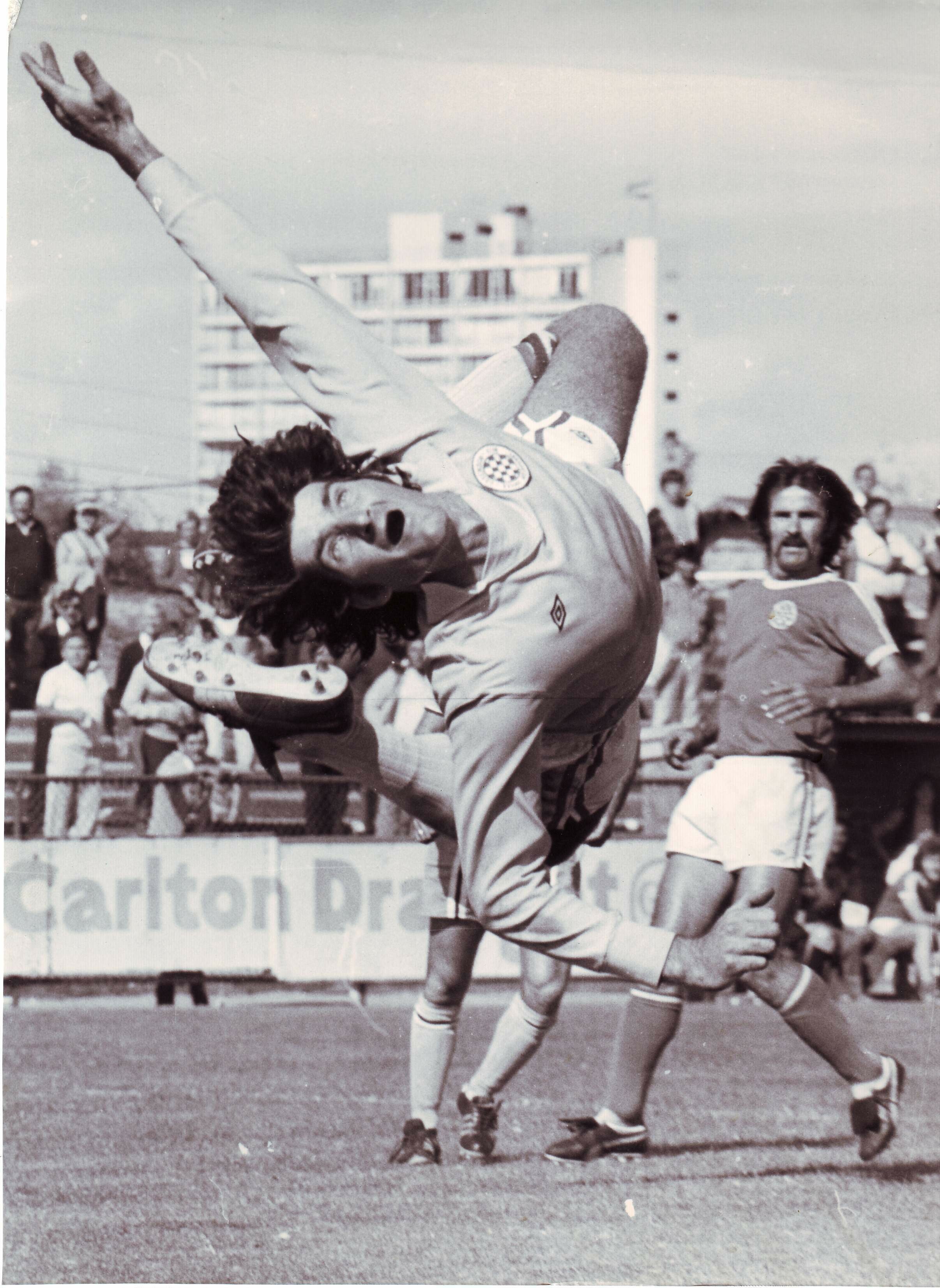
Showing posts with label Kimon Taliadoros. Show all posts

Saturday, 10 September 2022

Shambles to shambles, farce to farce - South Melbourne 1 Green Gully 0

This Federation! This competition! Every week there's something new. In especially good weeks, you may get several bits of nonsense all on top of each other. And if you've been very good, the Victorian soccer farce fairy might even bless you with the gift of multi-farce in grand final week. This week has been one of those glorious occasions - and we still have grand final day itself yet to come. The way the events transpired, Football Victoria comes out looking like an organisation that did not seem to have a Plan A, let alone a Plan B.

I can't help but think this is all South Melbourne's fault. If only we had folded in 2004 like we should have. If only we had not won the 2006 grand final that Oakleigh didn't qualify for, thanks to their legendary choke. If only we hadn't won the 2015 Dockerty Cup final at Lakeside against Oakleigh. If only we hadn't won the 2016 grand final n home turf against Oakleigh. If only we'd smiled and said "please sir, can I have some more" whenever Oakleigh inevitably came for another one of our players, in their vain and ongoing attempt to be us. If only we had sucked just that little more than we have managed to over the past 17 years - not quite as bad as Melbourne Knights, but somewhere in that ballpark - then there wouldn't be an issue at all.

Can you imagine anyone caring about all the things that happened this week, had it been an Oakleigh vs Green Gully final instead? Sure, there might've been some fuss-kicking, but it's probably fair to say that had Gully qualified for the grand final instead of us, the grand final double-header would have been played at Lakeside, Lewis Italiano parachuting into Jack Edwards Reserve onto the corpses of Oakleigh's seven or eight eligible goalkeepers would have been grumbled upon mostly by a handful of Heidelberg fans, and there's no chance that federations and clubs would feel the need (at implied gunpoint, in some cases) posting notices reminding people not to take recourse to abuse on social media.

But we mucked things up making the finals, then by winning the minor premiership, and we especially mucked up last week by defeating Green Gully despite much inconvenience. Within the first 20 minutes, the referee missed (apparently due to an unfortunate angle) Ben Djiba having his leg snapped by a Gully defender. The we had Andy Brennan go off with a groin injury. Twenty minutes gone, and two of five substitutions gone, and two of the three (not including half time window), substitution making slots gone. And yet, somehow despite this - and despite having to take off substitute Josh Wallen early, because had a yellow card, and who'd want to (hypothetically) play with ten men for 50-60 minutes deep into injury time in the event that Wallen got sent off - we got through.

Sure, we were the better team for most of the game, but my goodness was there also some arse involved. Morgan Evans had a solid game replacing Djiba. Alun Webb's outside-of-the-foot winning goal, past a wrong-footed and blindsided Gully goalkeeper, looked magical live, and much less magical on replay. I haven't even dared look at the last ten minutes of the match, where we sat back to hold the lead, and saw one cross after another flash across the face of our six-yard-box. I don't even really want to think about long throws, or no Harrison Sawyer, or as some (including this pseudo-reporter) have put it, getting this far with basically no midfield. I'll say this of this team - one thing it hasn't lacked for all season is heart. Normally that shouldn't be enough to get you this far, but here we are.

You won't die wondering this year. "Swoop the ref" has
 already been crowned South of the Border's chant of the year.
I will not be taking any further questions on this matter.
Photo: Luke Radziminski.

So on Sunday evening, having won our way into our first grand final since 2016, we were faced with the absurd situation that no-one knew where we were going to play the grand final, or when. To be fair, the warning signs were there even in the lead-up to the finals, when media pass holders received an email to apply for grand final access, and there was no detail about when or where the grand final would be played.

Normal people had perhaps assumed that as per the most recent grand finals prior to the Covid cancelled seasons, that'd we end up at AAMI Park. But as the finals series wore on, it appeared less and less likely that would happen. Uncertainty about if/when Melbourne Storm would host an NRL finals match was certainly something to consider. Cost too exorbitant to hire, especially in the event that South didn't make it, especially against an equally marquee opponent? Also sensible to take on board. Where else could they play it? Knights Stadium, with its pitch troubles? Olympic Village, with its lighting troubles? Anywhere else, with its everything else troubles?

It was a surreal moment when post-match some South fans threw out as a suggestion - completely in jest - Caroline Springs George Cross' ground in Plumpton, I mean, it was just a joke. It was also surreal seeing South championship winner, former Football Victoria president, and current Football Victoria CEO Kimon Taliadoros being corralled in our social club by several people, all asking the same question: where is the grand final going to be played? And all he could offer with certainty was "not Lakeside". Which, despite all the rumours going around, seemed to be the most certain detail once we'd qualified for the final. 

That only serves to reinforce the conspiracy theory that our winning the game on Sunday was the worst thing that could've happened to FVs grand final plans. You can almost guarantee that had we lost, the grand final would have been held at Lakeside, and pretty much no-one would have complained. But we had won, and our opponent would be Oakleigh, a long-term grumbler on being made to play cup finals and grand finals against South at Lakeside.

So Lakeside was out. And night fell, and no announcement had been made. And then the next morning, and still no news. Until finally the announcement came. City Vista! With 280 odd seats, limited shelter, and no elevation around the outer. City Vista, with its small car-park and poor public transport connections. 

Some of us have been around long enough to remember the 2013 preliminary final at the neutral SS Anderson Reserve in Port Melbourne, and what a magnificent occasion that was: lines out the door, crap sight-lines, rain pissing down with next to no shelter. Some of us are also able to recall the 2016 grand final at Lakeside, and in particular its shambolic organisation. Limited ticket booths and that slow Ticketmaster printing mess. People not getting in until 20 minutes after kickoff. The outer stand not opening until the second half. Not enough food vendors. The crowd being let in for free because of the gate shambles. 

Some of the people who made the City Vista decision were literally in charge the day they realised too late that they should've opened the other grandstand for the 2016 grand final. Instead of remembering that farce, they decided to play the 2022 grand final in a phone booth. What about the elderly, those with children, those who are unable to stand for long periods of time - hell, what about short people? A venue chosen purportedly in part for its accessibility - unlike some other options, it has four changerooms, which can accommodate both the women's and men's finals - ironically excludes almost every other class of soccer person.

Even as a relatively tall, able-bodied person, I can't say that I would want to watch a match of this importance at a venue like that. Judging by the highlights videos that Essendon Royals made from their away games there, the only elevated part of the non-seated areas is the media tower. And you've also got those big, black benches like Hume City have, which also obstruct views, and those big black fences at each end. 

While things have changed over the past couple of years for me and my sojourning around Melbourne's grounds, I still like to think that I generally make an effort to get to far-flung and below par amenity wise grounds. I think my record on that speaks for itself. And yet, the decision to play this match at City Vista was so insulting, so degrading, I made the choice early on that I would not go. I'd watch the game in the social club, or at a mate's place, or at home. I'd rather not do that - I'd rather be at every game we play, especially this one, supporting our players -  but at some point even I have to think about my own sense of dignity. Others were torn on the matter of whether to attend or boycott, and I had no quibble with that. But it's fair to say that regardless of whether you were planning to go or not, the reaction to the announcement of City Vista as the grand final venue was intense.

What a way to start grand final week. The original
 announcement on Facebook had attracted tons of
mostly negative commentary before the deletions
 started; and then it was locked completely. 
And it wasn't even just South fans having a go. No one loves a crisis (and a whinge) more than Australian soccer fans, but it's been years since I've seen this level of engagement with Football Victoria's social media efforts. Like most social media efforts at this level, most posts enter the world while barely leaving a footprint in the digital engagement snow. Here though, it got to the stage where there were so many people voicing their frustration, that a Facebook post promoting the first local grand final in three years had to lock comments. Just about the only people defending the decision were a couple of George Cross supporters. I feel sorry for the people running the social media for FV. They're the ones being asked to put lipstick on one hell of a pig. This should be the week where they get to do some of their best work; yet they've been relegated to deleting comments to shield an incompetent and unaccountable board from their incomprehensible decision. 

So FV couldn't promote the final. South Melbourne couldn't promote the final. Even Oakleigh weren't promoting the final. This wasn't just because of the backlash, but also because even after having announced the venue and timeslot, and having announced the time that tickets would be available for purchase online, no tickets - not even a link for those tickets - were available at that designated time. 
One hoped that the radio silence was because alternatives were being thrashed out. It's hard to admit when you've got it wrong, especially with everyone hammering you - but there was still time for FV
to fix their mistake. Take the social media outrage on the chin, and just do what was best for the game. Show some leadership. Maybe even make a display of that core value of "openness", and explain how we got here, and how we're going to move forward to a better solution.

Somewhat incredibly, that's (kind of) what happened. 

Football Victoria put out a press release announcing a change of venue for the double header from City Vista to Olympic Village. It even explained that AAMI Park was ruled out due to expense, and that Lakeside was ruled out because it would not be a neutral venue. Fair enough. But surrounding those brief explanations about why two grounds weren't used, there was also some extremely salty prose on why City Vista, and why that was actually still a good decision. And that justification basically comes down to the venue having four changerooms, better accommodating the men's and women's matches, making sure that "the player, officials and sponsor experience would be exceptional."

The fans appeared to have been nowhere in FV's consideration of choosing a venue. What's quite astonishing about that is that it reveals a belief within Football Victoria that they doubt that there'll be much of a crowd to a first NPLMVIC (and even NPLWVIC) grand final day in three years. It's one thing for fans to moan about the state of local soccer crowds but it's quite another for the organising body itself to come out and say that a venue with 280 seats (many of which will have their sight-lines blocked from people standing on the fence line), no meaningful elevation, no shelter, big black benches, and big black fences at each end, would be more than adequate. 

Either that, or Kimon's comment in our social club following the Gully match - that they had no idea where the grand final would be played, except certainly not at Lakeside - was absolutely true, and that they made the City Vista decision on the run. Honestly, I don't know which would be worse - that FV were going to play the grand finals at City Vista all along, and only pretended to not know that in advance; or that they had no plan of what to do in case Lakeside did not present itself as an option, and then had to get their PR crew to write retconned guff about how City Vista was the perfect venue for such an occasions, if only it wasn't for the pesky fans demanding that they be allowed to enjoy the day, too. 

And even though Olympic Village is an improvement, it still could have been better. Pave Jusup, president of Melbourne Knights, noted that his club had offered Knights Stadium to FV weeks in advance of the finals, and that the problematic pitch would have been prepared with due care for the day. The lack of changerooms which apparently ruled out Knights Stadium, with its 4,000 seat covered grandstand, plentiful parking, and elevated terracing, did not rule out Olympic Village. One could gripe about not making the "perfect the enemy of the good (enough)", but the persistence in playing both men's and women's finals on the same day is an obvious part of the problem.

Given that they apparently had no plans about what to do either way, it doesn't make sense as to why FV didn't just choose to play the NPLW grand final on a different day, as a standalone fixture. They've done it before, and it was fine, good even. They could even have played it at the City Vista venue that they apparently think so highly of. That way you could also play the men's 21s grand final - which also includes South - at a venue with only two changerooms, but also one that can accommodate fans in relative comfort. The decision to play the NPLW and NPLM grand finals on the same day at a venue with only two changerooms, also means that there will be incredible delay between the two games. The men's final will now start at 6:30PM on a Sunday. If there's extra time and penalties, with all the post-match awards guff it might not even finish until 10:00PM. People have work the next day. Kids have school the next day. If we win, we can't even celebrate it properly.

As if everything else wasn't farcical enough this week, FV decided to crash a fuel tanker into the flaming rubble of grand final week, by finally making a public announcement of journeyman goalkeeper Lewis Italiano's eligibility to play for Oakleigh. He has been allowed to arrive at Jack Edwards well after any and all transfer windows have closed, but apparently because all of Oakleigh's (four, or six, or eight, or whatever it is) other eligible goalkeepers are not fit enough to play, well they were allowed to sign him. Was Heidelberg allowed the same dispensation for their goalkeeper availability issues? Do the medical certificates all check out that, over Italiano's last three or four weeks at Oakleigh, not one of the other keepers has come good?

I really want to see the hospital records, or the death certificates, whichever may be relevant. I want to know which of Oakleigh's keepers is in hospital due to gigantism caused by abuse of brain and nerve tonic. I want to know which Oakleigh keeper is lying on the barroom floor having come off second best in an argument about who was England's greatest prime minister. And I certainly want to know which Oakleigh keeper Chris Taylor sacked, because said keeper wouldn't shave off his sideburns.

Such antics are not without precedent in Victorian soccer, and yes, there are rules which make allowances for replacing keepers. Your correspondent recalls late in the 2012 season, when Bentleigh Greens lost their on-loan keeper Lawrence Thomas back to Melbourne Victory with three games left in that home and away season. Thomas was replaced by Griffin McMaster, who up until that point of 2012 had been busy playing in a hopeless Moreland Zebras side. McMaster came in for Thomas, was part of a team that scraped into the finals (at our expense), and got knocked out against an Oakleigh side who featured some bloke called Lewis Italiano; that Oakleigh side went on to lose the grand final to the rocket flare powered Dandenong Thunder side coached by Chris Taylor. 

Which just goes to show how pathetically small Victorian soccer is, and that we need more Queenslanders just to open up the family tree which seemingly more resembles a stump. And yes, Oakleigh also have a bloke who played in a championship with us eight years ago (and against in our loss in 2015), and another bloke who played in a championship with us six years years ago. 

Anyway, history lessons aside, there's now a venue and a time, and those of who can go, should. But my goodness, I am expecting the worst. Not just on field, where I expect our luck/charm/whatever to come wanting, but off it, too. Kimon Taliadoros has already copped it online, but so has FV president Antonella Care - who just so happens to be the spouse of one Aki Ionnas; the long time and well known - and already not very much loved among South fans - power-broker of Oakleigh, whose management of that club over the past 17 years has had more than the whiff of trying to become a pseudo-South Melbourne.

You can imagine the commentary that's come out, both level-headed and otherwise, trying to draw connections between Oakleigh being in the grand final and not wanting to play at Lakeside, and getting their wish; by being able to sign a replacement goalkeeper, when another club could not. Just about the only thing that they haven't got is a changing of the date away from tomorrow, which would allow them more rest before (or after) their upcoming FFA Cup semi-final. I imagine that vitriol tomorrow will be much worse which, from a purely angry perspective, I understand. What I don't hope to see is the clu  getting punished because things go too far, especially of things are going badly for us.

I guess the best that I can hope for is that nothing said or chanted tomorrow crosses the lines of targeting someone based on protected category (race, gender, etc). I already expect for any all FV officials to cop a worse reception than Tony Labbozetta did after the 2001 NSL grand final. Maybe the aim tomorrow should be for sarcasm? Instead of chanting "fuck the FFV", how about "we love the FFV"? They couldn't do much against something like that. 

Anyway, all this, and the grand final to come tomorrow.

Awards
Somewhat lost in the kerfuffle over the venue, South picked up a few awards at the Gold Medal night on Monday. Our media team won some kind of award. South fan and photographer Luke Radziminski won the Les Shorrock award for best photo. Harrison Sawyer was officially awarded the golden boot, and finished just one vote behind the two joint winners of the Gold Medal; one naturally wonders what would have happened if he'd closed out the home and away season with us, instead of heading to India.

Our biggest win on the night - and really no surprise - was Javier Diaz Lopez winning the goalkeeper of the year award. That sees Javier join Dean Anastasiadis (2005, 2006), Peter Zois (2010), and Peter Gavalas (2013) as state level goalkeeper of the year prizewinners. 

Final thought
Only just figured out this week that my new job is basically Dodgy Asian Betting commentary, but in a courtroom.

Tuesday, 22 August 2017

Some thoughts on Joe Gorman's 'The Death and Life of Australian Soccer'

The book is out now, and is widely available at chain
  and independent booksellers. It's also available as an
 ebook. The paperback retails at about $32 in stores
Warning: this piece contains some minor spoilers. Also, it's not really a review, more of a very ragged meandering through the book's themes and other stuff, partly because I can't hold together a coherent narrative to save myself, but also because I was told (probably rightly) that I couldn't really review a book I was in. Also I've been writing this while holed up at home because I've been sick.

Before I begin there are two clarifications that I need to make about this review. The first of these is for those of you who have not read yet the book, to keep in mind that your reviewer and an element of his writings and ideology is a part of this book, used as a vehicle for explaining Gorman’s thesis. The second point is that I have read this book before; not only in the discussions over several years with Joe which have helped inform and influence it – though to be absolutely clear, what is presented here is very much Gorman’s own argument, based on his own thorough research – but especially its draft form which was a little longer but otherwise near enough to the finished product.

The point of that preface is to say the following: I admit that I was almost in tears reading what would become this book the first time around, and having read it in its completed form now, I grieve again for what has been lost so far and for what will likely be lost soon enough. I also felt that it would upset people, especially on our side of the bitter/new dawn ledger, because unlike in his journalism Gorman does not go out of his way to appease our sensitivities especially regarding our future prosperity and relevance. As for the people on the new dawn side, if they get upset at anything in this book, they always have the comfort of being able to revel in Australian soccer now being designed in their image.

For whatever optimism a follower of one of the 'old' clubs might hope to elicit from this book, it is quickly dashed by its opening gambit. Yes, the book’s title tells us this will be the case. Yes, we know the National Soccer League is already doomed, having seen it die (or be murdered) first-hand. But the opening section, in illustrating the before and after of Marconi’s rise and fall in as stark a form as possible – the classic documentarian’s technique of juxtaposing images of a paradise turned into a ruin – there is no getting away from the pall which will only darken over the course of The Death and Life of Australian Soccer’s 375 pages.

The book covers much more than the NSL, by looking at what came both before and after it. Rather than seeking to confine itself to the 27 year window of the NSL in isolation, the book seeks to tackle much bigger fish. Gorman’s main questions are the perennial ones. First, how did ‘ethnic’ become a dirty word in Australian soccer? Second, why has Australian soccer internalised its hatred of ethnicity in this way? These are the nagging questions for both soccer and Australian society at large. They are important for what happened after 2004 in Australian soccer, and the rhetoric put out that the 'problem' of ethnicity was meant to have been solved once and for all. For Australian society at large, the question is at what point should the rights of migrant communities (especially non-English speaking ones) to have self-determination and control of their own affairs be curtailed.

Though ethnicity has been the perennial question in Australian soccer, and by extension in academic analyses of the game, in recent times new ideas have been pushed toward the middle (especially by Roy Hay) about how the structural flaws of the game's governance were as important as ethnicity to the game's historical woes, and that these structural flaws are an under-appreciated element of the Australian soccer story. Gorman’s book then tilts the scales back to the ethnic question, but in a more sophisticated way than has often been done before. Previous discussions have often been superficial, couched in terms of the self-interested politics of the game itself. Gorman seeks to address the matter of ethnicity as it manifests in Australian public culture independent of soccer, at the same time as it becomes a dirty word within soccer.

We arrive then at the core problem of ethnicity and how Australian society should be organised. Should different ethnic communities be allowed a measure of self-determination, or should they be expected to assimilate? If it is the former, how much freedom should they be allowed? Can they have a presence in national affairs in a scheme and style which does not acknowledge the assumed cultural, economic, and political centrality of Anglo-Celtic Australians, and perhaps even seeks to challenge that dominance? In no other sphere of Australian life has the dominance of Anglo-Celtic culture been challenged in quite the same way as it has been in Australian soccer thanks to its often unrepentant ‘ethnic’ quality. For a game already considered to be foreign to Australia, the ethnic takeover of the game – within the governing bodies, but especially in just sheer numbers on the hills and terraces – doomed the sport to a unique kind of obscurity, one where it was simultaneously popular among its constituent communities and yet invisible to mainstream Australia.

(And in that regard, I am only interested in discussing Australian soccer from after 1945, and if Ian Syson wants his pre-1945 stuff to be included in this debate he should hurry up and publish his book on the matter.)

There is no way Australian soccer can fight back from this position under an overtly ethnic format: not in its early 1960s glory days, not by the late 1970s when the NSL was formed out of fear, not hope, and certainly not through the withering and erratic decline of the 1980s and 1990s. While the formation of ethnic soccer clubs could have been seen as migrants making a commitment to Australia in a different way, instead it was seen as an anti-Australian maneuver. This is an understandable view to take from people outside the game, but the problem was that people within the game also saw it this way.

In some respects this story can only be told by an Anglo who was not a follower of the NSL. Everyone else is too close, and likely being ‘ethnic’, only able to see the issue from the inside. Gorman’s point in the early part of the book that he and his dad, otherwise committed soccer people, only went to one NSL game is the perfect (or near enough to perfect) vehicle for exploring this issue. It presents a change from Gorman’s usual work in his journalism on soccer. There he was obliged to obliterate or obscure himself as a narrator in the great journalistic tradition, giving off the vibe of neutrality and getting his politics across by choosing which quotes to use and from whom. That gave Gorman an always plausible get-out clause should any interview subject say anything particularly egregious or objectionable or outright insane – an unusually plausible possibility in Australian soccer. Here instead we have a reassertion of Gorman’s own character, playing the role of the de facto Anglo representative.

Goodness knows that putting it like that reveals the situation's deep seated problems of anthropological neutrality, but I've never done any undergrad sociology units, and the sociology books (both pro and anti sociology) I've scavenged over the years have mostly remained on my shelves.

What balances out Gorman's Anglo-outsider perspective more than anything is his framing much of the early analysis through the experience of Andrew Dettre, a man more or less the opposite of Gorman. Where Gorman is young, Anglo and situated firmly in the role of a journalist, Dettre is (by the end) very experienced, foreign-born, and not merely a journalist but also an activist. It is an activism not limited to soccer either; Dettre had grand schemes for Australian society as a whole, and a hope that soccer could be a vehicle for driving that social change. This is an important aspect of the work. Dettre had grand and sometimes contradictory ideas about soccer, but these were tied to grander ideas about what the nation could be. They reflected his own political feelings but also his experience as a refugee and migrant. This intellectual outpouring spanned several decades, pseudonyms, publications, and literary styles. Much as Gorman would wish he could write a biography of Dettre’s incredible life, such a book would never sell. Setting a quasi-biography of Dettre within a biography of Australian soccer therefore makes sense.

But as unique as Dettre is as an Australian soccer intellectual, he did not emerge or write from within a cultural vacuum. One of the things Gorman does here is rescue the Hungarians and their contribution as a collective to Australian soccer from under the weight of the more visible Italians, Croatians and Greeks. (It also takes, or rather I hope it will take, at least some of the heat off those latter groups who often get the entire blame for the failure of the NSL and the 'holding back' of Australian soccer). The Hungarians differ from many of their more well-known rival and contemporary ethnic groups. Their immigration numbers were smaller and centred on two very short bursts of migration. They were also more likely to have been educated, less prone to forming ghettoes, and through St George Budapest, made the sincerest attempts of all the ethnic clubs to broaden their fan base.

But even though they provide much of the intellectual and conceptual heft for soccer and the NSL to move forward, Dettre is not exactly like the other Hungarians. His intellectualism crosses over into an elitism that creates a distance between himself and his audience, including other journalists. The broadness of his thinking, the depth of his feeling, and the scope of his ambition is at times overwhelming. The social marginalisation of soccer further curtails his ability to transform Australian society, and it is no great accident that he has his greatest (albeit qualified) successes when he works for the Whitlam government.

There may be those while reading this book who will attempt to trace what effect if any that Gorman's reading of Dettre's work and speaking with the man himself has had on this book. Gorman may think otherwise, but I don’t see much if any stylistic influence resembling Dettre’s in Gorman’s work. That is unavoidable in a sense, not just for the length and dedication of Dettre’s career to this cause, his intellectualism, and Dettre’s learning English as a second language; but it is also because Dettre was never only looking back but also always looking forward. When Dettre ceases looking forward with any optimism, it effectively marks the end of his involvement with the game. To that end the most visible influence Dettre has on Gorman is in declaring an end to things. In the 1980s Dettre writes obituaries for the game, for the soccer press, and for the hope that ethnicity and soccer might create a pluralist Australia. Here, Gorman writes the obituary to end all obituaries, seeing a sort of end of Australian soccer history. What else is there to write about in Australian soccer, especially in terms of the present anodyne, Anglicised arrangement?

As the book comes to a close, Gorman becomes outwardly sentimental. Not that he has treated everything that has come before as simply a matter of facts, but there is a further disintegration in the veneer of objectivity. Among the tragedies for Gorman is that individuals initially left behind by new football could be reintegrated into the new world, but not the cultural and organising structures that created those individuals. This affects not only those who were affiliated with those past structures, but also those who currently belong to groups which resemble in their self-organisation – mostly accidentally – the structures of the past. If Gorman writes an elegiac 'end of history' for ethnic soccer in Australia, knowing that the Anglo establishment and those who have joined them have quashed any hope for even a minor revival from new migrant communities, he does not fall far from Dettre's late era manifesto.

But it is worth remembering that many of those who ran and followed the ethnic clubs were in some important ways not so different from their mainstream Australian sporting counterparts, in that they were bound to a safe and conformist conservatism, something which must have frustrated Dettre immensely. Because for all the praise (if that's the right word) you can give to the NSL for its diversity compared to other sports, for large periods of time the NSL itself was at best only a narrow multicultural experiment, limited mostly to clubs formed by migrants from central and southern Europe. While on the field it had a truly global diversity, off the field it had limited interest to people not directly connected to the scene. While there were enough people from those constituent ethnic communities to sustain them, this was not an issue; but soon enough those communities started drifting away.

In time the greatest betrayal of the ethnic clubs, if one can use such a provocative term, comes not from their own or the governing bodies' incompetences, nor the disinterest of the general public who had no obligation to follow them, but from those younger supporters who turned their back on their fathers’ clubs. It is a provocative assertion, and I do not believe Gorman is making it as strongly as I am, but there is more than the suggestion that without the intervention of ethnics inside the game towards change, things may not have ended up in the direction they did. The sons of the immigrants left the old edifice to die, either by leaving the game completely or joining in the new world.

This is the most profound demographic shift of them all, and it is my assertion based upon reading this book that it is more important than the hordes of juniors and their parents, the midweek indoor and futsal players, and the silent majority who even now show no interest in local top-flight soccer, preferring instead late nights and highlights packages from overseas leagues. For all the failure of the ethnic clubs to tap into new audiences - including the spectacular failure of St George, who tried harder than anyone to branch outwards - the inability of the ethnic clubs to hold on to their core support is what ultimately dooms them; growth for most of them is non-existent, and even for the best of them only incremental.

Gorman doesn't put all the blame for this on the ethnic clubs - there is much in Australian soccer and Australian society that they cannot control, and the self-loathing of those governing the game also drives people away - but nevertheless the crowd numbers speak for themselves. Without the ethnic communities growing out of their clubs and the ethnic scene, without those supporters jumping across to new broadbased franchises or moving towards mainstream Australian sports (or leaving the game entirely), it would not have been so easy to dislodge the pre-eminence of the ethnic clubs. The desire of soccer to mainstream itself was tied to the desire of migrants to mainstream themselves, a funny thing in itself considering persistent political and media fearmongering about ethnic ghettoes.

(As an aside, one observance and one unrequited desire. The observance is that perhaps summer soccer was the greatest mistake ever made by Australian soccer authorities, because whereas when the various football seasons overlapped people were forced to choose which one they would attend, when there was no overlap it became easy to have one's cake and eat it too. The unrequited desire is for someone to write a book on the cultural history of Saturday morning foreign language schools, which would include reference to being hotbeds of street soccer.)

The arrival of Perth Glory showed what was possible in a previously unrepresented market; Adelaide United cemented the idea, because it sprouted from the topflight corpse of Adelaide City Juventus; Melbourne Victory colonised its market in a way no other team has; and Western Sydney Wanderers finished off the job, bringing Australian soccer's migrant heartland over en masse to the A-League. Some would interpret this as evidence of the migrant soccer fans evolving to the next stage of becoming Australians, but it can also be interpreted as them assimilating and subsuming their differences into a larger amorphous whole.

It also does not take into full account those examples where broadbased clubs fail, with my thoughts on this usually going toward Brisbane Strikers. Some of the blame is put onto the notion that it was wrong to expect a league with any ethnic representation to succeed, the comparison being made by Lou Sticca of the ethnic clubs being dirty water that only serves to pollute the clean water of the broadbased clubs. I guess he only came up with this analogy after the clean water of broadbased Carlton SC got dirtied by its association with the dirty water of the footy club. But if there's one thing which comes through, is that as rubbish as the management of most of the clubs ethnic and non-ethnic was in the NSL, it was the ethnic ones which survived and still survive, whereas most of the non-ethnic ones carked it quick smart.

Oh Joe, why not something about Morwell Falcons? There's so many nooks and crannies to discover about Australian soccer, and you talk about Australian soccer moving away from a democratic and meritocratic paradigm, but the Falcons only get passing mention in your book! They came from a town of fewer than 20,000, built a nice boutique stadium and social club, earning their way through the league system while other people - you know who you are - were and still are banging on about some dump called Geelong and when it will get its act together. But I digress.

Then there is the intervention of the players. Many of them were born and raised within the ethnic club system at the game’s most prestigious clubs, and thus they understand intimately the cultural framework of the game. The players become militant after being exploited for too long, and quickly become the best organised, the most professional, and the most ideologically consistent faction in Australian soccer. If there is an argument to be made about structure predominating over ethnicity as a means of examining the fortunes of Australian soccer, it is via the players becoming a new force which disrupts the decades long tug of war between the governing bodies and clubs.

There are plenty of moments in this book which will generate debate. Among them is Gorman’s belief of the sheer folly of promotion and relegation and a second division, asserting them to be anathema to Australian sporting culture. Gorman also says, more or less, that promotion-relegation cannot happen because the A-League was not just an attempt to make a successful sporting competition, but about overturning an entire system of being. Gorman argues that before the A-League was even formed that it existed as a ‘state of mind’, with the idea being that it would transcend, but not reflect Australian soccer; that all the rough edges would be smoothed out, and that the game would be gentrified. For a sport which had spent so long not doing what it was told, this is the ultimate victory or betrayal depending on which side of the side of the debate you come from.

And has not South of the Border talked about the wilful embourgeoisement of the game in Australia? Some of it has been done on an individual level (fees, extra coaching, making little Johnny/Johnette feel special), and some of it has been done on a macro level, for example moving to modern stadiums that the teams cannot afford but which look good. And always linked to that, the attempt to shed any links to the past, including the self-loathing of soccer governing bodies' past and present and their revulsion of being linked with SBS. Not that SBS is an ideal commercial partner for any sport except those like the Tour de France, but much of the commercial limitations come from them being associated with ethnicity and the game's past by sponsors, the 'mainstream' and worst of all, Australian soccer fans.

Under such a framework, finances and commercial viability are almost of secondary concern. Those arguing for promotion and relegation have to not only successfully argue that the idea stacks up financially, they also have to argue convincingly that the current system as it has been set up can and must be overthrown, and that soccer need not follow what the other Australian sports do. Considering how hard so many people have worked to make Australian soccer as much like the other 'traditional' Australian sports as possible, this will be no mean feat. It would be, as Gorman argues here, a case of soccer returning to its old guise of trying to change Australian culture instead of fitting in.

Another lesson to be learnt is that soccer in Australia expects the momentum of goodwill to sustain it, and when it does not, it starts acting reactively. Bursts of interest due to World Cup qualification (now considered a fait accompli process rather than a do-or-die event) or cream of the crop touring teams disguise longer bouts of stagnation. Spurts of heightened interest and engagement do not have the same value as consistency of interest, the kind which sustains the two major codes of football. And while the NSL was certainly not immune to acting haphazardly to its rotting stagnation, neither is the A-League and the current FFA regime safe from its own inability to truly entrench itself among the likes of the NRL or AFL, as opposed to transient competitions like the NBL or Super Rugby, whose teams have little to no local connection and no consistency of feeling, and more precipitously, no communal corporeality. Gorman raises doubts about the meanings of many of the current A-League franchises, implying a soft underbelly which would not be able to survive truly testing times.

I have long argued however that this vagueness can actually be a strength and an appealing quality for many. There is just enough clarity about who these A-League franchises are – usually the team from ‘here’ – and more than enough ambiguity so that ideological and emotional connections are free to be construed in any which way different supporters like. People are free to adopt a level of commitment that for the most part is theirs and theirs alone, and not dependent on a greater whole. And while one could point out the fact that should these entities run into trouble that they would cease existing rather than carry on in a lower league, even though the ethnic clubs have often continued, for most people who care to think about these things they too have stopped existing. 

Gorman is right to suggest that the ability to decide for oneself how committed one is to a cause means that at any moment one may simply choose not to be as committed. A book such as this by its nature is interested in those who are engaged with the game in ways aside from its recreational aspects. Thus you have among the many players, administrators and journalists people like the statistician Andrew Howe, and the late zine editor and agitator Kevin Christopher, whose presence also plays at adding colour to the Anglo spectrum. But it is missing the great mass of people, the silent majority, those who make home economics style decisions - insofar as their decision making is based around the allocation of their limited leisure time and money - about how they will follow the game. While those people are essential to the success of any mass sporting entertainment product, those people do not spend an inordinate amount of time obsessing about what Gorman has long considered the most niche of topics in Australian soccer, discussions which take place in equally niche environments: the abandoned terraces of state league clubs, and the dank corners of #sokkahtwitter. 

Me having lunch with Joe Gorman somewhere in Ballarat earlier this year
 One of the things which will probably go unremarked about this book is
 Joe's use of literary depictions of Australian soccer. While I can't take credit
 for anything else which appears in this book (except the bits where I get
quoted or paraphrased, which is mostly stuff from here anyway) I will
take credit for introducing Joe to that literary material. Even better though
was Joe using other stuff that he found in Soccer World, including
work by Dettre, former Socceroo Ray Richards, and children's writer
David Bateson. I do hope it prompts people to read that kind of work,
especially David Martin's The Young Wife. Photo: Ian Syson.
So while I may have some qualms about my portrayal in this book, leaning as it does towards an almost untenable miserableness, I can nevertheless understand my being included in this book. Gorman’s interest lies in two types of people; those who were involved with running the game, whether they felt something for it or not; and more importantly, those who have thought and written deeply about the game, whose emotional devotion is much harder to question. But I am wary of being depicted as a victim; partly because if indeed I am a victim, I am not the only one.

In that sense my inclusion in this narrative is validation of two things; that I have thought deeply about the game and written about it in that way; and that I have felt deeply about the game, and that whether I am right or wrong on the matters which I discuss, there is a purity to whatever agenda I may have. That purity of feeling is not exclusive to me though. Still, seeing yourself in print in any format, let alone what is likely to be praised as a landmark book on Australian soccer history, is enough to make one feel a little anxious. It is an anxiety based not just around what strangers will think of you, but also what those who know you will think of you. In my case, the worry is that I will be interpreted (through no fault of Joe's, really) as being the definitive voice of old soccer in its current guise.

The bit where I come into the book has largely gone
unremarked upon so far, except for a friendly bit of
banter relating to my resembling one of those guys who
 loses interest in a band he likes when the band becomes too
 popular. Without arguing too vociferously against such
 a portrayal, because there's probably some latent truth to
it, it did remind me of a bit in Simon Price's biography of
the Manic Street Preachers. When the Manics break through
commercially with their fourth album Everything Must Go,
 
their concerts start attracting boorish Oasis and Britpop

listening types in addition to their then loyal and very
alternative audience. Basically the two types can't stand
each other, and eventually the feather boa wearing, zine
writing original fans, who had supported the band through
 thick and thin up to that point, start drifting away.
It's a great book by the way, I highly recommend it.
Lest anyone get ahead of themselves on that front, I have made it clear on many occasions here and elsewhere that I have never sought to claim such a mantle, and that South of the Border has always been about offering a place for any South fan to put pen (or cursor) to paper (or screen). That South of the Border has had limited success in that is beside the point - we have published a diversity of voices, including non-South voices - and have attempted to solicit contributions from the South public, mostly to little avail. So it goes.

Problematic then for me within this analysis is that amid Gorman’s gentle evisceration of Anglo-Celtic Australians (especially those of a pro-multicultural bent) for their refusal to engage with ethnic soccer, the absence of the British migrant is perplexing. It is all the more confusing because of oblique references made to the Englishness of Perth Glory’s Shed – the acceptable kind of ethnicity for many of those in Australian soccer who otherwise wanted to purge ethnicity – as well as noting the flood of British players who were involved in the early parts of the NSL. But British migrants and especially the English, whose numbers collectively outnumbered every other migrant group combined after the war, are otherwise nowhere to be seen.

Likewise those people who ran the clubs and especially those first generation migrants who followed those clubs are also greatly under-represented. Indeed one of my fellow South Melbourne supporters noted upon purchasing the book that I was in the index far more than long time South Melbourne Hellas president George Vasilopoulos. Though it fits in with the way Gorman has decided to tackle his subject, it feels like a massive lacuna that will never be filled. Players, younger supporters, journalists, administrators are all there, as are those who went on to found the ‘broadbased’ clubs during the NSL, but not those who were there at the beginning of the ethnic soccer club phenomenon. Some of these guys are dead, and I suppose that's a reasonable enough excuse. 

But there are still guys who are alive and kicking who probably should have been included in this. For a book that was going to end up with narrative and thematic gaps no matter how much was included, this is a major omission. Ironically, this fits in with Gorman's thesis of the Anglo rejection of non-Anglo culture, in that non-English language news sources and interview subjects are mostly absent from the book. One can't blame that on the author's monolingualism, because one would need reading proficiency in several languages to get across the thousands of column inches; either that, or a well paid research team to sift through the ethnic papers of record.

There are unavoidable issues in the book, based around treating each state and region fairly, the experience of Indigenous Australians, and the story of women’s participation, or just as often, non-participation. As much as there is an ethnic vs non-ethnic issue which dominates our thinking on Australian soccer’s past, there is also a state vs state issue; the experience of the game varies so much between regions, and it is difficult if not impossible for people to feel they have a shared connection. Some of the sojourns Gorman takes to cover this stuff works well – I am thinking here in particular of the Queensland State League section – but others seem occasionally to be tacked on, or not to fit exactly, as if Gorman is trying to cram in as many things as possible. 

To an extent Gorman agrees with this, arguing early on that there is no possibility of writing a point-to-point history of Australian soccer, and he does well to include as many parts of the national soccer experience as he does; but one cannot help but feel that there were times when some states or regions or experiences which were not covered in depth or at all. And since most of the NSL was based around Melbourne and Sydney, it makes sense if more time is spent there.

Even though they are of value and worth including, the parts dealing with women's soccer can only hope to provide a taste of that experience. This is frustrating, because women's soccer, like other women's sports both in Australia and overseas, deals with many of the same issues of assimilation and self-determination; should women's sport work with or separately to men's sport? Does women's sport lose the chance to forge its own identity if its proximity is too close to men's sport? These are questions however for another writer to confront more fully.

The book is as much about what came before and what happened after as it is about what happened during. Therefore it scoots along at some points, while being more detailed in others. There are lacunas which will frustrate people, especially those who feel that their experience or their region is not covered in enough depth. Some people will want more of the specific car crash details of bad soccer governance and outrageous incidents, but the risk is that those will be seen as the main point of the story with the bigger issue of soccer's cultural positioning being lost. Focusing too much on these risks turning any analysis of Australian soccer into a freak show, which is fine for idle internet banter but less suitable for a serious book of history.

Of course the book could be twice as long, even more formidably detailed, and better for it in my opinion. But there is also the advice Stephen Hawking's editor gave him prior to publishing his bestselling A Brief History of Time: namely, that for every equation Hawking would put in, the potential audience would be halved. Thus a book written this way is also more accessible, written not only for the initiated and already interested, but for those for whom the NSL and the world which sustained it mean little more than folklore.

Dealing largely with documentary evidence and interviews, the book does not engage much with academic debates. It helps with the book's accessibility, but there were moments when an engagement with other books, such as Ross Solly's imperfect but important Shoot Out would have been welcome, if for no other reason than more explicitly tracing different political party relationships to the game; from Dettre and Whitlam's progressivism, to the NSW Labor Right faction's ethnic bloc backing Tony Labbozzetta (which vanishes when ethnic clubs need the most support), to the Liberals changing the game and its ethnic character into something more like their own ideal of the national character.

But the book does most things very well. It nails soccer's contradictory nature; its tendency for being both ahead of the curve (Dettre/St George/Canberra City/Newcastle KB) but also behind the curve (pretty much everyone in the game at some point). It gets that the conflict of sport has never been just business, especially not in Australian soccer, whose raison d'être was one of primarily self-proclamation and actualisation. It gets the conservatism of the ethnic clubs, and their reluctance to cede the one major bit of power and cultural influence they have in Australian culture, but mostly their desire to be left alone.

Its selection of quotes is very good, from Mark Rudan’s 'it was their job to fit in with us'; the description of David Hill as being to the right of Genghis Khan; the lead up to the 1997 grand final being like 'the wogs against Brisbane'; and Jesse Fink's denouncement of Ange Postecoglou when the latter became Brisbane Roar coach as offering nothing because Postecoglou is 'old soccer'. But even within the structure of the book, there will be quibbles about who was interviewed and why, and I think many of those quibbles could be justified. Remo Nogarotto gets much more time than Tony Labbozzetta. Kimon Taliadoros gets interviewed in his guise as the vanguard for the establishment of the player union movement, but he does not get asked about his later time as South Melbourne general manager, which would have yielded interesting information about South's late struggles to move between its past and an uncertain future. There is almost no mention of Tony Ising, which whether you consider him one of the great prophets or the most unnecessarily bitter man in Australian soccer, seems like a large oversight.

The early reviews have been positive about the book, albeit largely thin on detail. Australia’s most noteworthy soccer historian, Roy Hay, writing his first impression of the book has largely lauded it, with his necessary caveat about the lack of emphasis on the organising structures put in place in the early 1960s. Others have focused on Gorman’s belief that the idea of promotion-relegation and second division is folly, and that there are lessons to be learned from the NSL’s haphazard attempt to implement the former. Adam Howard has gone into much greater depth on that particular matter, arguing the point that while history can provide a guide and a warning, on this matter Gorman has misappropriated the details for his own defeatist narrative.

My stance being well enough known on the promotion/relegation issue, it is not for me to continue a debate I have little interest in, preferring to let that run its own course. But Howard's point about Gorman's apparent defeatist tone is worth picking up on. Because of its sense of finality, and its desire to declare a definitive end to the past, this book leaves the reader without any sense of how things might change for Australian soccer in the future. The history of Australian soccer has been one of constant upheaval, and yet there is an assumption made in this book that that process has ended, at least in ways that we are familiar with.

Recent events in the form of wrangling for control over the game and its future direction have shown us this is not quite the case; and while I do not think that the ethnic clubs are or could be the main drivers of any future change, to present them as likely having no meaningful future is too forceful of an assertion. But that is also very much a personal take, as I would like to think there is hope, however outrageous that hope may seem, and that our resilience in the face of all obstacles could one day yield a new direction. Maybe Gorman refuses to speculate for the sake of speculation, but the lack of optimism in the book rather than creating an empathy (the feeling that we are suffering together) for soccer migrants old and new will likely only engender a hopeless sense of sympathy (feeling bad for someone's plight, but not feeling that their burden is yours as well) .

It is the kind of thing which makes me wonder who is going to read this book, and what wider impact it will have. After all, how many reviewed and discussed the Hay/Murray magnum opus? The discussion on matters of books and history among the soccer community seems intermittent at best, and for the most part these discussions are reflective rather than inspiring a call to arms. It is unfair to demand something else from Gorman here, because while he is at pains to not try and diminish the ongoing survival of the old clubs, he cannot lie and say that they have a thriving existence. The dwindling few followers of the 'prominent' ex-NSL clubs who will read this book will be able to change little about the situation.

To be clear, no one doubts the sincerity of their - our - passion; after all, it takes a certain kind of moral hard-headedness to keep following a state league club in the way that we do. In the epilogue in particular, which finishes with a rewriting of a blog post I made - a post that I know back then struck Gorman as extraordinarily poignant - there is little hope. For those with the intestinal fortitude to keep following the old clubs, that moral certainty is also matched up with what is also a rare sense of duty. While I tend to think in the book Gorman’s tone is more realist than defeatist, those two adjectives when deployed in the way they have been here are not so far from each other. The fields have been sown with salt. There will be people who will rail against that view, possibly ignoring the argument’s nuances, but Gorman is at pains to point out the violent excision of one of Australian soccer's core attributes, its ability to harbour new migrants who bring their numbers, playing talent and novel organisational attributes. Neither is there any hope that another Dettre could emerge. From which community? From which medium? To say what, exactly, and to whom? It is remarkable that an Andrew Dettre even existed in the first place.

Those picking up the book who never experienced the NSL or ethnic soccer in full flight might better understand how we got to now, but soon enough they will probably be back at the A-League, that competition dreamt up not just to rehabilitate soccer in a benign sense, but to cleanse it. If the idea of ‘cleansing’ has potentially volatile and incendiary overtones – especially within an Australian soccer context! - it is hard to argue that this is not what has happened. Damnatio memoriae it may not be, but it is as close as we can get.

My chief concern with the book then is not with its content, which I broadly agree with and which I think has been written very well. Rather it is with what will follow it? Will people merely praise the book, cherry pick certain sections out of it, and then discard its lessons and deeper message about using soccer as a means of understanding Australian society? After all, while it is a book about Australian soccer it is also a book about ‘us’ as a nation. Gorman throws down the challenge to the current generation of soft-headed multiculturalists, but will they engage with this book in the way I believe they should?


The Death and Life of Australian Soccer is not a hagiography of the NSL or ethnic soccer. For those hoping for a celebratory tome about the NSL, its great matches, players and clubs, this is not that book. Gorman writes that he hopes that in time those stories will be written – but in the meantime he emphasises that something has been lost, and there is some empathy in that emphasis. It is hard to pin down what exactly may have been lost – perhaps it is the large scale generosity of spirit from the true believers, those who literally built their clubs from scratch, not dependent on wealthy benefactors; perhaps it is the chance for a different Australia to be promoted. If Gorman is not exactly channelling the grief of those left behind, he is at least channelling Dettre's disappointment.

Monday, 20 February 2017

Everything in its right place - some overdue thoughts on the Ferenc Puskas statue

Ferenc Puskas bust at Real Madrid
training ground, Valdebabas, Spain.
Here is another post which would have been better off shorter and presented in a more timely fashion. So it goes.

Some of the photos of the various statues on this page were sourced from 'From Ptich to Plinth: The Sporting Statues Project', a quite interesting website with a fair bit of academic content as well. 

In retrospect, it made a lot of sense to walk from Flinders Street Station to Gosch’s Paddock along the Yarra. Yes, I had gotten into the city too early for the scheduled start of the unveiling of the Ferenc Puskas statue, but it was a nice day for that walk anyway, along the shaded path, just before it got too hot.

Along the way, I came across a broad spectrum of Melburnians. There were those making their way up to the tennis centre for the Davis Cup doubles tie; tourists; joggers; cyclists at various points along the Lycra-wearing spectrum; families out for a stroll; rowers on the river.

Statue of Collingwood champion Bob Rose, outside
Collingwood's Holden Centre headquarters.
Coming up to the revamped and renamed Glasshouse, now occupied by the Collingwood Football Club and re-named the 'Holden Centre', I saw the statue of Collingwood champion Bob Rose, captured in mid-baulk, and thought about how far away he was from home, both geographically and chronologically. How much would he recognise of what Collingwood had become? Would he wonder why his statue was not at Victoria Park, the scene of his greatest triumphs?

I then walked past Olympic Park, or what remains of it after Collingwood’s annexation of the stadium. This is where Puskas’ crowning achievement during his involvement in Australian soccer took place, the onetime de facto – and democratic – home of Victorian soccer. It had hosted Socceroo matches, National Soccer League matches and Victorian finals ranging from top-tier and Dockerty Cup deciders to amateur cup finals. Of course you would not know that if you looked at it now, but some peoples' histories are more important than others.

Statue of John Landy helping up Ron Clarke,outside what was once
Olympic Park.
Then it was past the statue of John Landy helping up Ron Clarke, which at least provided a sign of athletics’ past at the venue. At this point I was joined by an older, grey-haired gentleman wearing a suit - a bit too for me much considering how hot it had already become - complete with an embroidered Melbourne Victory jacket. We pooled our efforts into trying to find where the Puskas statue was meant to be unveiled. I never caught the man's name, and he didn't learn mine, even though he had attempted to tell me about his connection to Puskas.

We then went past the Bubbledome where keen Bruce Springsteen fans had already camped out hours before the gates were due to open for The Boss' concert. My grey-haired companion then saw some people he knew exiting the car park, and I left him to it. I proceeded around the eastern side of the Bubbledome, to the back of a Melbourne Storm training ground to where a couple of small marquees had been erected. The caterers had arrived, but not many others as yet.

The statue prior to its unveiling. Photo: Paul Mavroudis
I mention the existence of all these people not just to set the scene (which is a literary weakness of mine anyway), but to note the complete and utter obscurity of the unveiling of this statue as an event in its own right. Not that statue unveilings are usually big events in Australia, let alone for a soccer player, but that all added to the unnatural feel of this event even before it had properly got under way.

The statue was sitting underneath some trees almost in a grove, covered by a black cloth, out of the way of most foot traffic likely to approach the Bubbledome. On that matter, I found myself in polite disagreement with Roy Hay, who felt that there would be plenty of foot traffic that would come across the statue where it was situated. But more on that later.

Because before the statue could be unveiled, there was the necessity of enduring the official proceedings, which I assumed would be relatively short, so we could get to the business of seeing the statue and taking our share of the complimentary food and drink on offer. How wrong I would be on that front.

A small crowd gradually built up, a mix of elements of the local Hungarian diaspora, assorted official flunkies of the government and sporting worlds; a small official South Melbourne Hellas contingent; Australia’s preeminent soccer historian in the form of Roy Hay; South Melbourne Hellas fan and local Greek sports journalist George Karantonis; and me. Oh, and those who were due to speak as part of the day's formalities.

Les Murray opened up proceedings, discussing Puskas the player and what he meant to Hungarians of that era, followed by a video montage blighted by the kind of rousing, over-the-top symphonic montage music we should have all become de-sensitised to by now. Then for reasons that I still cannot fathom, Mark Bosnich was asked to speak. Bosnich had never played for a side coached by Puskas, nor played (so far as I’m aware) against a team coached by Puskas, and yet there he was, asked to be the day’s equivalent of Bob Newhart being asked to speak at Krusty the Clown’s funeral.
Peter Tsolakis, Mehmet Durakovic, Kimon Taliadoros and Joe Palatsides.
Photo: Roy Hay.
The most poignant part of proceedings soon followed however, when four members of the South Melbourne Hellas side that Puskas coached to the 1991 NSL title were given the opportunity to reminisce. Peter ‘Gus’ Tsolakis was first, and he provided perhaps the most profound insights into Puskas’ soccer idealism. Tsolakis recalled playing on the wing and tracking back to defend during a training session, and subsequently getting told off by Puskas: ‘that’s the full-back’s job – your job is to score goals’.

A statement like that reflected Puskas’ idealistic but also antiquated views on how to play football, one in which there was little room for cynicism, let alone tactics. Tsolakis went on to recall another simple instruction from Puskas: ‘show me what you learned as a child’, thus giving licence to his players to be creative, and to enjoy themselves, and to remember that the crowd is there to be entertained, that the game is about goals, but also that it is a players’ game, not a coach’s one.

Ferenc Puskas statue, Obuda (Budapest), Hungary.
Scuplture by Gyula Pauer and Dávid Tóth,
The statue was 'conceived the idea from a photograph of Puskás
 enthralling a group of children with his ball control
 at the Toros de Las Ventas square in Madrid
'
Mehmet Durakovic recalled being re-united with Puskas when Durakovic was captain of Selangor, and Puskas was there to coach the Hungarian national team against them. Puskas slapped Mehmet in greeting, shocking the Asian onlookers, who had very different rules of etiquette around physical contact.

Current Football Federation Victoria president Kimon Taliadoros recalled practicing free kicks with his non-preferred left foot, and being castigated for it by the notoriously single-sided Puskas. When Taliadoros scored a long-range bomb with his left foot for South against Melbourne Croatia at Somers Street, he ran to Puskas to let him know all about it – only to be greeted by Puskas wielding a doubled-handed mountza, the Greek hand gesture of insult descended from the Byzantine practice of smearing ashes over the faces of criminals.

Ferenc Puskas bust, Zala County, Hungary.
(For reference, there is also of course the recollection by Paul Wade in his autobiography Captain Socceroo, of Wade initially interpreting the mountzes he would receive from the crowd as a variation of a high five.)

Then it was time for one-time South Melbourne sponsor, then Melbourne Victory shareholder, and now Tasmanian A-League bid backer Robert Belteky to speak. As the Australian delegate to the Puskás Foundation Board of Trustees, Belteky was apparently instrumental in getting this statue commissioned and brought to Melbourne. Unfortunately, while Belteky spoke for a while, most of what he said was inaudible to those not underneath the marquee. This was not due to any technical malfunction, but rather due to Belteky mumbling his way through most of his prepared remarks.

Ferenc Puskas bust, Kobanya-Kispest traffic junction, Budapest, Hungary
Then it was the turn of a representative of the Hungarian government to pontificate for a while (a quick google says it was Zsolt Németh, chairman of the Hungarian parliament's foreign affairs committee) saying nothing of importance, while those members of the audience not fortunate enough to have snagged a spot under the marquee tried to avoid becoming roasted by the heat of the day.

Then another speaker in the never-ending cavalcade, a public servant or state government flunky of some sort standing in for the Victorian Minister for Sport John Eren (turns out it was Liberal state upper house member Bruce Atkinson). The aforementioned flunky at least managed to pique my interest as we sweltered in the shade, after what was almost an hour and a half's worth of speeches and formalities, by somehow bringing in a connection to Melbourne Victory and the Bubbledome, and throwing in the line that roughly went, 'wasn't it wonderful that South Melbourne had contributed to soccer's growth in Australia by bringing over Puskas, but wasn't it even better that we had now subsumed that tribalism and moved forward with the A-League and teams like Melbourne Victory'.

Ferenc Puskas statue, Pancho Arena, Flecsut Hungary.
It bears a striking resemblance to the statue unveiled in Gosch's Paddock.
Sculpture by Béla Domonkos 
Missing from the reminiscences of Puskas’ time in Australia was the story of how he got here and how he came to coach South Melbourne Hellas, regardless of whatever conjecture there is around that story. One can understand and forgive leaving out the controversies, while still feeling if not aggrieved, then at the very least disheartened by the lack of acknowledgement of the Greek community’s experience during this celebration of Puskas’ time in Melbourne.

If, as was acknowledged on the day, Puskas’ time in Australia went unnoticed by Australian society, then why was so little attention paid to those who did pay attention – in this case, one thinks specifically of Melbourne soccer’s community and the local Greek soccer community in particular who would flock to training sessions to be near Puskas?

Ferenc Puskas statue, Szentes, Hungary.
Sculpture by László Csíky
Photo: Dr László Csíky
If nothing else, Puskas' time in Australia was a supreme exemplar of what soccer was like in this country at the time. It was a pursuit that was followed madly by its adherents, but which was nigh on invisible to the rest of Australia society. One of world football's greatest was here for three years, living here in almost total obscurity - except, importantly, for those who knew and understood. It many ways, Puskas' time mirrored that of those who watched him, especially those of the predominantly central and southern European migrants involved with soccer at the time - both subaltern, and existing in a parallel cultural world to that of mainstream Australia.

There is little doubt that Puskas’ tenure at South had at least something to do with Puskas’ tenure as manager of Panathinakos in the 1970s. Because Puskas could speak Greek, but very little English, Ange Postecoglou, who was captain of that Hellas side, would act as the de facto translator. There were no South Melbourne Hellas office holders or supporters of that era asked to speak, nor any Greek-Australian soccer journalists of that time.

Instead, apart from those former South Melbourne players, the emphasis of the day was more on Puskas the phenomenon, to the point where even his managerial career was being extolled, when the record shows that he was in fact a mediocre manager at best.

Ference Puskas statue in Gosch's Paddock, Melbourne.
Photo: George Donikian.
Then finally, the statue was unveiled, and I must say I was underwhelmed. Keep in mind though that I'm at best an armchair art-critic when it comes to the visual arts - but I think there is something to the idea that soccer is a difficult sport to capture effectively in marble or bronze. With the exception of a goalkeeper making a save - something much better suited to photography than sculpture - the game's most poetic moments are embedded in movement, not in moments of stasis.

In that sense, cricket and footy have significant advantages when it comes to presenting heroic moments of stasis: for cricket, a batsman captured at the end of of his follow through on a batting stroke, or a bowler at or just after the moment of release; for footy, the high mark or the booming kick.

With the exception of the aforementioned diving save, soccer's most significant moments are not about stasis, but movement. The dribble (could you sculpt a nutmeg?), the interplay of a string of passes with the requisite movement off the ball, and of course the swerving shot, which at its peak exists purely in the realms of applied physics, independent of any player.

Ferenc Puskas during his stint as South Melbourne Hellas coach,
resplendent in a trademark ugly jumper.
Having said that, such observations do not seek to elevate the aesthetics of one sport over another, as was attempted - and irretrievably badly at that - by academic Stephen Alomes at the 2012 Worlds of Football Conference held by Victoria University. Nevertheless, having set up the parameters of soccer's most pleasing aesthetic moments in this way, this statue (to me if seemingly not to anyone else at the unveiling) seems lumpen and lacking in grace.

There is of course, also the incongruity of having a statue of Ferenc Puskas the player in Australia as opposed to the manager, despite Puskas having never played the game in Australia.

Yet to be completed Ferenc Puskas statue.
Ultimate destination unknown.
Sculptor, László Csíky.
Now despite the strong desire of what has been dubbed Australian #sokkahtwitter - including your correspondent - that Melbourne's Puskas statue be of the overweight, bad jumper wearing Puskas, or the tracksuit wearing Puskas, or at least the suit wearing, grand final day Puskas, one had to be realistic. Yet, all the same the fact it was a statue of the playing Puskas as opposed to a managerial Puskas was disappointing - the statue of a playing Puskas is utterly alienating, existing outside of almost all local context.

If the most poignant of reminiscences on the day were about Puskas' kindliness, humility and gentlemanly conduct while he was a football manager in Australia, this statue fails to get anywhere near that feeling. It was noted at the unveiling, almost as an aside, that this will be one of four Puskas statues around the world. Did they mean based on this mould? Or did they mean overall? If it is the former, then it hardly makes our statue unique. If it is the latter, it is not much better, as busts and statues of Puskas have sprung forth in many places, especially in Hungary. All the more reason then that our statue should have been of the Puskas that we knew.

The statue's position at the back end of a rugby field also separates Puskas from where he did his greatest work here. To a very large extent, this is unavoidable - Middle Park Stadium no longer exists; Olympic Park also no longer exists, if we're being honest; and for whatever reason (see later notes on this), the Hungarians and the Puskas Foundation, who funded this enterprise (along with a regional tour of the FIFA Puskas Award and a gala dinner on the Friday night before the statue's unveiling), didn't feel like placing it outside Lakeside (which would pose its own historical-conceptual issues, ala the Bob Rose statue, but at least it would be closer to where South Melbourne Hellas currently lives).

Soccer players statue at Australian Institute of Sport.
Scupltor, John Robinson.
Photo: Philip Abercrombie. 
The path that the statue sits alongside is very much out of the way - the majority of the mass of people that will head to the Bubbledome for its various sporting and musical events, or heaven forbid, Olympic Park for a Collingwood VFL game, will not come across the statue, as most people who visit those venues tend to come from Richmond station, or via the tram, or if they're feeling particularly fit, from along the river from Flinders Street. The people most likely to come across the statue are cyclists, who probably won't stop, or a Melbourne Storm player collecting a stray ball during a training session.

Sporting statues in Australia seem to me to be a fairly recent phenomenon. Before that, when it came to erecting statues we probably did much as the British did - when we commissioned sculptures, it was of soldiers, politicians, explorers, and maybe the occasional scientist. In more recent years, as sport has started catching up not just on the merits of history in its own right, but especially the propaganda value that it can elicit in the hearts and minds of the general public, various sporting bodies have seen the cultural heft that can be achieved by neoclassical tributes to sporting icons. Thus footy statues have sprung up in all sorts of usual (MCG) and unusual (Braybrook Hotel on Ballarat Road) places, and even tennis has chimed in with the cheaper alternative of using busts of its champions at the tennis precinct. (the only one of which was immediately recognisable was John Newcombe, because of the moustache).

Johnny Warren statue outside the
Sydney Football Stadium.
Sculptor, Cathy Weiszmann.
Photo: Johnny Warren Comnunity.
Aside from this Puskas statue, there are three extant soccer statues or sculptures in Australia that I am aware of. One of these is at the Australian Institute of Sport, and is of a generic soccer scene, with anonymous players. There is also the statue of Johnny Warren outside the Sydney Football Stadium. And lastly, there is the statue of the late Dylan Tombides outside Perth Oval.

In their own way all of these statues - including the Puskas one - represent some crucial aspect of the Australian soccer experience, even if that was not the chief intent of each of the sculptors. In Tombides, we have the personification of the young Australian soccer player venturing overseas, to Europe and especially England, seeking their footballing destiny and fortune. In Warren, we have the supreme archetype of the Australian soccer evangelist - noted more for those efforts rather than the exploits of their playing career. In the statue of the anonymous players, we have the anonymity of the game and its participants. And in Puskas, we have the overseas guest, a giant of the sport living almost anonymously in a town which was and still is alternately oblivious to soccer's existence, and envious of soccer's global reach. But the net effect of all of them is to remind Australians of soccer's sense of displacement within Australian culture. Even Warren, whose club career was entirely spent in Australia, is more notable for his efforts to create a place for a global game in this most crowded and parochial of sporting nations.

Now one can, as is often the case with my writings, take all of this pontificating with a large dose of salt. I am almost by nature drawn to the farcical and absurd in situations such as this, unwilling to accept the prosaic and straightforward nature of such projects. As nonsensical as I find the statue's placement to be, it will apparently be joined in future by other statues in what has at least been informally dubbed an 'avenue of champions'. I am told that there had been an attempt or an offer made by FFV to the people behind the Puskas statue project to have it located outside Lakeside Stadium, but that the decision to locate it at that particular part of Gosch's Paddock had already been made.

Stature of Dylan Tombides
outside Perth Oval..
Sculptor, Robin Hitchcock.
Photo: Perth Glory
If this 'avenue of champions' does actually come about, one wonders who will pay for it, and what hope there is of soccer getting any more statues as part of such a project. (I will leave the question of which Australian, or especially Victorian, soccer player would merit a statue open for now). This statue of Puskas reputedly cost $75,000, and was paid for by Belteky; though to cast doubt on that, there are various media reports which suggest this was all done by the Hungarians, who plan to unveil three more statues of Puskas around the world; even this monument then is not unique, but instead intended to imply a message of ubiquity.

(I should note that of the four Puskas statues to be created, I don't think any of the photos of the Puskas statues I've included here, apart from the Gosch's Paddock one, are part of that project. I have searched for a Puskas statue in Madrid, but I do not think one exists, and thus I assume that one of these four planned statues will end up there.)

It has been intimated to me that the Victorian Government initially didn't even want the statue, but after much negotiation eventually came around to the idea. As part of one of the most extended quid pro quo agreements I can think of, this whole thing is being done at the behest of the city of Budapest's bid to host the 2024 Summer Olympics. Apparently, when Melbourne was bidding for the 1996 Olympic Games, Ferenc Puskas had acted as a sort of ambassador for the bid.

In its design, procurement, placement and veneration, the statue is more about Hungarians' ideas of Puskas than of what his Australian tenure meant to those who experienced it first hand. Later, I would attend the Moreland City vs Werribee City game at Campbell Reserve - apart from those at the game who had also been at the statue unveiling, such as George Donikian, no one would have been the wiser that a Ferenc Puskas statue had been unveiled on the same day. Why would it?